Addison Disease in Dogs: A Complete Owner’s Guide
Some dogs do not look seriously ill at first. They just seem quieter. They skip breakfast once in a while. They vomit, then act normal the next day. Owners often tell me, “Something feels off, but I can’t explain it.”
That instinct matters.
Addison disease in dogs is one of those conditions that can hide behind vague signs for a long time. It can look like stress, a sensitive stomach, picky eating, or “just getting older.” Then suddenly, it can become an emergency. The good news is that once you know what to watch for, ask your veterinarian the right questions, and get proper treatment, many dogs do very well.
Is My Dog Just Tired or Is It Something More
Maybe your dog still greets you at the door, but not with the same bounce. Maybe dinner sits untouched some nights. Maybe there has been vomiting on and off for weeks, with stretches where everything seems fine again.
That pattern is one reason Addison’s is so frustrating. It rarely announces itself clearly in the beginning.
I think of the dog who still wants to be near the family, still wags, still tries to go on walks, but tires out halfway through. Then there is the dog who has “random” stomach trouble every few days, or the senior dog whose appetite has gotten fussy enough that owners start rotating foods just to get a few bites in.
Many owners blame themselves first. They wonder if they changed treats too quickly, missed a routine, or overlooked dehydration. In reality, these waxing-and-waning signs are exactly why Addison’s is often called a pretender. It borrows the look of many other problems.
When your concern deserves a closer look
A dog with Addison’s may have days that seem almost normal. That can make it tempting to wait and see.
Pay closer attention if your dog has a pattern like this:
- Low energy that comes and goes
- Periods of poor appetite
- Intermittent vomiting or diarrhea
- Weakness, trembling, or seeming “not quite right”
- A dip in body condition over time
If your dog keeps having the same vague stomach or energy issues over and over, that pattern itself is useful information. Tell your veterinarian exactly how often it happens and what it looks like.
The hardest part for owners is uncertainty. The most helpful response is not panic. It is careful observation, timely veterinary care, and trusting that repeated “small” signs can point to something important.
Understanding Addison Disease The Great Pretender
Addison’s disease is also called hypoadrenocorticism. That word sounds intimidating, but the basic idea is simple. Your dog’s adrenal glands are not making enough of certain hormones that the body needs every day.
The adrenal glands are small structures near the kidneys. Even though they are small, they help control major jobs like stress response, blood pressure, hydration, and the balance of sodium and potassium.
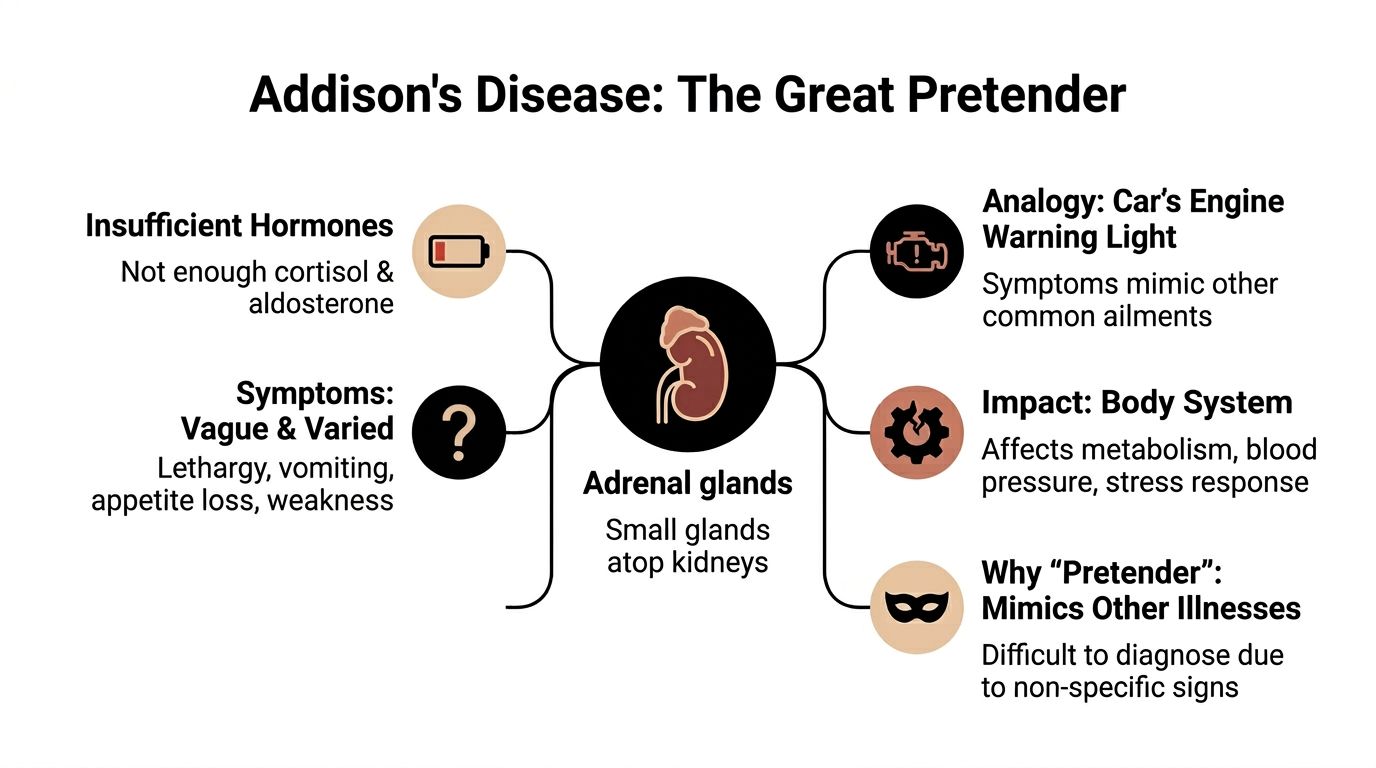
The simple analogy
Think of the adrenal glands like a car’s electrical support system.
Cortisol is part of what helps the body respond to strain, maintain energy, and keep many systems steady under pressure.
Aldosterone helps manage salt, potassium, and fluid balance.
When those hormones are missing, the body can still move along for a while, but it does not handle stress well. Small problems become big problems faster. Appetite falls off. Energy drops. The digestive system becomes unreliable. Blood pressure and electrolytes can drift into dangerous territory.
Why it fools people
Addison’s gets called The Great Pretender because it can mimic a long list of more common problems. A dog may look like they have a sensitive stomach, kidney trouble, general weakness, or stress-related illness.
That is especially true because signs usually do not appear until about 90% of the adrenal gland tissue has been destroyed according to the AKC Canine Health Foundation grant summary. By the time owners notice a pattern, the disease may already be well established.
The same source notes that Addison’s affects about 1 in 1,000 dogs, but some breeds such as Standard Poodles and Portuguese Water Dogs can have prevalence as high as 8 to 10%, and 70% of cases occur in female dogs.
Typical and atypical Addison’s
Not every dog with Addison’s looks the same.
Typical Addison’s
This form involves deficiency of both cortisol and mineralocorticoids. Dogs often develop the classic electrolyte changes veterinarians watch for, especially high potassium and low sodium.
Atypical Addison’s
This form mainly shows glucocorticoid deficiency. These dogs may not have the classic electrolyte changes early on, which can make the diagnosis even easier to miss.
What causes it
In most dogs, the problem is immune-mediated adrenalitis. The immune system mistakenly attacks the adrenal tissue. The result is gradual loss of adrenal function.
Other causes exist, including some medication-related or secondary forms, but immune-mediated destruction is the most common cause.
What this means for your dog is simple. Addison’s is not caused by you choosing the wrong food, missing one walk, or allowing too much excitement. It is a medical condition that needs veterinary diagnosis and hormone replacement.
Spotting the Elusive Warning Signs of Addison's
The signs of Addison disease in dogs often come in two volumes. First come the quiet hints. Later, if the condition worsens, the body may stop coping and the signs become dramatic.
That difference matters because catching the whispers is far easier on your dog than waiting for the alarm.
The subtle whispers
These are the signs owners often dismiss at first:
- Poor appetite that seems selective or inconsistent
- Low stamina on walks or play
- Mild weakness or reluctance to jump, climb, or rise
- Shivering or trembling
- Intermittent vomiting
- Loose stool or diarrhea
- Weight loss
- Acting subdued or depressed
- Drinking and urinating more than usual
A dog may show only a few of these at a time. They may improve with rest, then return again after excitement, travel, boarding, illness, or another stress.
One clue deserves special attention. About 52% of dogs with hypoadrenocorticism have a history of chronic vomiting, according to this review in the National Library of Medicine. If your dog keeps circling back to vomiting without a clear answer, Addison’s belongs on the list of possibilities your veterinarian may consider.
The loud alarms
An Addisonian crisis is an emergency. This is the point where the body can no longer compensate.
Watch for:
- Sudden collapse
- Severe vomiting or diarrhea
- Profound weakness
- Extreme lethargy
- Signs of dehydration
- Shock-like appearance
- A frighteningly quiet, limp, or barely responsive dog
In advanced untreated disease, dogs can collapse and may develop fatal cardiac complications related to high potassium. That is why a dog who seems “just tired” one day can be critically ill the next.
If you are unsure whether your dog is dehydrated, this guide on signs of dehydration in dogs can help you understand what to check while you contact your veterinarian.
Signs of Addison's Disease Whispers vs. Alarms
| Subtle Whispers (Early/Atypical Signs) | Loud Alarms (Addisonian Crisis Signs) |
|---|---|
| Skipping meals or eating less | Collapse |
| Vomiting now and then | Repeated severe vomiting |
| Loose stool off and on | Severe diarrhea |
| Lower energy on walks | Profound weakness |
| Mild shaking | Barely responsive behavior |
| Weight loss over time | Shock-like state |
| “Picky” behavior around food | Emergency dehydration and electrolyte imbalance |
Why owners miss the pattern
Owners are not careless when they miss Addison’s early. The condition is slippery.
A dog may have a bad weekend, then a normal week. Another may only show stomach signs. Another may seem stressed or anxious when the underlying issue is hormonal imbalance.
Keep a simple log of vomiting, appetite, energy, bowel movements, and any trembling or weakness. A short timeline often helps your veterinarian see the pattern faster than memory alone.
The key takeaway is this. Repeated vague illness is not nothing. It is information.
How Vets Confirm a Diagnosis of Addison's
Most owners feel some relief once testing begins. The symptoms may be vague, but the diagnostic process is more structured than people expect.

Your veterinarian usually starts with a physical exam and baseline lab work. These tests do not confirm Addison’s by themselves, but they can raise suspicion quickly.
First clues in bloodwork and urine
With classic Addison’s, vets often see low sodium and high potassium. That fits with the loss of mineralocorticoid function.
Another useful clue is something called an absent stress leukogram. In plain language, when a dog is sick, vets often expect a certain white blood cell pattern associated with stress hormones. In Addison’s, that pattern may be missing because cortisol is lacking.
Urine may also be more dilute than expected in a sick dog. This can confuse the picture and make Addison’s resemble kidney disease or other systemic illness.
The screening test and the confirming test
A baseline cortisol test can help rule Addison’s out. According to the Merck Veterinary Manual page on hypoadrenocorticism, a baseline cortisol level above 2 mcg/dL has a nearly 100% negative predictive value. In practical terms, if the baseline cortisol is above that threshold, Addison’s becomes very unlikely.
But a low cortisol result alone is not enough to make the diagnosis.
The definitive test is the ACTH stimulation test, and the same Merck reference notes it has sensitivity and specificity above 95% for primary hypoadrenocorticism.
How to think about the ACTH stimulation test
Here is the simplest analogy I use in the exam room.
The vet is checking whether the adrenal “battery” can respond when asked to work. A healthy adrenal gland should react to ACTH stimulation by producing cortisol. A dog with Addison’s gives a flatline response.
That poor response confirms that the glands are not doing their job.
To make the testing process easier to visualize, this short video gives a helpful overview:
Questions to ask your veterinarian
- What did the electrolytes show
- Was the baseline cortisol low enough to justify ACTH testing
- Does my dog look more like typical or atypical Addison’s
- Do we need hospitalization now, or can this be worked up safely as an outpatient
If your dog’s signs come and go, bring a written history to the appointment. Dates of vomiting, appetite dips, weakness, and stress events can be as helpful as lab results.
A diagnosis of Addison’s can sound heavy. Many owners feel better once they know there is a name for the pattern and a treatment plan that follows.
From Crisis Care to Lifelong Management
Treatment has two chapters. The first is emergency stabilization if a dog is in crisis. The second is long-term hormone replacement.
Both matter, but they feel very different.
If your dog is in crisis
An Addisonian crisis is urgent because the body may be severely dehydrated and unable to keep sodium and potassium in a safe balance.
According to the PetMD review on Addison’s disease in dogs, crisis therapy involves aggressive IV fluids with 0.9% NaCl to correct dehydration and electrolyte problems. After stabilization, dogs move to long-term management with DOCP injections every 25 to 30 days and daily prednisone. That same source notes the target sodium-to-potassium ratio is greater than 30:1, an untreated crisis is nearly 100% fatal, and properly managed dogs have over a 90% survival rate with a normal median lifespan.
That is a dramatic contrast. It is also why fast treatment saves lives.
What happens after the emergency
Once a dog is stable, the goal shifts from rescue to routine.
Most long-term plans include:
- Mineralocorticoid replacement such as DOCP, usually given on a regular injection schedule
- Glucocorticoid replacement such as prednisone, usually given by mouth
- Follow-up bloodwork to monitor electrolytes and guide dose adjustments
- Extra vigilance during stress, illness, or surgery, when steroid needs may change
Some dogs need more dose fine-tuning than others. That is normal. The first months after diagnosis often involve rechecks while your veterinarian finds the best maintenance plan.
Life becomes manageable through consistency
Owners often fear that every quiet day means another crash is coming. Usually, what helps most is routine.
Keep records in one place
Track medication dates, doses, appetite, vomiting, and follow-up lab results. If you want a practical system, this guide on how to organize medical records at home is useful for keeping everything easy to find before appointments or emergencies.
Build an emergency mindset without panic
Dogs with Addison’s do best when their people know what “normal” looks like for them. A change in appetite, energy, or vomiting pattern is easier to catch when you already have a baseline.
It also helps to keep practical supplies ready. This list of 8 essential items you should have in your dog's emergency kit is a smart place to start.
Respect stress
Travel, boarding, surgery, other illness, and major routine changes can matter for these dogs. Ask your veterinarian what signs should trigger a same-day call and whether your dog needs medication adjustments during stressful events.
The long-term goal is not a perfect life with zero setbacks. It is a stable routine, fast response to changes, and regular check-ins with your veterinary team.
Most owners settle into this rhythm well. After the early learning curve, giving medications and attending rechecks often becomes just another part of loving a dog with a chronic condition.
Nutritional Support for Your Addisonian Dog
Medical treatment keeps an Addisonian dog alive and stable. Nutrition helps that dog feel stronger, more comfortable, and more willing to eat.
That distinction matters.
A dog with Addison’s may have days when food seems unappealing, the stomach feels unsettled, or energy is low enough that even walking to the bowl feels like work. Hormone replacement is still the foundation. But what happens at home, meal after meal, plays a major role in recovery and day-to-day quality of life.
The challenge is common. A dvm360 discussion of Addison’s disease notes that while treatment focuses on hormone replacement, persistent GI issues like vomiting, diarrhea, and poor appetite affect up to 70% of Addisonian dogs, and practical dietary strategies are rarely discussed.
Why eating can be hard after diagnosis
Owners sometimes expect appetite to bounce back the moment medications start. Sometimes it does. Sometimes it takes longer.
A dog may still feel washed out after a crisis. Another may associate food with nausea from prior vomiting episodes. Seniors may already have dental sensitivity or reduced appetite before Addison’s enters the picture.
That means the goal is not just “offer food.” The goal is to make the normal meal easier to accept.
What supportive feeding looks like at home
A thoughtful meal routine can help:
- Keep the base diet familiar. Abrupt food changes can muddy the picture when your veterinarian is trying to monitor GI signs.
- Use small, tempting meal enhancements. A topper can improve smell, flavor, and interest without replacing the main food.
- Support hydration. Some dogs eat better when meals are moistened or when a savory mixture encourages extra fluid intake.
- Make medication time calmer. If your dog resists pills, a food enhancer can turn medication into a more positive routine.
A practical way to use a topper
A dehydrated meal enhancer can be useful because it is flexible. You are not replacing the whole meal. You are making the current meal easier to finish.
Sprinkle over kibble
A light dusting on top of your dog’s regular kibble can increase aroma and palatability. This is especially helpful for picky eaters who sniff the bowl and walk away.
Mix with water
Many dogs respond well to a soft, savory texture. Mixing a topper with water can encourage both eating and hydration at the same time.
Use it for pill hiding
Prednisone and other medications can become a daily struggle if your dog is already food-averse. A flavorful topper mixed into a small bite of food can make dosing smoother.
The best topper is not a replacement for veterinary treatment or for a balanced base diet. It is a support tool that helps your dog keep eating, drinking, and cooperating with care.
Why ingredient simplicity matters
Dogs recovering from illness often do better when owners can clearly see what they are adding to the bowl. Simple ingredient lists are easier to tolerate, easier to track, and easier to discuss with your veterinarian if GI signs continue.
For many dogs, nutrient-dense ingredients with strong natural aroma can be especially useful when appetite is poor. The point is not to “treat Addison’s with food.” The point is to support body condition, routine, and comfort while the medical plan does the hormonal heavy lifting.
Signs your dog may benefit from mealtime support
Look more closely at nutrition if your dog is:
- Leaving kibble behind
- Eating only when hand-fed
- Losing enthusiasm for meals after a recent illness
- Struggling with pill time
- Showing low energy and slow return to normal appetite
- Older and more selective about texture or smell
Gentle feeding habits that help
Offer calm meals
Feed in a quiet place. Stress can suppress appetite.
Watch the pattern, not one meal
One skipped breakfast is not the whole story. Repeated reluctance matters.
Ask before making major diet changes
If your dog is newly diagnosed, your veterinarian may want consistency while medications are being adjusted.
Prioritize palatability and compliance
If a topper helps your dog eat their regular food and take prescribed medication with less resistance, that is meaningful support.
For owners of dogs with Addison’s, especially seniors, recovering dogs, and chronic picky eaters, mealtime support is not a luxury. It is often part of keeping the whole treatment plan workable at home.
Your Questions Answered About Living with Addison's
A diagnosis of Addison’s often comes with a strange mix of relief and fear. Relief because the mystery finally has a name. Fear because now there is a lifelong condition to manage.
Here are the questions I hear most often.
Will my dog live a normal life
In many cases, yes. With proper treatment and monitoring, the outlook is very good. The hardest period is often around diagnosis, especially if your dog first presents in crisis.
After that, many dogs return to a happy, active routine. The keys are medication consistency, follow-up care, and not ignoring changes in appetite, vomiting, weakness, or energy.
What is atypical Addison’s, and will it get worse
Atypical Addison’s means the dog shows cortisol deficiency without the classic electrolyte abnormalities at the start. These cases can be tricky because they do not always fit the textbook picture.
Some dogs remain in that form and do well with monitoring and treatment. Others may need closer follow-up over time if the picture changes. Your veterinarian will guide how often bloodwork and rechecks are needed.
How do I reduce the risk of another crisis
You cannot remove every risk, but you can lower the odds of a serious setback.
- Give medications exactly as prescribed
- Attend follow-up appointments
- Track appetite, vomiting, stool, and energy
- Call early if something changes
- Prepare for stressful events by asking your vet in advance what to do
Many relapses become more manageable when owners notice the small signs before they become big ones.
What should I watch for at home
Pay attention to your dog’s personal baseline. For one dog, the first clue may be refusing breakfast. For another, it is trembling after exercise or seeming drained after a routine outing.
Changes worth reporting include poor appetite, vomiting, weakness, unusual tiredness, diarrhea, or collapse. When in doubt, call.
What if giving pills is a battle
That is common, especially in dogs that already associate food with nausea or stress. Keep the routine calm and predictable. Use your veterinarian’s dosing instructions carefully, and make administration as easy as possible.
If you need practical ideas, this guide on mastering medication moments how to give a dog a pill with ease offers useful techniques.
Should I feel guilty for not noticing sooner
No.
Owners do not cause Addison’s by missing a clue. This disease is famous for looking like many other things. You are doing the right thing by learning, observing, and staying involved in your dog’s care now.
Dogs do not need perfect owners. They need attentive ones. A dog with Addison’s can do very well when their person responds early, follows through, and asks questions.
Living with Addison’s is a long-term commitment. It is also a manageable one. Once the diagnosis is clear and the treatment plan is in place, most families find their rhythm.
If your dog is recovering from illness, eating inconsistently, or needs extra support at mealtime, ChowPow can help make their regular kibble more appealing. ChowPow is a dehydrated beef heart meal topper, not a replacement for your dog’s current food. You can sprinkle it over meals, mix it with water to encourage hydration, or use it to make daily medication easier to give. For picky eaters, seniors, and dogs rebuilding strength, that kind of support can make everyday care feel much more doable.
-
Product on sale
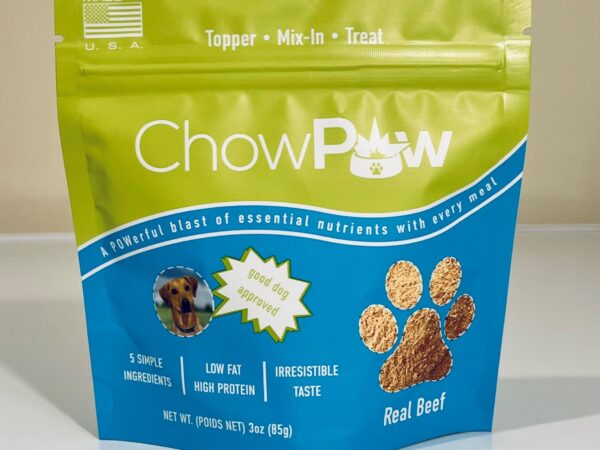 Dog Food Topper - Beef HeartOriginal price was: $14.99.$10.95Current price is: $10.95. - or subscribe and save up to 20%