
American Leopard Hound: The Complete Breed Guide
A damp trail, a cold morning, and a dog moving with purpose through the brush. That scene fits the American Leopard Hound better than any show-ring introduction ever could.
This is a breed built to work, think, and stay close to its people, and if you're considering one, it helps to understand both the dog you see in the living room and the hunter that still lives under the coat.
Meet the All-American Leopard Hound
The American Leopard Hound doesn't just look distinctive. It carries a long working history in the way it moves, watches, and responds. On a trail, this dog tends to look switched on. At home, that same dog often settles in as a warm, people-focused companion who wants to stay involved in whatever the family is doing.
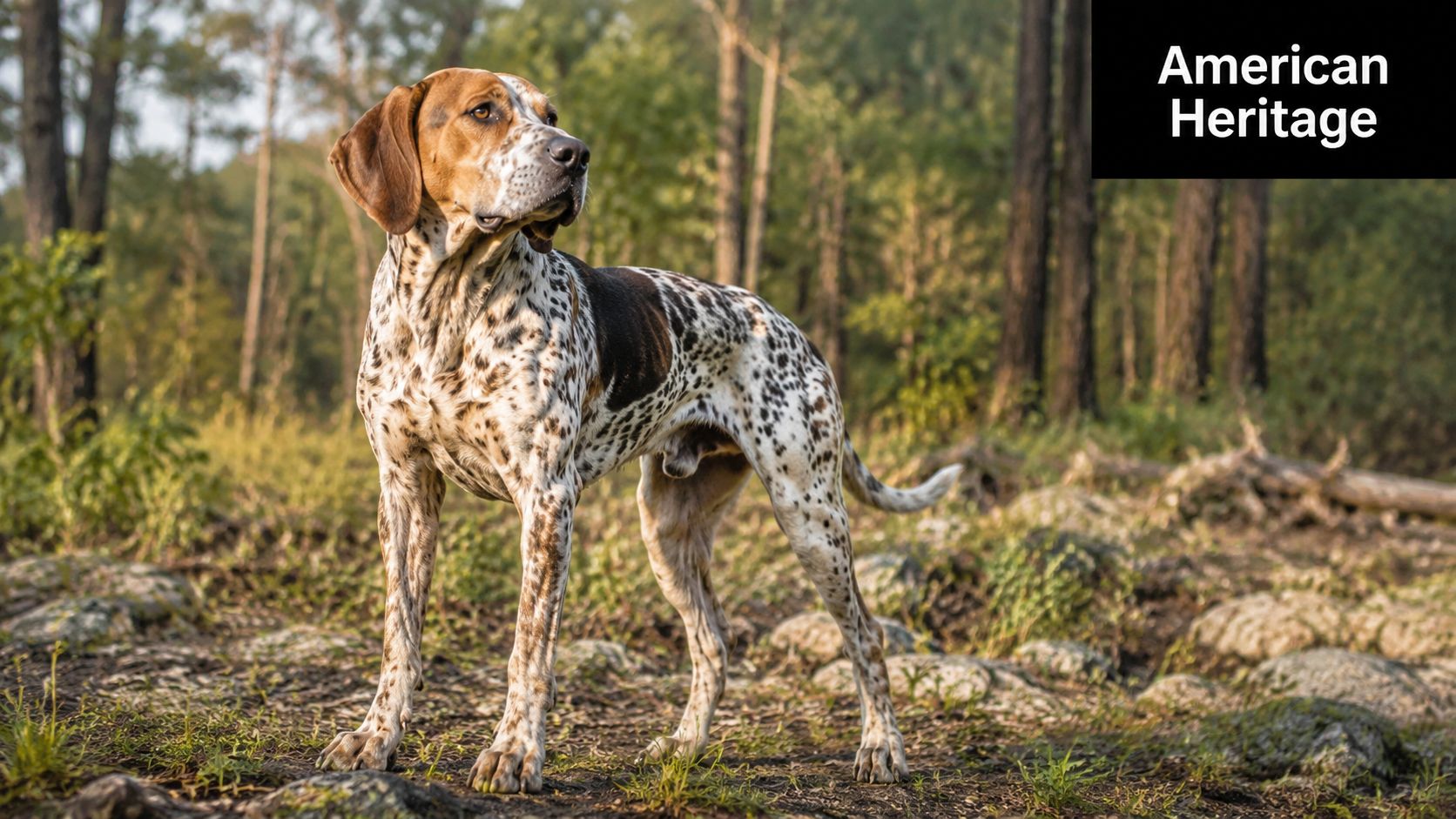
What surprises many first-time readers is that the American Leopard Hound isn't just “a spotted hound.” It's a serious working breed with deep roots in American hunting culture. That background matters because it explains a lot about modern ownership. A dog bred to trail game for long distances won't be happy with a quick trip around the block and nothing else.
What daily life with one feels like
Living with this breed usually means balancing two truths at once. The first is easy to love. These dogs are often affectionate and eager to please. The second is what catches people off guard. They can also be independent, intense, and very ready to follow their nose.
That mix is exactly why they're so compelling. You're not getting a decorative dog. You're getting a capable partner with instincts that still show up in everyday life, whether that means scanning the yard, staying alert on hikes, or getting excited by scent-heavy games.
Good fit: Owners who enjoy training, outdoor time, and giving a dog a job usually appreciate this breed far more than owners who want a laid-back couch companion.
If you enjoy learning about purpose-bred dogs, ChowPow's dog breed spotlight collection is a useful place to compare personalities and care needs across working breeds.
Origin and History of a Pioneer's Dog
A family on the early American frontier did not keep a dog just because it looked unusual. They kept a dog because it could find game, stay with a trail for hours, and help put food on the table. That practical beginning explains the American Leopard Hound better than any modern label.
The breed is widely regarded as one of the oldest tree dog types in the United States. Early accounts place dogs of this kind in North Carolina in the early 1700s. Breed historians also connect their development to dogs brought by settlers, with possible roots in Mexico through Spanish dogs crossed with native stock, according to this historical breed overview.
Built by need, not fashion
The American Leopard Hound developed the way a good tool develops. People kept the traits that worked. A dog that could track scent through rough country, locate game, and stay steady under pressure was useful. A dog that tired quickly or needed constant direction was not.
That helps explain why the breed can feel so capable and so independent at the same time. In the woods, handlers needed a dog that could make decisions without falling apart when it was out of sight or out ahead on a trail. In a modern home, that same trait can show up as determination, problem-solving, and occasional stubbornness.
History also helps with care. Dogs shaped for long hunts were built to burn energy steadily, not just in short bursts. Many modern pet dogs eat convenient diets that meet basic needs but do not always match the workload their bodies were designed for. For an active American Leopard Hound, a quality meal topper can be a practical way to add protein, moisture, and flavor support to the main diet, especially for dogs that train hard, lose interest in dry food, or need help recovering after long outings.
A simple way to read the breed's past is to connect job to present-day needs:
- Frontier work: trailing and treeing game in difficult country
- Traits that survived: endurance, nose-driven focus, independence
- Owner takeaway: daily life usually goes better with steady exercise, training, and food that supports an active body
The name changed, the purpose stayed the same
Formal breed recognition came much later than the dog itself. The United Kennel Club recognized the breed as the Leopard Cur in 1998, then changed the name to American Leopard Hound in 2008.
That timeline matters because it shows how this breed was formed. Its identity came from generations of work first and kennel paperwork later. The spotted coat catches attention, but usefulness is what kept the breed around.
That is still the clearest way to understand the American Leopard Hound. Owners who respect its hunting heritage usually make better choices about routine, enrichment, and nutrition. Owners who expect a purely ornamental hound often feel confused by how much drive and stamina this breed brings into everyday life.
Defining the Breed Physical Traits and Appearance
A good American Leopard Hound does not look decorative. It looks prepared.
Everything about the breed's outline points back to hard use in rough country. You see a dog with leg under it, enough muscle to stay powerful over distance, and a body shape built for efficient movement instead of extra bulk. That matters for modern owners because physical design often hints at care needs. A dog built to cover ground usually needs daily activity, recovery support, and food that helps maintain lean muscle rather than adding unnecessary weight.
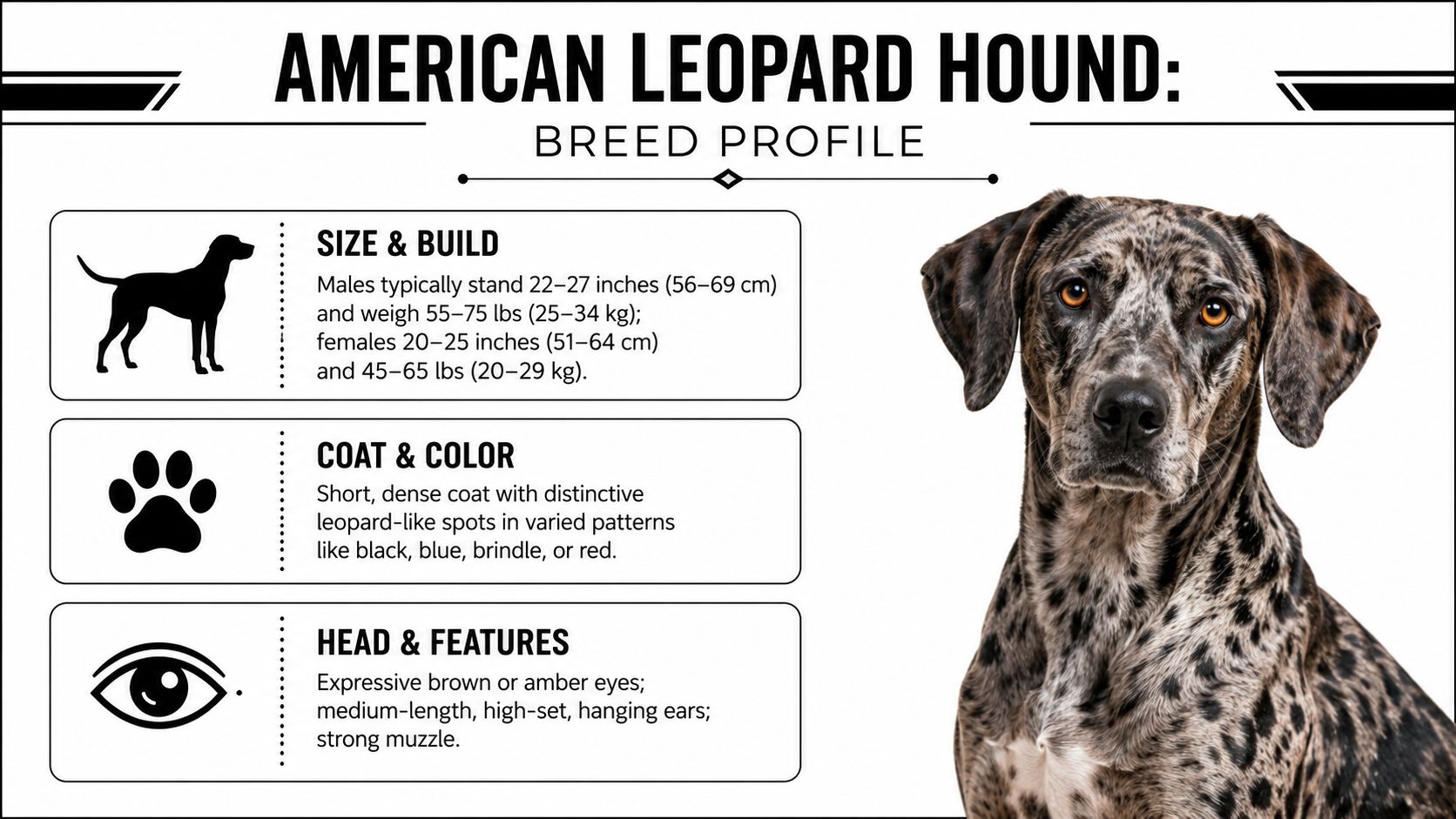
Adult American Leopard Hounds are medium to large dogs with a balanced, athletic frame and a long working life for an active breed, as noted earlier in the article.
Size, shape, and movement
The easiest way to read this breed is to look at how it should move. A well-built Leopard Hound should seem ready to travel for hours, the way a distance runner carries strength differently from a sprinter. The body should appear balanced and capable, with enough substance for real work but without heaviness that wastes energy.
Breed descriptions from the United Kennel Club place the American Leopard Hound in a practical working range for height and weight, with males generally larger than females. The same standard describes a gait with reach and drive, which fits the breed's history as a dog expected to keep going over uneven ground rather than impress in a show ring with exaggerated motion.
| Trait | What to notice |
|---|---|
| Overall build | Athletic, hard-muscled, and work-ready |
| Movement | Smooth, efficient, and steady rather than flashy |
| Impression | A dog made to keep going over distance |
That structure has a daily-life consequence. Dogs with this kind of efficient frame often stay in better condition when their diet supports sustained activity. For owners feeding kibble alone, a quality meal topper can help add moisture and protein support, which is especially useful for active hounds that burn through energy on long walks, tracking games, or hunting outings.
Coat and color patterns
The coat is often the first feature to attract attention. The name suggests one specific look, but the breed is more varied than that.
American Leopard Hounds can appear in leopard spotting, solid colors, or brindle. Some have bold, dramatic patterning that stands out from across the yard. Others carry a quieter version of the same genetics, with less contrast or a more blended appearance. That variety can confuse first-time owners who expect every dog to match the heavily spotted photos that tend to circulate online.
The coat itself is more than decoration. It is a working layer that helps protect the dog outdoors, which makes sense for a breed developed to handle brush, weather changes, and long days outside.
Why the coat matters
A protective coat works like field gear. It helps the dog stay comfortable while moving through cover and spending time in changing conditions. That practical purpose is easy to miss if you only focus on color.
The UKC breed standard describes a coat made for function, with an outer layer and undercoat that help the dog work across different conditions. For owners today, that means the coat should be judged less like a fashion feature and more like part of the breed's equipment. It also helps explain why skin and coat support belong in the nutrition conversation. Active hounds often do better when their diet provides enough animal protein, fats, and moisture to support both muscle recovery and coat quality. A well-chosen topper can be a simple way to improve palatability and add nutritional support without rebuilding the entire feeding plan.
Practical takeaway: The American Leopard Hound should look balanced, durable, and ready for effort. Its body and coat were shaped by work, and its care routine should respect that.
The Leopard Hound's Personality and Temperament
A good way to understand the American Leopard Hound is to picture an old farm dog at the end of a long day. It has spent hours using its nose, making decisions at a distance, and staying focused on a job. Then it comes home, settles near its people, and keeps one ear open. That history still shapes the breed's personality, even when the modern version lives in a fenced yard and sleeps on a dog bed.
What you get is not a one-note temperament. You get a dog that can be socially warm and highly people-aware, while still carrying the self-direction of a working hunter. For owners, that mix explains a lot of everyday behavior that might otherwise feel confusing.
The family side
At home, many American Leopard Hounds are attentive without being clingy. They often like to keep tabs on the household, follow the flow of activity, and rest best when they feel included in daily life. A dog with that background usually does not enjoy being treated like furniture.
With children, the match can be very good if the home is calm, respectful, and supervised. These dogs tend to do better with clear routines and predictable handling than with rough, noisy play. Movement catches their attention fast. Teaching kids how to greet, pet, and give the dog space matters just as much as teaching the dog family rules.
The working mind behind the personality
This breed was built to solve problems in the field. That matters because a dog bred to track game does not approach the world passively. It notices scent, movement, and change, then decides what deserves attention.
At home, that can look like persistence, curiosity, and selective hearing. The dog may understand a cue and still stay interested in the trail crossing the sidewalk. That is not a character flaw. It is inherited job focus showing up in modern life.
A few common examples help:
- On walks: scent can pull the dog's attention away from your pace and route
- In the yard: squirrels, rabbits, or rustling brush can trigger intense interest
- Around small pets: management and careful introductions are often necessary
- During training: repetition without purpose can lose the dog faster than short, meaningful sessions
That is why this breed benefits from activity that feels like work, not just exercise. Nose games, search tasks, and structured outings usually fit better than a plan built only around casual walks. If you want ideas for giving that drive a healthy outlet, this guide to indoor and outdoor dog exercise options for active dogs is a useful place to start.
Why this breed gets misread
Some owners expect a classic hound that is hard to engage. Others see the affectionate side and expect an easygoing companion that will adapt to anything. Both assumptions miss the middle.
The American Leopard Hound often responds best to fair, clear training with a reason behind it. A useful comparison is a smart employee who likes having a job to do. Give direction, keep it consistent, and make the work meaningful, and you usually get a willing partner. Rely on endless repetition or vague boundaries, and you may get pushback. Owners who need a refresher on building structure with an adult dog may find the PawCraft 30-day program helpful.
| Trait | What it often means at home |
|---|---|
| People-oriented | Bonds closely and likes being part of daily activity |
| Trainable | Learns well with consistency, timing, and purpose |
| Independent-minded | May pause to assess instead of reacting instantly |
| Prey-aware | Needs supervision around movement, wildlife, and small animals |
One more piece often gets overlooked. Temperament and nutrition are connected. A hardworking, high-drive dog does better when meals support steady energy, muscle recovery, and satisfaction after activity. Dry food alone can be enough for some dogs, but active hounds sometimes benefit from added moisture and extra animal-based nutrition to make meals more filling and appealing. A quality topper can help support that without forcing a complete diet change.
The best owners do not try to erase this breed's instincts. They give them direction. That approach tends to bring out the version of the American Leopard Hound that people love most: engaged, capable, affectionate, and ready for a job.
Exercise and Training for an Intelligent Hunter
An American Leopard Hound needs more than “some exercise.” It needs purposeful activity. That's the difference between living with a satisfied dog and living with one that starts inventing its own entertainment.

A breed like this was shaped to use nose, body, and brain together. If you only meet one of those needs, you'll often see the gap somewhere else. The dog may pace, become noisy, lose focus, or start turning ordinary household moments into jobs you didn't assign.
Give the dog work, not just motion
A long leash walk is useful, but it shouldn't be the whole plan. Think in layers.
- Scent work: Scatter feeding, scent trails, and simple tracking games let the dog use its strongest natural tool.
- Structured movement: Hiking, brisk walking, and safe running outlets help burn physical energy.
- Skill practice: Obedience drills, recall games, and place work teach the dog how to settle and respond.
- Problem-solving: Puzzle feeders and hide-and-seek tasks keep the mind engaged.
If you need ideas that go beyond the same daily loop, ChowPow's guide to indoor and outdoor dog exercise options is a helpful starting point for building more variety into the week.
Training that fits the breed
The best training style for an American Leopard Hound is clear, fair, and consistent. Harsh handling usually backfires with a smart dog that already has independent instincts. You want cooperation, not conflict.
A good session is usually short, focused, and worth the dog's effort. If you repeat the same cue too long, many hounds start checking out. If you keep the dog engaged and reward quickly, you'll often get a much better response.
This general rhythm works well:
- Start with movement so the dog isn't trying to learn while overexcited.
- Ask for one or two core behaviors such as recall, leash attention, or a place command.
- Reward promptly with food, praise, or access to the next activity.
- Stop before the dog gets bored so training ends on a win.
For owners adopting an adult dog or trying to build consistency from scratch, the PawCraft 30-day program gives a practical framework you can adapt to a breed that benefits from routine.
Mental exercise counts
Many owners underestimate how much calmer a dog becomes after nose work. A short scent game can take the edge off in a way that random free time in the yard often doesn't. That's because the dog is using instinct with structure.
Here's a useful training reminder in action:
Don't wait for unwanted behavior to prove your dog is under-stimulated. Build jobs into the week before boredom turns into a habit.
The owners who do best with this breed usually treat exercise like a plan, not an afterthought. That approach respects what the American Leopard Hound was bred to be.
Grooming Needs and Common Health Concerns
A good grooming routine for an American Leopard Hound should match the job this breed was built to do. These dogs were developed to move through woods, brush, mud, and uneven ground, so their care needs are less about polish and more about keeping the body working well.
Their coat is usually low-fuss, but low-fuss does not mean hands-off. A quick brush removes loose hair, dirt, and plant debris before it works deeper into the coat or irritates the skin. After hikes, hunts, long yard sessions, or wet weather, it helps to do a simple nose-to-tail check. Look at the ears, between the toes, under the collar, and along the belly where burrs and small scratches often hide.
The ears need special attention. Floppy ears work a bit like a closed room with limited airflow. Moisture can linger there longer, especially after rain, swimming, or time in tall grass, which can make irritation more likely.
A practical routine usually looks like this:
- Brush the coat after dirty or active outdoor days.
- Check the ears weekly and clean them using your veterinarian's guidance.
- Inspect the feet for cuts, cracked pads, foxtails, or seeds.
- Trim the nails so the dog can run and turn comfortably.
- Watch the skin for redness, hot spots, or areas the dog keeps licking.
Home setup helps too. If your hound uses the yard often, a cleaner potty zone can reduce the mud, moisture, and debris that end up on the coat and paws. Guides like Modern Yard Landscapes on dog potty can help you create an area that is easier to keep sanitary and easier on your dog's feet.
Health care with this breed also makes more sense when you connect it to its history. The American Leopard Hound was bred as an athletic working dog, so sound movement, strong senses, and day-to-day durability matter. You are not only asking whether the dog is friendly or attractive. You are asking whether the dog was bred to hold up physically over years of active life.
Two topics deserve direct questions before you bring one home. One is hearing. Merle coloring can be beautiful, but it also deserves careful breeding decisions because congenital deafness is a known concern in some merle dogs. The other is joint health, especially hips, because an active hound places real stress on its frame over time. As noted earlier from Lancaster Puppies, responsible breeders should be able to discuss BAER testing for hearing risk and OFA hip evaluations for breeding dogs.
Ask plainly. Good breeders expect it.
| Question | Why it matters |
|---|---|
| Were merle breeding dogs BAER tested? | Helps you understand how the breeder addresses hearing-related risk |
| Were the parents' hips evaluated through OFA? | Gives insight into joint health and breeding decisions |
| What ear care routine has this dog already had? | Shows whether preventive care has been part of the dog's normal routine |
Daily care and nutrition overlap more than many owners expect. Skin quality, coat condition, recovery after exercise, and healthy weight all reflect what goes in the bowl. For a breed with working-dog roots, how lifestyle changes a dog's nutrition needs from country living to city life is especially useful to understand. A dog that spends weekends on trails has different recovery demands than one whose exercise comes mostly from neighborhood walks. In some cases, a quality meal topper can help support appetite, add targeted nutrients, and make a standard diet fit the dog in front of you more closely.
Health screening does not promise a perfect dog. It does show that the breeder is making informed decisions, and that usually leads to better odds of bringing home a hound that can stay active, comfortable, and capable for years.
Optimal Nutrition and Finding Your Hound
Feeding an American Leopard Hound well starts with one basic truth. This is a dog built for effort. Even if your individual hound lives as a companion, the breed's body and instincts still reflect that athletic background.
For working hunting dogs, active-season feeding may require 25 to 30% higher caloric intake than companion dogs, with diet adjusted to maintain a lean body condition, according to the breed and care information from Lancaster Puppies. That doesn't mean every pet American Leopard Hound should eat like a field dog year-round. It does mean owners should pay attention to workload, body condition, and how the dog is using energy.
Why “good enough kibble” isn't always enough
Kibble can provide the base of the diet, but some dogs need a little help getting from “technically fed” to “thriving.” That's especially true for active dogs, picky eaters, seniors, and dogs coming back from stress, illness, or reduced appetite.
Beef heart is one ingredient many owners find appealing because it offers concentrated nutrition in a form dogs often enjoy. Beef heart contains 50 to 60mg of taurine per 100g, a nutrient linked to heartbeat regulation, blood flow, cardiovascular health, and eye function in dogs, according to this beef heart nutrition article.
That said, balance matters just as much as ingredient quality.
The right role for a meal topper
Organ meats like beef heart should make up about 10% of a dog's total dietary intake, which confirms they are a supplement, not a replacement, for complete kibble diets, according to this guidance on feeding beef heart to dogs. That's the key point many owners need spelled out clearly.
A quality topper is there to boost the nutritional value of the existing meal, improve palatability, and support appetite. It isn't there to replace a complete and balanced base diet.

Used well, a topper can be especially practical for:
- Picky eaters: A stronger aroma and richer taste can make mealtime more appealing.
- Senior dogs: Softer meal enhancement can help dogs that aren't excited by dry kibble alone.
- Recovery periods: Dogs under stress or healing may benefit from more enticing meals.
- Active dogs: Owners can support appetite and meal interest without rebuilding the entire feeding plan.
If you're comparing how lifestyle changes a dog's feeding needs, this piece on city vs country canine nutritional needs adds useful context.
Choosing the dog itself
Once you know the breed fits your life, the next decision is where the dog comes from. A reputable breeder should talk openly about temperament, working traits, screening, and what the dog is likely to need in a home. A rescue or breed-specific adoption route can also be a great match, especially if you're prepared to work through adjustment and training.
For new owners who want a little more confidence before bringing home any dog, these resources for first-time dog owners can help you prepare for the day-to-day side of ownership.
The American Leopard Hound can be a remarkable companion. It's affectionate, capable, and full of working intelligence. But it does best with people who respect the whole dog, not just the eye-catching coat.
If you want to make your dog's regular meals more appealing without replacing their current kibble, ChowPow is a simple way to add a nutrient-dense beef heart topper to the bowl. It's made to enhance what you already feed, which is especially useful for picky eaters, senior dogs, and active dogs that need extra mealtime support.
-
Product on sale
 Dog Food Topper - Beef HeartOriginal price was: $14.99.$10.95Current price is: $10.95. - or subscribe and save up to 20%