

Dog Barking at Night: Causes and Calming Solutions
You're lying in bed, the house is finally quiet, and then your dog starts barking at 2 AM. Maybe it's a single burst that turns into a long spell. Maybe you pace, whisper, plead, and wonder whether your dog is anxious, bored, stubborn, or trying to tell you something important.
That uncertainty is what makes dog barking at night so draining. The good news is that barking almost always follows a pattern, and once you identify the pattern, the fix gets much clearer. The answer is rarely “just ignore it” or “just train harder,” because barking can be a response to noise, habit, discomfort, or a body that isn't feeling right.
Why Your Dog Barks at Night and What It Really Means
A lot of people assume night barking is random misbehavior. It usually isn't. A dog that wakes the household after dark is often reacting to something the family can't hear, see, or smell, or trying to settle a feeling that hasn't resolved yet.
The dog's point of view matters
Dogs pick up on environmental details humans miss, especially faint movement, distant sounds, and smells drifting through open windows or hallways. That's why a dog can seem “fine” all day and then suddenly bark once the house goes still. In practical terms, night is when a small trigger becomes a big event.
There's also a bigger reason to take barking seriously. Official complaints about barking dogs in the UK rose from 18,108 between August 2019 and July 2020 to 25,971 in the next 12 months, an increase of about 43% according to the reporting on complaint data. That tells us barking isn't only a training nuisance, it can become a community issue, especially where homes sit close together.
Practical rule: If barking only happens at night, start by asking what changed in the environment before you assume your dog is being difficult.
Why quick fixes often miss the real issue
A generic correction can silence the sound for a moment, but it doesn't tell you what set the barking off. A dog who barks at a passing raccoon needs a different plan from a dog who barks because the room feels too exposed, and both need a different response from a senior dog whose barking comes from pain or confusion.
That's why a simple resource like how sound dampening blinds work can be useful in the right situation. The value isn't the product itself, it's the idea behind it, reducing the trigger rather than arguing with the bark.
The most helpful mindset is to treat barking as communication. Once you know what your dog is reacting to, you can work with the behavior instead of getting trapped in a cycle of noise, frustration, and guesswork.
The Four-Question Framework to Diagnose Nighttime Barking
The ASPCA's approach is useful because it turns a vague complaint into a behavior pattern you can observe: when and where the barking happens, who or what the dog is barking at, what triggers it, and why the dog is barking ASPCA barking guide. Those four questions matter because barking that looks the same from across the room can have totally different causes.
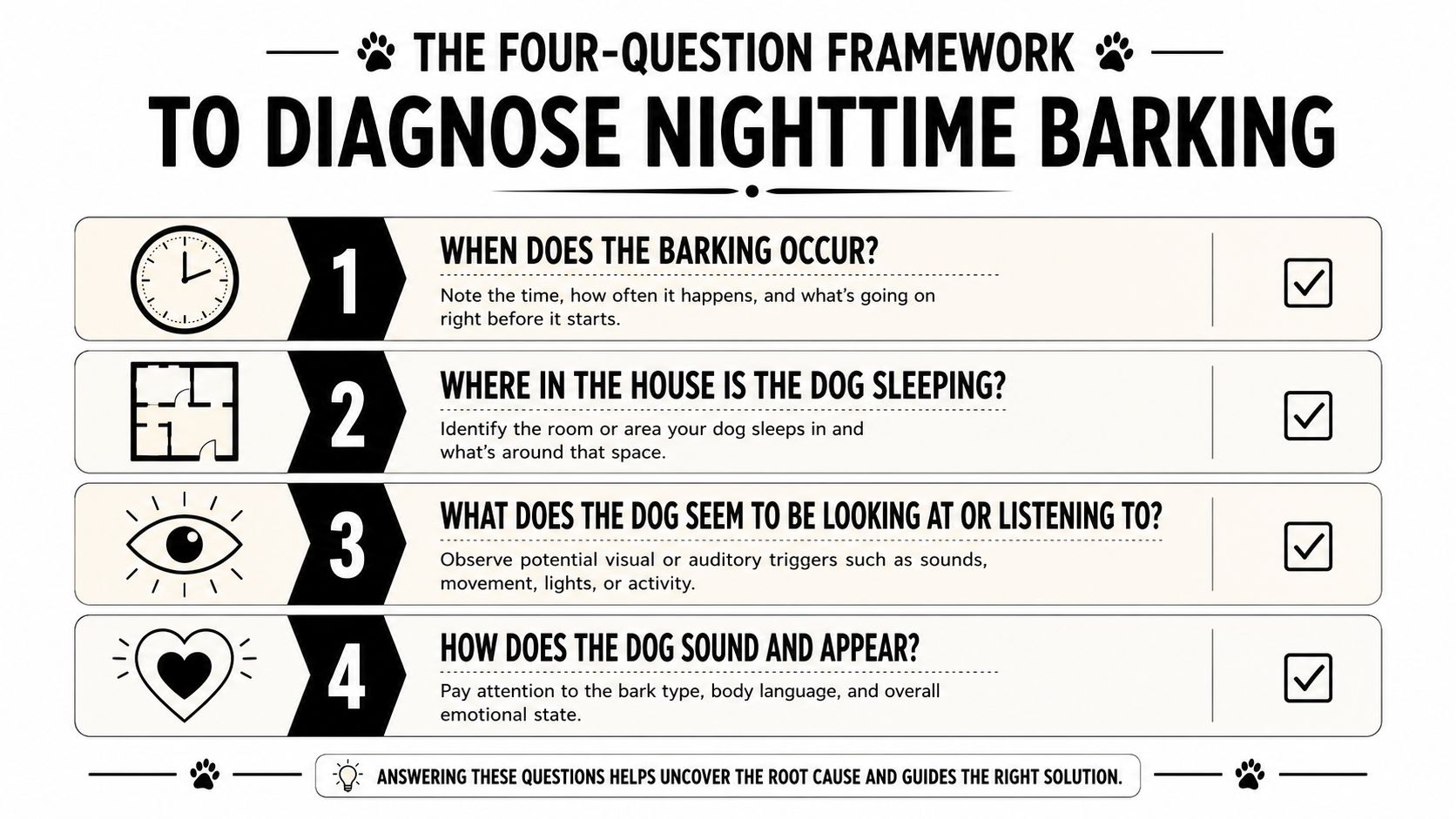
Start with timing, location, and target
Write down the exact time barking starts, where your dog is sleeping, and what seems to happen right before it begins. If your dog only barks near the front window, that points in one direction. If barking starts after you go to bed and the house gets quiet, that points somewhere else.
A useful note from the ASPCA framework is that barking is not one behavior, it's a category. Some dogs bark to alert, some bark to seek attention, some bark because they feel uneasy, and some bark because they have pent-up energy or frustration. The label matters because the fix has to match the reason.
Track pattern, not just volume
For three or four nights, keep a simple log. Mark the trigger, the room, the time, and how your dog acted before and after barking. You're looking for repeatable clues, not perfection.
A dog that barks once at a sound outside needs a different plan from a dog that barks for company after bedtime.
If the barking stops when you move the dog away from the window, that's information. If it settles when you add calm structure, that's information too. If it gets worse when you respond with your voice, your dog may have learned that barking makes you appear.
For a broader look at barking patterns, this internal guide on understanding and addressing excessive barking in dogs fits well with the same diagnostic mindset.
Environmental Changes That Reduce Nighttime Triggers
The easiest place to start is the sleeping space. Dogs don't need a perfect bedroom, they need a setup that makes triggers less obvious and rest easier to maintain. That often means removing the thing your dog keeps responding to rather than trying to out-train it.

Change one thing at a time
Start with the simplest shift. Close the curtains, block window access, or move the bed farther from the most active part of the house. Dogs Trust recommends a consistent bedtime, a toilet break before bed, and putting the dog in the quietest part of the house, with white noise or a radio if outside sounds are the problem Dogs Trust advice. That advice works because it lowers the number of things your dog has to filter while trying to sleep.
If you live in an apartment, hallway noise and neighbor activity can become part of the trigger picture. In that case, a fan, white noise machine, or radio can make a real difference because it masks the small shifts that keep a dog on alert. The goal is not to create silence, it's to make outside noise less sharp.
Make the room easier to ignore
Some dogs sleep better when they can't stare out a window or monitor a moving light source. Blackout curtains help with visual triggers, and bed placement matters more than many owners realize. A dog bed in a quiet corner can be more restful than one in the middle of household traffic.
If your dog uses a crate or kennel, the setup should feel safe, clean, and predictable. For outdoor or kennel environments, a practical guide like long-lasting kennel drainage tips is useful because comfort starts with basic environmental control, not just training.
The best test is simple. Make one adjustment, keep it for several nights, and watch for change. If barking drops, you've learned something important. If nothing changes, don't stack ten fixes at once, keep narrowing the trigger.
<iframe width="100%" style="aspect-ratio: 16 / 9;" src="https://www.youtube.com/embed/l1QAs4dLTC0" frameborder="0" allow="autoplay; encrypted-media" allowfullscreen></iframe>
For dogs who react strongly to sudden noise or environmental surprise, this internal piece on why fireworks terrify our furry friends gives useful context about alarm-like triggers.
When Night Barking Signals Medical or Age-Related Issues
Not every barking problem is a training problem. That's the part many owners miss, especially when the dog is older or recovering from illness. If barking is new, persistent, or paired with restlessness, pain, confusion, or a change in sleep habits, it deserves a veterinary conversation.
Watch for changes, not just noise
A dog who suddenly starts barking at night after months of quiet may be telling you something has changed physically. Older dogs can develop cognitive dysfunction, and they can also become more vocal when pain makes it hard to settle. A dog that gets up, circles, pants, or seems disoriented at night is not merely being “chatty.”
The YouTube discussion on this topic notes that new barking in an older dog can warrant a vet check, especially when cognitive dysfunction or pain might be involved age-related barking discussion. That idea matters because quiet houses can make discomfort easier to notice. What looks like behavior can sometimes be the first visible sign of a body that's struggling.
Recovery and discomfort can look like barking
Dogs recovering from illness, surgery, or medication changes may vocalize because rest feels awkward. Some will bark when they can't settle into a position that used to be comfortable. Others become more restless at night because healing pain shows up most clearly when the house is still.
That's where a different kind of check is useful. Look for stiffness, reluctance to lie down, repeated repositioning, appetite changes, or odd confusion. If the dog is older, the threshold for a veterinary exam should be low.
Important sign: If the barking is paired with disorientation, pacing, or a sudden personality change, treat it as a health question first.
If you're also worried about tick-borne illness, this guide on signs of brown dog ticks is worth reviewing alongside your vet visit. The point is not to self-diagnose, it's to notice that barking can sit alongside other symptoms when a dog feels unwell.
Building a Calming Bedtime Routine with Nutritional Support
A calmer night starts long before lights out. Dogs settle better when their day makes sense, their body feels comfortable, and bedtime comes with a predictable rhythm. The Dogs Trust advice on routine, toilet breaks, and the quietest sleeping spot fits neatly here because routine lowers uncertainty Dogs Trust advice.
Feed, move, and settle in a predictable order
Daytime exercise and mental work help many dogs arrive at bedtime less keyed up. That doesn't mean wearing them out, it means giving them enough legitimate activity that their nervous system has a chance to come down later. A short training game, sniffing walk, or food puzzle can do more than a rushed lap around the yard.
Evening feeding matters too. Some dogs sleep better when dinner happens early enough that digestion isn't the last thing on their mind. Hydration matters as well, and some owners find that a food topper or meal enhancer can make regular meals more appealing for picky eaters, senior dogs with sensitive teeth, or recovering dogs who need extra encouragement to finish their kibble. ChowPow fits that role as a meal enhancement, not a replacement, and it's most useful when your dog needs a more appealing bowl without changing the base diet.
Build a wind-down ritual
Keep the last part of the evening boring in a good way. Use a final bathroom break, dim lights, and a calm activity your dog can predict. If your dog enjoys gentle handling, this internal guide on canine massage techniques to soothe your dog can support the wind-down routine without overstimulating the dog.
If your dog refuses dinner, seems too distracted to eat, or only settles after a very specific routine, pay attention. That pattern can point to anxiety, discomfort, or simple inconsistency in the household schedule. The routine should serve the dog, not the other way around.
Training Techniques and When to Avoid Reinforcing Barking
Training works best when you know what kind of barking you're dealing with. If the barking is attention-seeking, answering every sound with your voice can accidentally teach the dog to keep trying. Elanco's guidance is direct on this point, don't engage a dog that barks at night, because attention can reward the behavior Elanco behavior guide.
Reward the silence, not the volume
A quiet command only works when it's taught outside the problem moment. Start when your dog is already calm, mark the silence, and reward it. Over time, your dog learns that quiet behavior works better than barking for getting your attention.
If barking is alert-driven, redirecting to a known behavior can help more than repeated scolding. A bed cue, mat settle, or “go to place” pattern gives the dog something to do with the energy. If barking is fear-driven, though, forcing compliance can make the situation worse, so that's where the earlier sections on triggers and environment matter.
Know when training isn't enough
A dog trainer can help with pattern barking, but a veterinarian or certified behavior professional is the right call when panic, distress, or suspected pain enters the picture. That distinction saves time and reduces frustration. It also keeps owners from drilling the wrong skill when the issue is emotional or medical.
If a dog is barking because it feels unsafe, the first job is to lower the pressure, not increase it.
The legal side matters too. In the UK, persistent barking can be treated as a statutory nuisance under the Environmental Protection Act 1990, and BARC London notes owners could face a fine of up to £5,000 if they don't curb the behavior BARC London guidance. That's another reason to address the root cause early.
Your Action Plan for Peaceful Nights
Start with the simplest question. If the barking follows sounds, movement, or window activity, work on the environment first. If it follows separation, anticipation, or excitement, use structure and reinforcement. If it appears with pain, confusion, or a big change in behavior, call the vet before you train.
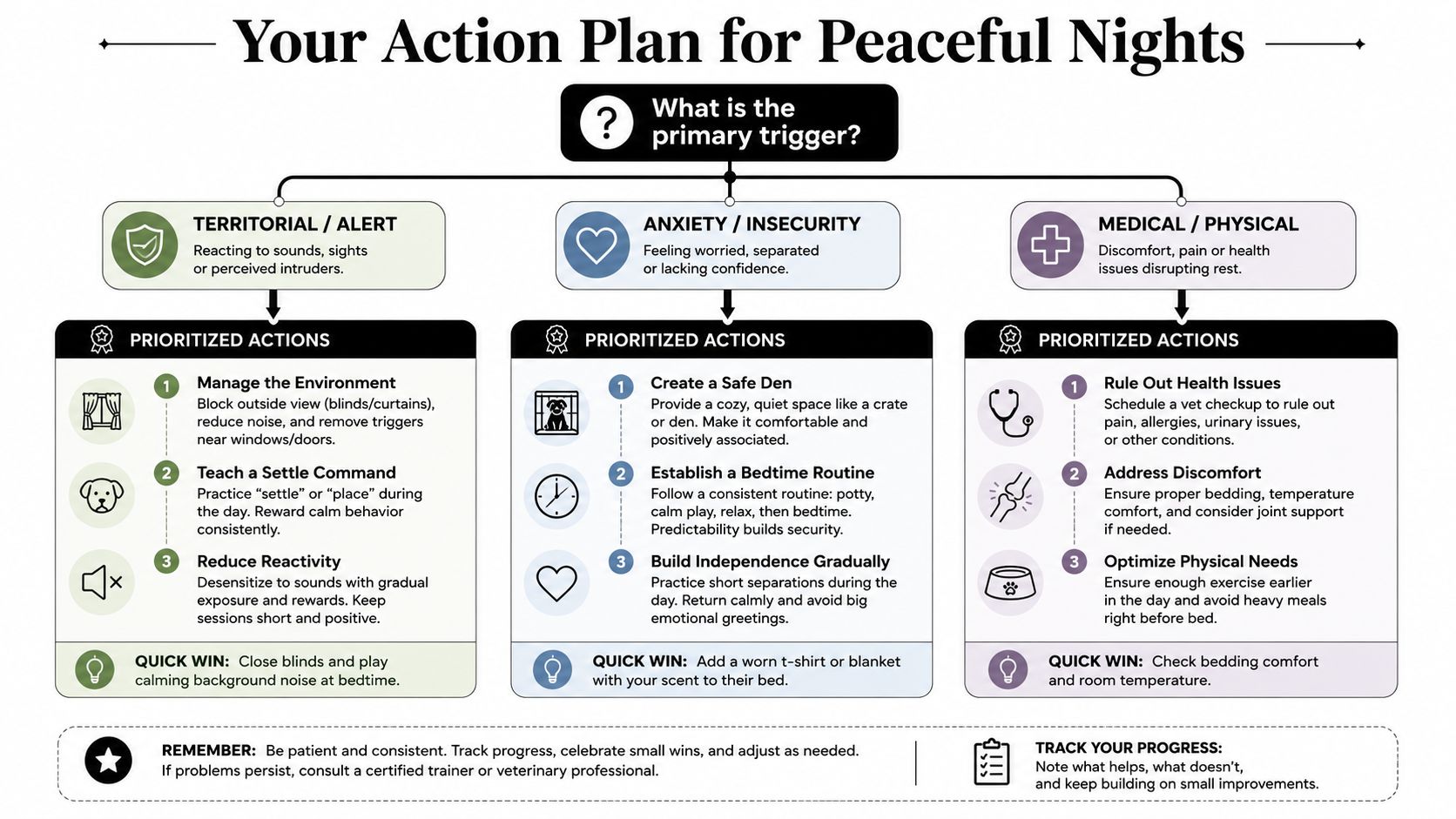
The fastest path is usually the one that matches the cause, not the one that sounds toughest. Keep changes small, give them time, and track what improves. Most dogs do better when the household stops treating barking as a single problem and starts reading it as a message.
If your dog's nights are getting harder because meals are hit-or-miss, a picky appetite may be part of the stress picture too. ChowPow helps turn regular kibble into a more appealing meal with a nutritional boost, which can be especially useful for senior dogs, recovering pets, and dogs who need a gentler way to eat consistently. Visit ChowPow to see how a simple meal enhancer can support calmer routines and better nightly comfort without replacing the food your dog already eats.
-
Product on sale
 Dog Food Topper - Beef HeartOriginal price was: $14.99.$10.95Current price is: $10.95. - or subscribe and save up to 20%