4 Week Old Puppies: The Complete Care & Feeding Guide
The fourth week is when a litter stops feeling like a row of sleepy newborns and starts feeling like a tiny demolition crew. One puppy is standing in the food dish. Another has discovered its siblings have ears worth tugging. The clean bedding you put down an hour ago already looks lived in. If you're caring for 4 week old puppies right now, that mix of pride, mess, and low-grade panic is normal.
This age is a turning point because everything starts happening at once. Puppies are getting mobile, they're noticing each other more, and feeding changes from simple nursing to a much more hands-on routine. You're no longer just keeping them warm and dry. You're managing appetite, hygiene, early confidence, and safety while they figure out how to be little dogs.
Welcome to the Fourth Week A Turning Point for Your Puppies
At this age, puppies don't move with much grace, but they move with purpose. They wobble toward sounds, climb over each other to investigate a corner, and start turning ordinary care tasks into group events. A litter that was mostly sleeping last week now has opinions. You'll hear more noise, see more play, and clean up more mess.
According to VCA's puppy raising guide, puppies should begin eating solid food at about 3.5 to 4.5 weeks, usually first as a softened gruel. By 4 weeks old, they can typically walk, run, and play, which is why this week feels so different from the one before. Their coordination is improving, and their curiosity is catching up with their bodies.
Practical rule: If your setup still only works for sleepy newborns, it's already out of date for 4 week old puppies.
The shift isn't only physical. The Royal Kennel Club description included in that same developmental window also notes early play behavior and even early problem-solving behavior through the fourth week, which lines up with what caretakers see every day. Puppies aren't just stronger. They're actively learning from the space, the litter, and the routine around them.
That means your job changes too. You need a feeding setup that supports gradual weaning, a den that can handle accidents and rough little bodies, and a routine that encourages confidence without opening the door to unnecessary health risks. This week is fun, but it's also the week where small shortcuts start causing bigger problems.
Transitioning Your Puppies to Solid Food
Weaning confuses people because they expect a clean handoff from milk to food. That's not how it usually looks. At 4 weeks, puppies are in a transition, not at the finish line. Nursing may still happen while soft food becomes a bigger part of the day.

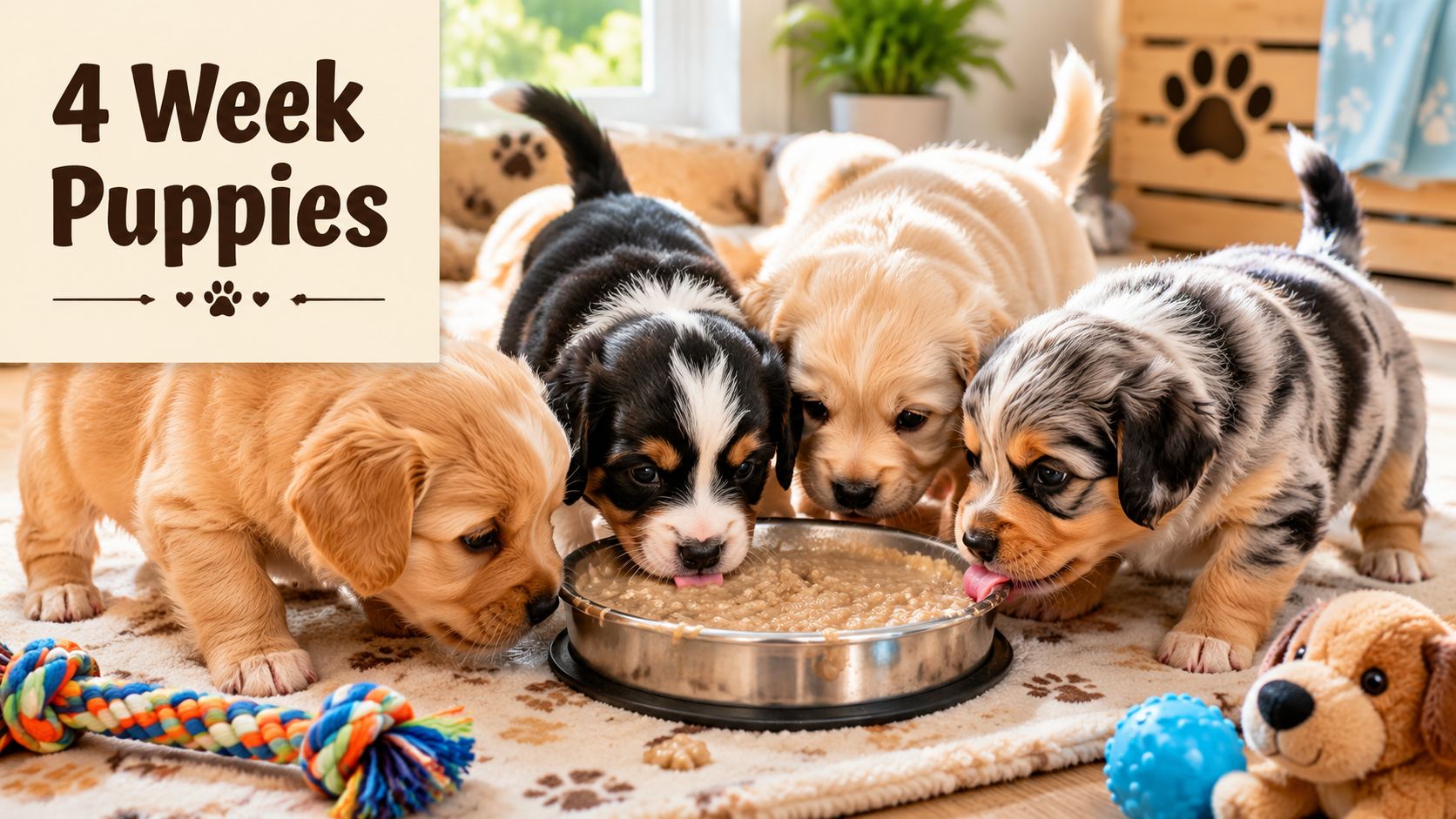
The AKC notes that at 4 weeks of age, puppies are entering the weaning transition. They can walk, start barking and wagging, begin eliminating without maternal stimulation, and solid food becomes a major part of the diet. A practical feeding approach during this window is a high-protein porridge made from puppy food softened with liquid, offered 4–6 times per day, with free access to fresh water. The same guidance notes that by about 6 weeks, puppies are commonly separated from the mother for around 4 hours per day, and they are typically weaned by 6–8 weeks. AKC also recommends daily or every-other-day weighing for the first four weeks to catch poor gain early in the weaning period, as outlined in the AKC puppy growth timeline and transitions guide.
How to make a good first gruel
A useful puppy gruel is simple. Start with a quality puppy food and soften it with liquid until it becomes a porridge rather than a paste or soup. The texture matters more than owners think.
If it's too thick, puppies wear it instead of eating it. If it's too thin, they may lick at it without taking in much food. You want something they can lap easily, with enough body that it stays in the dish.
A workable routine looks like this:
- Choose a puppy food meant for growth. Don't use adult maintenance food for this stage.
- Soften it thoroughly. Let it break down until there are no hard chunks.
- Serve it shallow. Wide, low dishes reduce crowding and face-planting.
- Expect mess. Their first meals are more of a training exercise than a clean feeding session.
Puppies don't need you to force the transition. They need repeated chances to try soft food while nursing still fills in the gaps.
What mixed feeding really looks like
This is the part many guides gloss over. Puppies at this age are often doing both. They nurse, then explore mush, then walk through mush, then nurse again. That doesn't mean the process is failing. It means it's underway.
The most useful way to judge progress isn't whether every puppy eats neatly from a bowl. It's whether each puppy is becoming more interested in soft food over repeated meals and staying active and engaged afterward. If one puppy hangs back, don't assume stubbornness. Check whether the bowl height is awkward, the mix is too cold, the texture is off, or littermates are crowding it out.
The Best Friends developmental guidance captures this point well in its discussion of the week-four weaning window. At 4 weeks, puppies are still nursing and solid food is introduced gradually, so weaning works better as a mixed feeding process suited to litter development and weight gain, not as an on-off switch, as described in Best Friends' puppy development stages overview.
A simple feeding rhythm that works
Don't overcomplicate the day. Consistency matters more than novelty.
| Time of day | What to do | What to watch |
|---|---|---|
| Morning | Offer softened puppy food | Which puppies dive in first, which hesitate |
| Midday | Offer another small gruel meal | Stool quality, energy, hydration |
| Afternoon | Repeat soft meal | Litter competition at the dish |
| Evening | Final soft meal before settling | Full bellies, cleaner bedding overnight |
That table isn't a strict clock. It's a rhythm. The point is to give several small opportunities to eat instead of expecting one big successful meal.
A few practical adjustments make a big difference:
- If puppies paddle in the bowl: use a wider dish with a lower fill level.
- If they sniff and walk away: warm the gruel slightly so it smells more appealing.
- If one puppy gets pushed aside: feed that puppy briefly with less competition nearby.
- If stools loosen suddenly: review consistency and speed of transition before changing everything at once.
For readers comparing foods, this guide to the best food for puppies can help you think through what makes a puppy diet appropriate during the growth stage.
Mistakes that slow weaning down
Owners usually run into trouble in one of three ways. They offer dry food too soon, they expect puppies to stop nursing all at once, or they skip weight monitoring because the litter looks busy and happy.
Busy isn't the same as thriving. The puppy that seems cheerful but consistently gets bumped off the dish can fall behind fast. Weaning goes best when you keep meals soft, transitions gradual, and your eyes on the individual puppies, not just the litter as a whole.
Creating a Safe and Stimulating Puppy Den
By the fourth week, the old whelping setup often becomes too small, too slippery, or too hard to keep clean. Puppies need room to move, but they also need boundaries that keep them from chilling, getting stepped on, or wandering into dirty corners. Good setups aren't fancy. They're washable, stable, and easy to reset several times a day.

Build zones instead of one open space
The cleanest dens have separate areas for sleeping, eating, and toileting. Puppies naturally do better when the whole space doesn't serve one purpose. Even at this young age, they begin to show preferences for resting in one area and eliminating away from it if the setup makes that possible.
Think in zones:
- Sleeping zone: soft, dry, warm, and slightly sheltered
- Feeding zone: easy to wipe, non-slip, and away from bedding
- Potty zone: absorbent and clearly separate from food and sleep
That basic layout reduces contamination and makes your daily routine easier. If every activity happens on the same patch of bedding, puppies stay dirtier and cleanup gets harder with each meal.
Surfaces matter more than décor
Puppies this age are learning how to stand, brace, turn, and pounce. Slippery flooring works against all of that. Use surfaces with traction so legs don't splay every time a puppy tries to move toward a sibling or bowl.
Bedding should be soft but not so bulky that puppies disappear into folds. It also needs to be easy to swap out quickly. At four weeks, convenience isn't laziness. It's what keeps the den consistently clean.
A good puppy area should let you remove soiled material fast, wipe surfaces fully, and put puppies back on dry footing without a long reset.
Chewable edges, dangling cords, unstable bowls, and tiny loose objects don't belong in the pen. Newly mobile puppies investigate with their mouths and feet before they have any sense at all.
Keep it clean without turning it sterile
You don't need a showroom. You need a den that stays dry, low-stress, and sanitary. Replace wet bedding fast. Wash dishes after meals. Refresh water often so it doesn't become a dumping ground for food and debris.
If you're improving the wider setup around the pen, this guide to creating a pet-friendly home has useful ideas for making shared spaces safer and easier to maintain.
Add stimulation in small doses. A textured mat, a soft toy too large to swallow, or a fresh safe surface to walk on does more for development than cluttering the pen with too many items. At this age, less is usually better if what you provide is stable, clean, and rotated thoughtfully.
Nurturing Early Socialization and Play
Four weeks isn't the age for broad social exposure. It is the age for building security. That difference matters. Puppies are becoming more social and more aware, but they still need calm, controlled experiences that teach them the world is safe and predictable.

A puppy that gets gentle handling, stable routines, and appropriate litter interaction now often copes better with novelty later. A puppy that gets overwhelmed or handled roughly can become wary fast. At this age, small experiences land hard.
What good early handling looks like
Keep handling short and quiet. Lift a puppy securely, support the body well, and return it before it becomes frantic. The goal isn't to test tolerance. It's to create repeated calm moments.
Useful low-pressure experiences include:
- Gentle hand contact: stroke the chest, shoulders, and back while the puppy stays settled
- Brief individual holds: separate from the litter for a moment, then return before stress builds
- Soft household sounds: normal voices and routine movement nearby, not chaos
- Simple texture changes: a clean towel, a different mat, or another safe walking surface
What doesn't help is passing puppies around to visitors, introducing too many new objects at once, or forcing interaction when a puppy is tired.
Let littermates teach each other
Some of the best early lessons happen puppy to puppy. They body-check, mouth, climb, and yelp at each other. That rough little chaos is useful when it stays balanced.
Watch the group closely. Healthy play tends to look mutual, bouncy, and brief. One puppy may pin another for a second, then switch roles or break away. Trouble starts when one puppy repeatedly gets trapped, cries without escape, or withdraws from the group.
If play has no pauses, no role changes, and no easy exits, step in and reset the group.
That reset can be simple. Separate the pushiest puppy for a short calm break, then return it. You're not punishing. You're preventing one personality from dominating the den.
Enrichment should stay close to home
At four weeks, enrichment doesn't mean outings. It means thoughtful variety inside a controlled environment. A new object with a different feel, supervised exploration outside the sleeping spot, or a new sound at low intensity is enough.
This stage rewards restraint. New owners sometimes think more exposure is always better. It isn't. For 4 week old puppies, better means gentle, clean, and repeatable. Confidence grows from manageable experiences, not from flooding the puppy with stimulation.
Your Puppy Health Checklist at Four Weeks
This is the age where health monitoring needs to become a habit, not a reaction. Puppies can look bright one moment and slide the next if something's off with intake, hydration, sanitation, or infection exposure. Daily observation catches problems sooner than wishful thinking does.
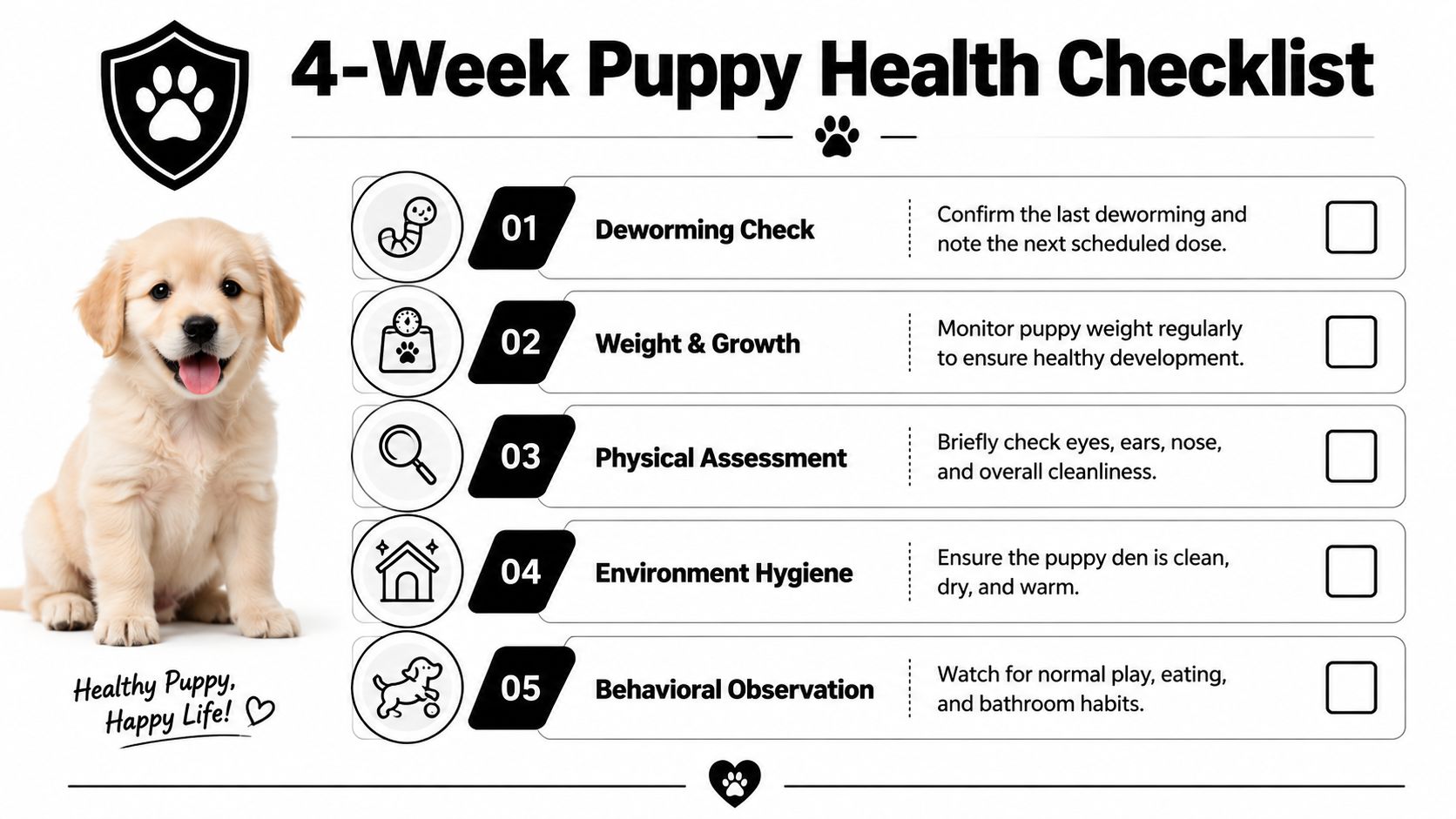
The key health challenge at this stage is balancing enrichment with infection control. At four weeks, puppies' immune protection is still largely maternal, deworming is typically repeated around week 4, vaccines are not yet due, and exposure to unvaccinated dogs must be avoided, as noted in this guidance on the 4-week puppy health window.
The daily check that tells you the most
You don't need an elaborate chart to notice whether a puppy is doing well. You need to look at the same basics every day and take changes seriously.
Use this short checklist:
- Eyes and nose: clear, not crusted or heavily soiled
- Body condition: clean enough to show normal care, not chilled or damp
- Stool and urine area: not caked onto the coat, no ongoing mess left sitting on the skin
- Behavior: interested in food, responsive, moving around, interacting with littermates
- Feeding response: not just approaching the bowl, but taking in food
Puppies that are active, interested, and steadily progressing in the routine usually tell you they're coping well. Puppies that detach from the group, stop competing for food, or sleep through activity deserve a closer look.
Deworming, vaccines, and the safety trade-off
People often assume that more social exposure is always helpful once puppies start moving around. The problem is timing. Their world is opening up before their formal vaccine schedule starts.
That's why four-week management needs discipline. Handle them, enrich them, clean their area well, and avoid the temptation to show them off to other dogs or outside visitors with unknown health status. This is also the age when caregivers often review the deworming schedule carefully, since repeat treatment around this week is common.
A simple decision guide helps:
| Situation | Better choice |
|---|---|
| Want more stimulation | Add clean textures and supervised handling in the den |
| Want to “socialize” quickly | Avoid outside dog contact and uncontrolled exposure |
| Unsure about health status | Check weight trend, appetite, cleanliness, and behavior before assuming it's minor |
Warning signs that need fast action
Some signs justify a same-day call rather than more observation.
- Lethargy: a puppy that won't engage, won't rouse properly, or separates from the group
- Feeding refusal: missing multiple opportunities to eat, especially if littermates are eating
- Digestive decline: repeated loose stool, especially if the puppy also seems weaker or messier than usual
- Hydration concern: tacky mouth, poor vigor, or a puppy that seems to dry out quickly
- Breathing or distress changes: persistent crying, obvious strain, or collapse
If you need a refresher on what dehydration can look like in dogs, this article on signs of dehydration in dogs is a useful reference point for owners who are still learning what to watch for.
Troubleshooting Common Issues and Vet Visits
Most problems with 4 week old puppies start small. A puppy skips one gruel meal. A stool gets loose after a feeding change. The litter gets louder at night because one puppy is uncomfortable or being crowded. That's why troubleshooting works best when you change one variable at a time and watch the whole puppy, not just the symptom.
If a puppy won't eat, first look at texture, temperature, and competition at the dish. If crying ramps up, check warmth, bedding dryness, and whether one puppy is being pushed away from the best resting spot. If stools loosen, slow the feeding transition and review hygiene before assuming the food itself is the problem.
A few home management details get overlooked. Bedding that stays damp can chill a puppy fast. Fleas can also add stress to a young litter and make a clean setup much harder to maintain. If you're sorting out environmental control in the house, Protect-A-Bed's advice on home fleas is a practical resource for handling the home side of the problem.
Call your veterinarian promptly if a puppy becomes limp, stops engaging, refuses repeated meals, shows worsening digestive upset, or seems distressed in a way that doesn't improve with basic care changes. At this age, waiting to “see how tomorrow looks” can be the wrong move.
The good news is that most litters settle into a rhythm once feeding, sanitation, and space are set up properly. Four weeks is messy. It's also one of the most rewarding stages you'll ever watch.
If you're feeding puppies or supporting a picky dog later on, ChowPow is designed as a meal enhancer, not a replacement for your current kibble. It's a dehydrated beef heart topper that can boost smell, flavor, and nutritional value when you need a little extra encouragement at the bowl.
-
Product on sale
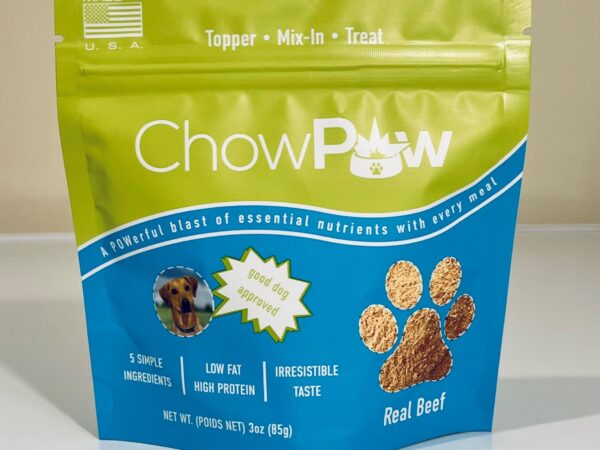 Dog Food Topper - Beef HeartOriginal price was: $14.99.$10.95Current price is: $10.95. - or subscribe and save up to 20%