
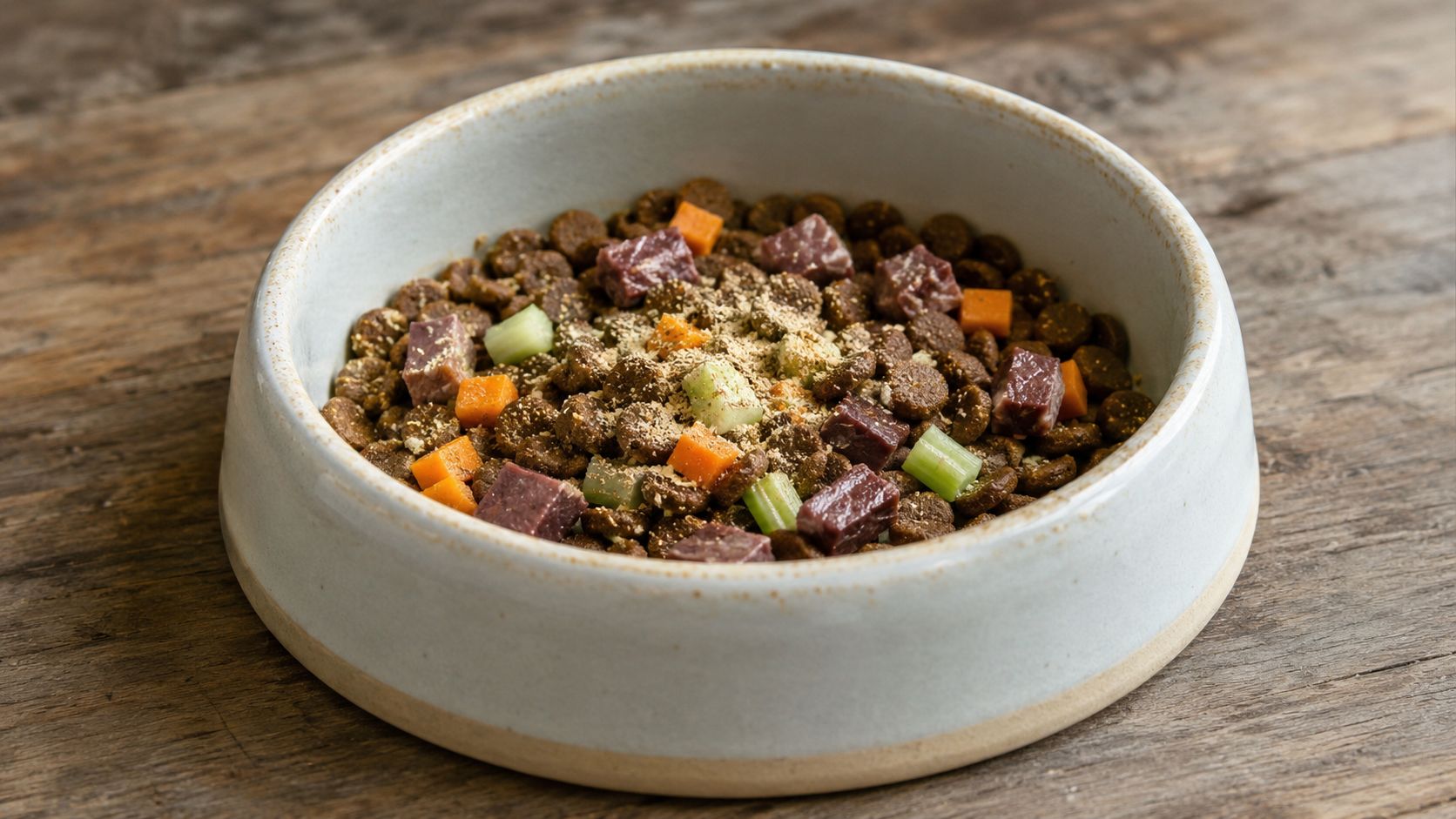
Raw Dog Food Supplement: A Guide to Boosting Your Kibble
You're probably here because you look at your dog's bowl and think, “This is fine. But could it be better?”
That's a common place to land. Many dog owners feed kibble because it's practical, consistent, and easy to store, yet they still want to add something fresher and more nourishing. Then raw feeding enters the picture and suddenly the whole topic gets complicated. You see talk about organs, bones, minerals, pathogens, balancing, and meal plans, and what started as a simple desire to help your dog feel better turns into homework.
A raw dog food supplement can be the middle ground that makes sense. It lets you improve your dog's current meals without throwing out your routine. For many households, that's the most realistic path. Not a total diet overhaul. Just a smarter bowl.
What Is a Raw Dog Food Supplement
A raw dog food supplement is best understood as a meal enhancer. It isn't meant to replace your dog's regular food. It's meant to add nutritional value, flavor, and whole-food support to the food you already serve.
This is akin to adding a nourishing topper to a basic meal. Your dog still eats their normal kibble, but the bowl gets a boost from nutrient-dense ingredients that can help fill in gaps or make the meal more appealing. That's especially useful if your dog is picky, older, recovering from illness, or bored with dry food.
A booster, not a full feeding system
This distinction matters because people often confuse “raw supplement” with “raw diet.” They're not the same thing.
A full raw diet asks you to think about complete meal balance, safe handling, storage, and long-term nutrient adequacy. A supplement is much smaller in scope. It's added in modest amounts to support the base diet, not replace it.
Practical rule: If something is designed to top kibble, mix into food, or enhance what's already in the bowl, it belongs in the supplement category, not the meal replacement category.
One good example of why these products appeal to dog owners is beef heart. Beef heart contains 17–20g of high-quality protein per 100g, which supports muscle strength and tissue repair in dogs when added to standard kibble, according to this beef heart nutrition overview. That makes it a strong candidate for a topper or powdered enhancer.
Why this approach feels more manageable
A lot of owners want the perceived benefits of raw ingredients but don't want the full complexity of raw feeding. That's reasonable. A supplement approach gives you a way to introduce whole-food ingredients in a simpler format.
It's similar to how people ease into nutrition changes themselves. Most of us don't rebuild our entire kitchen overnight. We start with one better habit. If you enjoy simple food-first upgrades in your own routine, you might also like to Find superfood mushroom hot chocolate that fits the same “small upgrade, big difference” mindset.
If you're still sorting through the broader debate on fresh versus processed feeding, this guide on raw vs cooked food for dogs helps clarify the tradeoffs without turning mealtime into an ideology contest.
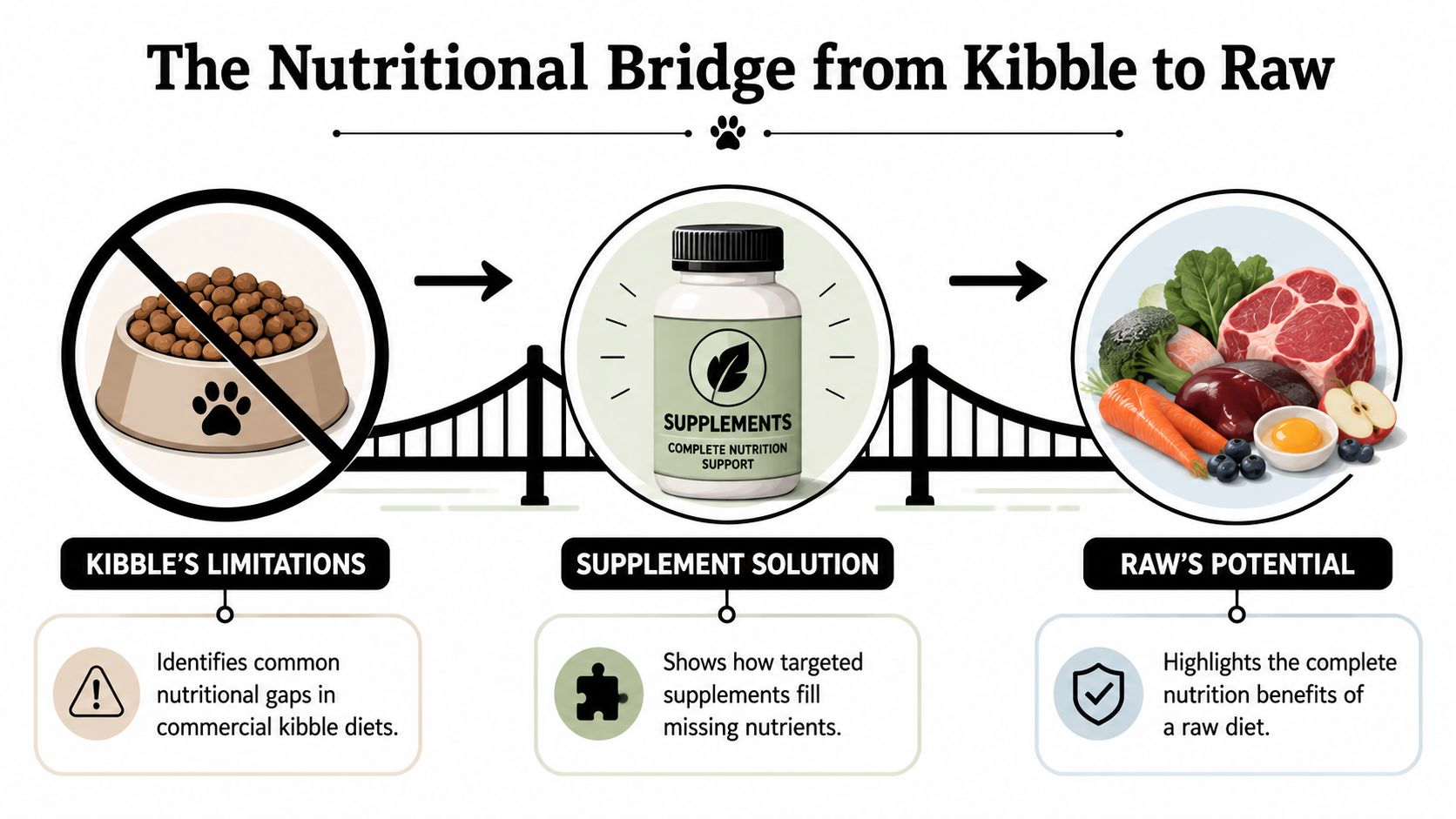
The Nutritional Bridge from Kibble to Raw
Kibble solves a lot of practical problems. It's shelf-stable, portionable, and convenient. But convenience doesn't erase the feeling many owners have that their dog could use something more fresh and food-based in the bowl.
That instinct isn't only about kibble. It also applies to homemade feeding. The surprise for many owners is that switching away from kibble doesn't automatically make a diet nutritionally complete.
Why “more natural” still needs structure
Raw feeding often sounds simple on the surface. Meat, organs, maybe some produce, and done. In real life, nutrient balance is where people get tripped up.
A study discussed in Scientific Reports found that approximately 45.5% of preprepared raw dog foods contained calcium levels exceeding the maximum recommendation, with excess ranging from 101% to 394% above safe limits. That's a striking reminder that “raw” and “balanced” are not interchangeable.
The same source notes that many owners choose raw because they want a healthier or more natural diet. The intention makes sense. The execution is the hard part.
The bridge idea makes nutrition practical
Supplementation serves a useful purpose. Instead of asking, “Should I stay on kibble or switch completely to raw?” a more practical question is, “How can I improve what I'm feeding right now?”
That's the bridge.
A carefully chosen supplement can add whole-food ingredients, support appetite, and introduce nutrients associated with less processed foods, while your dog keeps eating a familiar base diet. For many homes, that means less digestive disruption, less guesswork, and less risk of making a dramatic change too fast.
Here's a simple perspective:
| Feeding approach | Common challenge | Where a supplement helps |
|---|---|---|
| Kibble only | Can feel nutritionally flat or boring | Adds variety, aroma, and whole-food support |
| DIY raw | Can be hard to balance correctly | Helps target likely gaps |
| Mixed feeding | Can get inconsistent from meal to meal | Creates a steadier routine |
Raw ingredients can be helpful. Raw planning is where many people need backup.
Better doesn't have to mean all-or-nothing
Dog nutrition isn't a purity contest. If your dog does well on kibble but could use more enthusiasm at meals, or if you want to introduce richer ingredients without building a freezer inventory and balancing minerals by hand, a supplement-first approach is sensible.
It respects both realities. You want better nutrition. You also have a life.
Evaluating Supplement Safety and Quality
Safety is the first question responsible dog owners ask, and they should. When a product uses raw-style ingredients or draws inspiration from raw feeding, quality control matters as much as ingredient choice.
The biggest point of confusion is this: whole-food nutrition can be valuable, but unsafe handling can undo that value fast. That's why the smartest buyers don't stop at reading the front label. They look for signs that a company treats food safety as part of nutrition, not as an afterthought.
Know the risk you're trying to avoid
According to WebMD's summary of FDA Center for Veterinary Medicine findings, raw pet food is 1-out-of-3 likely to contain disease-causing pathogens such as Salmonella, Listeria, or toxigenic E. coli, and Salmonella-positive samples in North American commercial surveys ranged from 7.1% to 21%.
Those numbers explain why some owners feel uneasy about full raw feeding, especially if they have kids at home, older adults in the household, or anyone with a more vulnerable immune system. They also explain why a safer meal-enhancer format appeals to many kibble feeders.
What to look for in a safer supplement
If you're comparing products, focus on process, not just marketing language.
- Ingredient transparency. You should know what animal ingredient is being used and what plant ingredients are included.
- Processing method. Gentle dehydration can preserve a food-first feel while reducing the mess and handling concerns of raw meat in your kitchen.
- Lab testing. A reputable brand should be able to show that it tests for quality and safety.
- Clear handling guidance. Responsible companies tell you how to store and serve the product properly.
A brand that takes those points seriously is easier to trust than one that leans only on buzzwords like “ancestral” or “wild-inspired.”
The label tells you what's in the jar. The testing tells you whether the company deserves a place in your dog's bowl.
Quality claims should be readable, not mysterious
A good supplement shouldn't make you decode vague language. “Locally sourced,” “small batch,” and “quality certified” sound good, but they matter only when they're backed by specifics and consistent standards.
If you want a practical checklist for comparing toppers and enhancers, this guide on choosing the best dog food toppers is useful because it teaches you what to scan for before you buy.
One more thing. Safe products still need safe habits. Keep serving tools clean, seal the package well, and follow the company's storage directions. Good nutrition and good hygiene should always travel together.
How to Choose the Right Supplement for Your Dog
A good supplement should make your feeding routine clearer, not more confusing. If a label reads like a chemistry worksheet and the company can't explain why each ingredient is there, keep looking.
Start with the ingredient panel. The shorter and more recognizable it is, the easier it is to understand what you're adding to your dog's bowl.
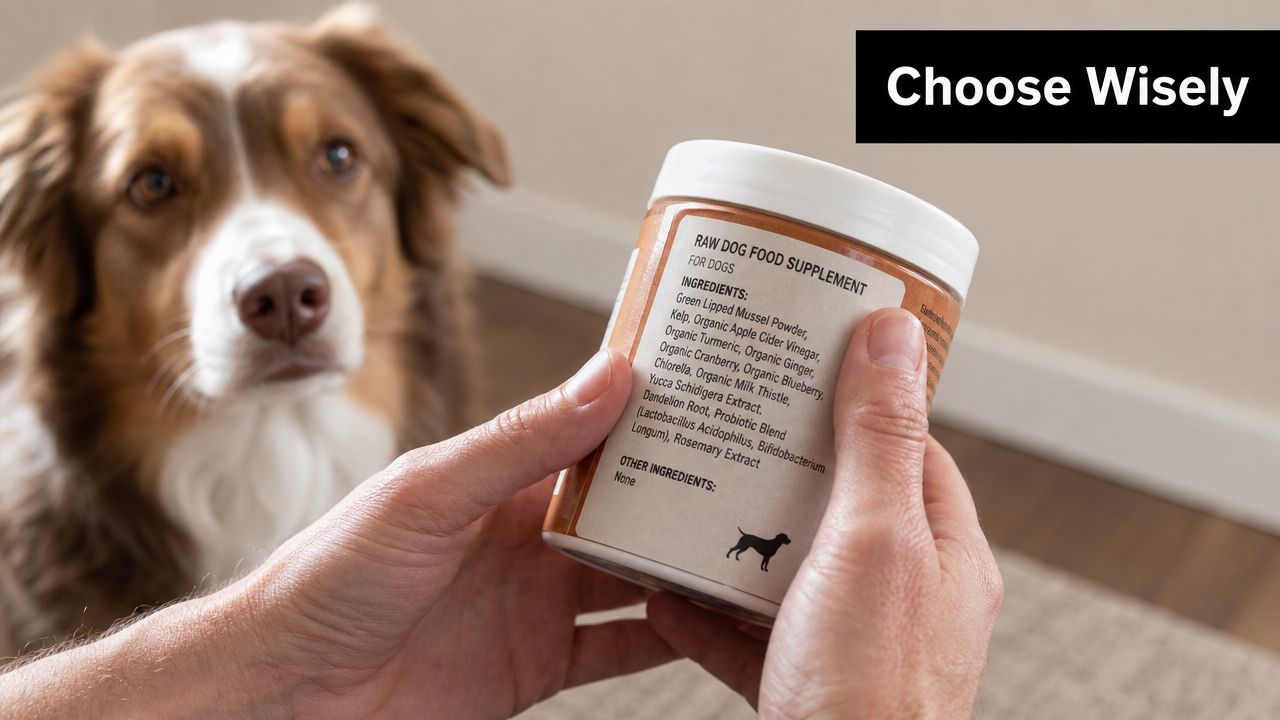
Read the ingredient list like a dog owner, not a marketer
Simple ingredients aren't automatically perfect, but they are easier to evaluate. If you see foods you recognize, such as beef heart, carrots, celery, or apple cider vinegar, you can start forming a practical opinion. If the list is loaded with vague terms, fillers, or a long trail of synthetic add-ins, ask why the product needs all that complexity.
A useful comparison point is what often goes missing in raw-style meals. North Hound Life's guide to raw dog food supplements notes that homemade and commercial raw meals frequently lack essential nutrients such as calcium, omega-3 fatty acids (EPA/DHA), and vitamin E. The same guidance recommends 5–10% vegetation and targeted supplements to provide polyphenols, fiber, zinc, and oxidation support.
That tells you something important. “Whole food” isn't enough on its own. The formula still needs a nutritional reason behind it.
Ask better sourcing questions
Some claims sound impressive until you try to verify them. Don't stop at “premium” or “human-grade.” Ask what those words mean in practice.
Use questions like these:
- Where are the ingredients sourced? If a brand says local, it should be able to explain local to what region.
- How is the product processed? Dehydrated, freeze-dried, and frozen all create different handling needs.
- Is the product tested? “Lab tested” should mean the company has a real quality standard, not just attractive packaging.
- What is this meant to do? Appetite support, meal enrichment, and palatability are different goals than complete diet formulation.
If gut support is one of your goals, it also helps to learn how to find quality dog probiotics so you can tell when a digestive product is worth adding and when it's just another label claim.
Watch how the product behaves in real life
A strong supplement should work in ordinary homes. It should sprinkle easily, mix without fuss, and fit into a weeknight routine when you're feeding your dog between errands and dinner cleanup.
This quick video gives a helpful visual sense of how dog meal enhancement products fit into everyday feeding:
The best products lower friction
A smart buying test is simple. Ask yourself whether the supplement will make feeding easier or harder.
Choose products that offer:
| What to look for | Why it matters |
|---|---|
| Recognizable ingredients | Easier to evaluate and trust |
| Clear serving instructions | Helps prevent guesswork |
| Flexible use | Works on dry food, soft food, or mixed with water |
| Satisfaction guarantee | Shows the company stands behind the product |
When a product checks those boxes, it's more likely to become part of your routine instead of another half-used tub in the pantry.
Practical Ways to Use a Meal Enhancer
Some supplements sound good in theory but end up sitting on the shelf because no one knows how to use them day to day. A meal enhancer works best when it solves a real feeding problem.
That might be a picky dog who sniffs and walks away. It might be an older dog who needs softer meals. It might be the nightly medication battle that turns the kitchen into a negotiation zone.

For the dog who's bored with the bowl
Some dogs don't need a diet change. They need a reason to care about dinner again.
A powdered enhancer can add aroma and savory flavor to plain kibble. For a picky eater, that small change can be enough to restart interest. You sprinkle a little over the top, toss the bowl lightly, and suddenly the meal smells like food instead of dry pellets.
For the senior who prefers softer meals
Older dogs often want comfort more than crunch. If chewing seems slower or your dog leaves hard pieces behind, you can mix a meal enhancer with warm water and stir it into kibble to create a softer mash.
That same approach can help dogs coming back from illness, dental procedures, or periods of low appetite. The food stays familiar, but the texture gets easier and the smell becomes more inviting.
Start small. A little topper mixed well into the usual meal is often more successful than a dramatic change all at once.
For hydration and stress-free dosing
A versatile supplement can do more than sit on dry food.
Try these practical uses:
- Savory broth. Mix the powder with water and pour it over kibble for extra moisture.
- Pill disguise. Stir a small amount into a soft bite of food to make medication less obvious.
- Travel meals. Keep feeding familiar while away from home.
- Recovery support. Add interest to meals for dogs who seem less excited to eat.
If you want more ideas for topper-style feeding, browse these examples of dehydrated dog food toppers and note how many situations call for convenience as much as nutrition.
Keep the enhancer in its proper role
This part is easy to overlook. Organ-rich ingredients are useful, but they still belong in the “addition” category unless the full diet is formulated to be complete.
According to this feeding guidance on beef heart for dogs, organ meats like beef heart should make up no more than 10% of a dog's total diet to help prevent vitamin A toxicity and nutrient imbalance. That's a helpful reminder that these foods are powerful in small amounts.
A meal enhancer should improve the bowl, not take it over.
Frequently Asked Questions
Lingering questions usually come down to one thing. You want to help your dog without overcomplicating feeding. That's the right goal.

Can puppies use a raw dog food supplement
Sometimes, but puppies aren't just smaller adult dogs. They're growing, and growth changes what “balanced” means. If you want to add a topper or meal enhancer for a puppy, check the product directions and ask your veterinarian whether it fits the rest of the diet.
A good rule is to treat supplements as small additions unless a veterinary professional tells you otherwise.
What's the difference between dehydrated and freeze-dried
Both methods remove moisture, but they aren't identical in texture, storage, or handling. Dehydrated products often work well as powders or meal toppers because they mix easily into kibble or water. Freeze-dried products may hold chunkier shapes and can be used as treats, toppers, or mix-ins depending on the format.
What matters most is less about which method sounds fancier and more about whether the product is safe, easy to use, and appropriate for your dog.
Does my dog still need other supplements
Maybe. It depends on what your dog already eats and why you're adding a topper.
Some dogs need only a palatability boost. Others may need support for digestion, appetite, or specific health concerns. A meal enhancer can improve the bowl, but it doesn't automatically replace every other nutritional tool. If your dog has allergies, digestive issues, or a medical condition, ask your veterinarian before layering multiple supplements together.
Bring the product label, feeding directions, and your dog's current food to your vet visit. That makes the conversation much more useful.
What should I ask my veterinarian before adding one
Keep it simple. Bring a short checklist:
- Current food name and how much you feed
- Any treats or extras your dog gets daily
- Medications or health concerns
- Your goal, such as better appetite, easier pill giving, or support for an older dog
- The supplement label so your vet can review ingredients and intended use
That kind of visit isn't about getting permission to care. It's about making sure all the pieces of your dog's diet make sense together.
If you want an easy way to boost the bowl you already serve, ChowPow keeps things simple. It's a dehydrated beef heart meal enhancer made to add flavor and whole-food nutrition to kibble, not replace it. You can sprinkle it on meals, mix it with water for a softer bowl, or use it to help with picky eating and medication time.
-
Product on sale
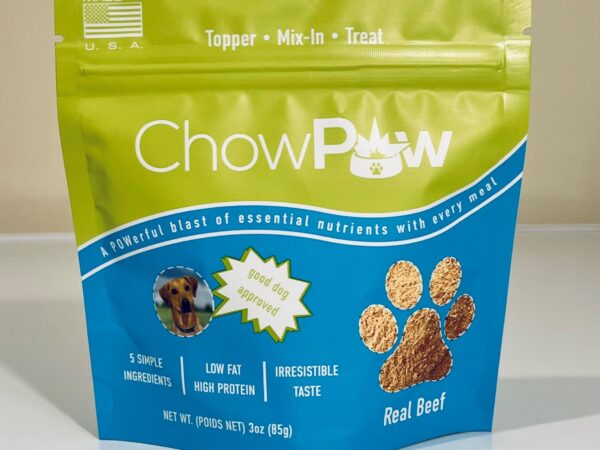 Dog Food Topper - Beef HeartOriginal price was: $14.99.$10.95Current price is: $10.95. - or subscribe and save up to 20%