Best Dog Food for Overweight Dogs: Healthy Weight 2026
You notice it in small ways first. Your dog pauses halfway through a walk. Jumping onto the couch takes more effort. Then your veterinarian says, kindly, “He could stand to lose a little weight.”
That moment can bring guilt, confusion, and a dozen questions at once. Am I feeding too much? Is the food wrong? Should I switch brands? Are treats the problem?
If that sounds familiar, you're not alone, and your dog is not “ruined” or destined to stay overweight. Weight gain in dogs is common, and in many cases it responds well to a steady plan built around the right food, measured portions, and realistic habits.
The tricky part is that the best dog food for overweight dogs isn't just the one with “light” or “healthy weight” on the bag. What matters is whether the food helps your dog lose fat safely, stay nourished, and feel satisfied enough that the plan lasts. That last part matters more than many owners realize.
Your Guide to Canine Weight Management
A lot of loving owners end up in the same place. They scoop food by eye, hand out a few extra treats, and share bites from dinner because their dog looks so hopeful. Months later, the dog is heavier, hungrier, and less active.
That doesn't mean you failed. It means your dog needs a more structured system.
A good weight plan has two jobs. First, it needs to lower calorie intake without cutting out essential nutrition. Second, it needs to be practical enough that you can stick with it on busy weekdays, family weekends, and all the moments your dog gives you that “I'm starving” face.
For many dogs, movement is part of that plan too. If your veterinarian says your dog is ready for more activity, it can help to explore exercise routines that support a gradual return to regular movement.
Daily success usually comes from simple habits:
- Measure meals carefully: Guessing tends to drift upward over time.
- Choose food for satiety: A dog who feels fuller is easier to keep on plan.
- Keep everyone consistent: One family member giving “just a little extra” can undo progress.
- Track what changes: Weight loss is easier when you can spot patterns early.
If you want a broader foundation on why this matters, ChowPow's guide on helping your dog achieve a healthy weight is a useful companion read.
Practical rule: Don't think of weight management as feeding less. Think of it as feeding smarter.
Understanding Dog Obesity and Its Health Risks
Extra weight in dogs is more than a cosmetic issue. It changes how the whole body works, from movement to breathing to everyday comfort.
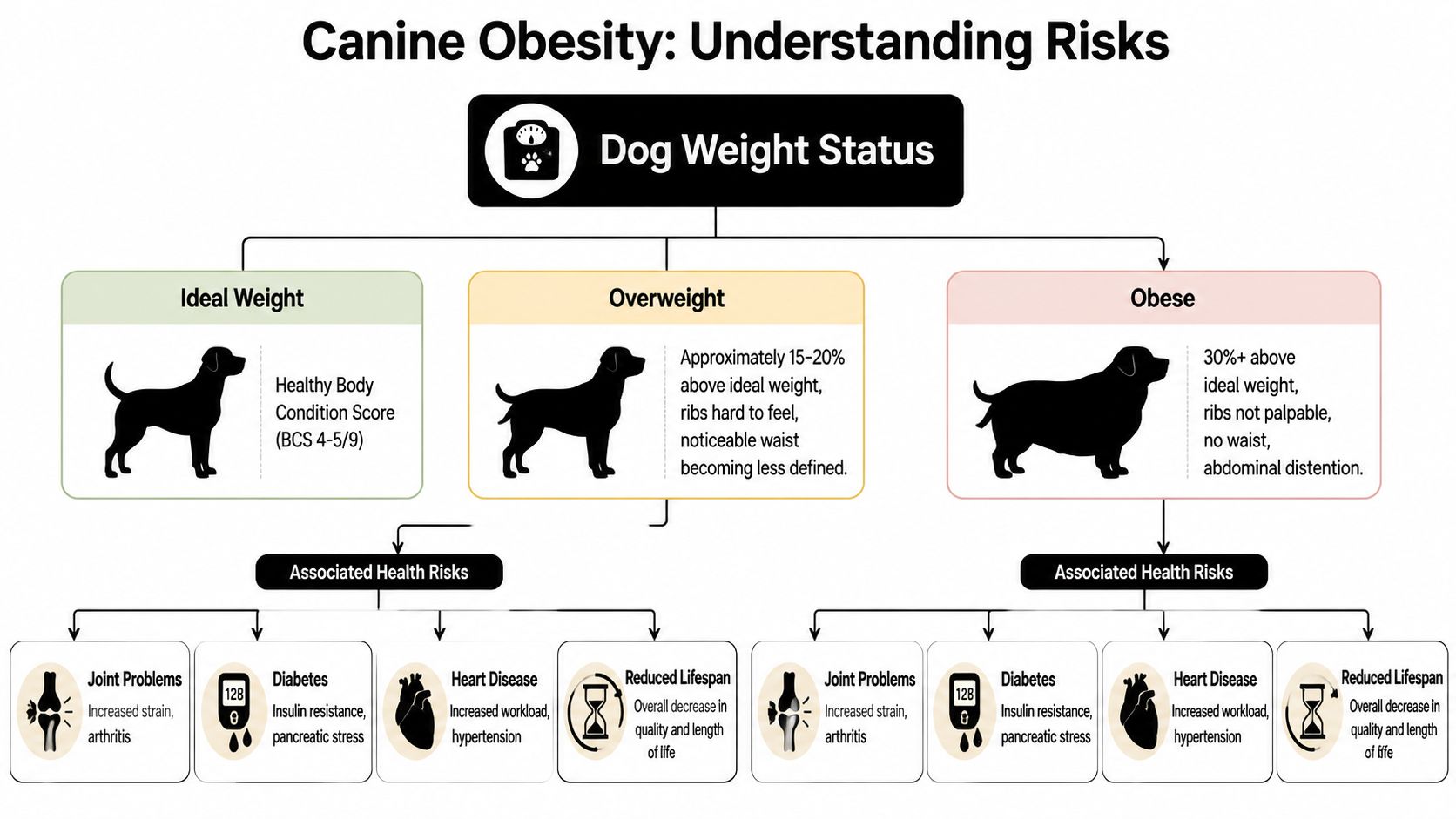
According to PetMD, dogs are considered overweight at about 10% above ideal body weight and obese at about 20% above ideal body weight, and veterinary guidance commonly targets a safe loss rate of 1 to 2% of body weight per week to reduce body fat while preserving lean tissue (PetMD guidance on obesity in dogs).
What overweight looks like in real life
Some owners expect obesity to be obvious. Often it isn't.
A dog can still wag, play, and act happy while carrying too much weight. The clues tend to be subtle at first:
- Hard-to-feel ribs: You have to press more than you used to.
- Less waist definition: From above, the body looks more oval than hourglass.
- Lower stamina: Walks get shorter, or your dog slows down sooner.
- More effort in daily movement: Stairs, jumping, and getting up from rest may look less easy.
Why the health risks add up
When a dog carries extra fat, joints absorb more strain with every step. That can worsen discomfort and make exercise harder, which then makes weight loss harder too. It becomes a cycle.
Veterinarians also watch overweight dogs more closely for problems involving metabolism, heart function, and breathing. Even before a formal diagnosis appears, many dogs feel less comfortable in their bodies.
That's why early action matters. You're not waiting for a crisis. You're making everyday life easier on your dog.
Extra weight changes the dog's whole routine, not just the number on the scale.
Common reasons dogs gain weight
Several factors can push weight upward at the same time:
- Portions creep up: A “full scoop” today may be larger than it was months ago.
- Treats add up: Training treats, table scraps, and chews all count.
- Activity drops: Weather, schedule changes, pain, or aging can reduce movement.
- Medical issues contribute: If weight gain seems sudden or stubborn, a veterinary check matters.
If your dog is heavier than they should be, the next step isn't panic. It's choosing a food plan that creates a controlled calorie deficit while still meeting nutritional needs.
The Nutritional Blueprint for a Weight-Loss Food
Many owners try the simplest fix first. They keep the same kibble and just feed less of it.
Sometimes that lowers calories, but it can also leave a dog hungry and may reduce nutrient intake if the original food wasn't built for weight loss. A better approach is to choose a food designed for the job.
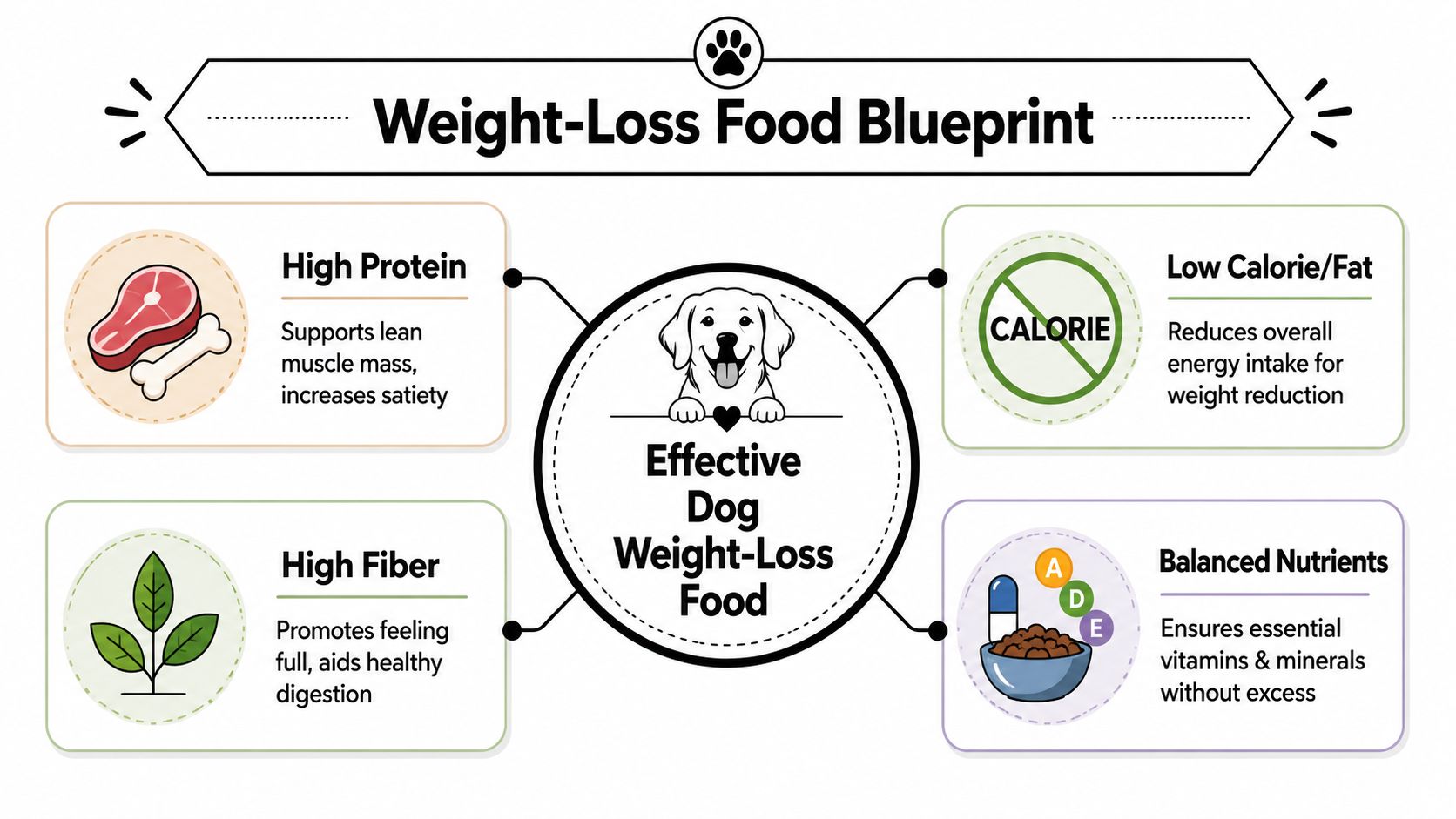
PetMD notes that the most evidence-based pattern for overweight dogs is high protein, low calorie, and high fiber, because protein helps preserve lean muscle during energy restriction while fiber increases satiety and reduces voluntary intake (PetMD vet-verified overview of weight-loss dog food).
High protein protects the good weight
When dogs lose weight, you want them to lose fat, not useful muscle.
Think of protein as the “maintenance crew” for your dog's body during a calorie deficit. It helps support lean tissue so your dog doesn't become weaker while slimming down. This is one reason weight-loss foods often look more protein-forward than regular maintenance formulas.
Fiber helps with fullness
Fiber is the part many owners underestimate.
A lower-calorie meal can feel disappointing to a dog if it disappears in seconds and leaves them looking for more. Fiber adds bulk and helps stretch out that feeling of satisfaction. It's a bit like adding more lettuce and vegetables to a human meal so the plate feels fuller without loading on calories.
If you want a deeper look at how this works in the digestive tract, ChowPow has a helpful article on fiber's role and benefits for canine digestion.
Lower fat usually means fewer calories
Fat is an important nutrient, but it also makes food more calorie-dense. That means small portions can pack a lot of energy.
For an overweight dog, the goal usually isn't “no fat.” It's less fat than a standard formula, while still keeping the food complete and balanced.
Here's a simple way to read the label:
- Protein matters for preservation: Look for a food that supports muscle during restriction.
- Fiber matters for satiety: It helps your dog feel less deprived.
- Fat affects calorie density: Lower-fat foods often make calorie control easier.
- Calories per cup matter in practice: If two foods look similar, the lower-calorie option is often easier to portion for weight loss.
Label-reading shortcut: Don't stop at the words on the front of the bag. Turn it over and compare protein, fat, fiber, and calories per cup.
A real weight-loss food should help your dog lose gradually without leaving them undernourished, miserable, or constantly begging.
Comparing the Top Overweight Dog Food Options
Once you know what a weight-loss food should do, the next question is which type of food fits your dog and your household.
Not every overweight dog needs the same solution. Some do best on a prescription veterinary diet. Others can succeed on a carefully chosen over-the-counter formula. Some owners prefer fresh or home-prepared meals, but those require more oversight to stay balanced.
One important benchmark comes from Cornell guidance summarized by Whole Dog Journal. Dry weight-loss foods should contain 30% protein or greater and 8% fat or lower, and moisture can make canned foods seem lower in fat than they are. For example, a food with 3% fat and 78% moisture is about 13% fat on a dry-matter basis, which is not especially low-fat (Whole Dog Journal on lower-fat dog food and dry-matter math).
Comparison of Dog Weight-Loss Diet Types
| Diet Type | Pros | Cons | Best For |
|---|---|---|---|
| Prescription veterinary diets | Clinically formulated for weight reduction, usually very consistent, often easier to use in structured plans | Require veterinary involvement, may cost more, some dogs dislike the taste | Dogs with significant excess weight, dogs with medical complexity, owners who want close veterinary guidance |
| Over-the-counter weight control kibble | Easy to buy, more choices, often simpler for long-term budgeting | Quality varies a lot, “weight control” on the bag doesn't always mean strong satiety or ideal macro balance | Dogs with mild to moderate weight gain and owners willing to compare labels carefully |
| Fresh or home-cooked diets | Often very appealing to dogs, can feel easier for picky eaters | Must be carefully formulated to stay complete and balanced, portions need close control | Owners working closely with a veterinarian or veterinary nutrition professional |
How to think through the choice
Prescription diets are often the clearest path when a dog needs a tightly managed plan. They're built to create a deficit without sacrificing essential nutrients, and they're often paired with regular weigh-ins and veterinary adjustments.
Over-the-counter foods can work well too, but they demand more homework. Some are effective weight-management formulas. Others are regular foods with lighter marketing language and only modest nutritional changes.
Fresh and home-cooked meals sound appealing because they feel “real” and many dogs love them. The problem isn't freshness. The problem is balance. If the recipe isn't complete and portions aren't measured, a dog can stay overweight while missing nutrients.
Questions to ask before you buy
- Does this food have enough protein? For dry diets, Cornell's benchmark is a strong starting point.
- Is the fat level lower? Check dry-matter context, especially with canned foods.
- How many calories are in each cup or can? That affects portion size immediately.
- Will my dog eat it consistently? The perfect formula won't help if the bowl stays full.
The best dog food for overweight dogs is the one that meets nutritional targets, fits your budget, and gets eaten predictably enough to support a long-term plan.
How to Calculate Calories and Portion Sizes
Many good intentions fall apart when owners buy a better food, but still eyeball the serving.
Weight loss works better when feeding becomes measurable.
A simple estimate many veterinarians use starts with Resting Energy Requirement, often shortened to RER. You may see formulas for it online, but the number should be treated as a starting point, not a final answer. Your dog's age, body condition, activity, and medical history all affect what calorie target makes sense.
A practical way to use calories
Start with your veterinarian's target if you have one. If you don't, ask for a daily calorie goal based on your dog's ideal weight rather than current weight.
Then match that number to the food label:
- Find calories per cup or per can
- Divide your daily target by that calorie figure
- Split the result into scheduled meals
- Subtract treats from the total, rather than adding them on top
That sounds basic, but it's the difference between a plan and a guess.
Why a kitchen scale helps so much
Scoops are inconsistent. Cups vary. One person levels the food. Another rounds it high.
A kitchen scale removes that wobble. Once you know the gram weight that matches your dog's target portion, each meal becomes more accurate. That consistency is one reason structured programs tend to outperform casual dieting.
Royal Canin reports that 97% of dogs lost weight in three months when fed its Satiety Support diet in a weight-management program, which shows how effective a properly formulated plan can be when the diet is structured and monitored (Royal Canin weight-management program details).
Measured feeding beats “pretty close” feeding, especially when progress slows and every extra handful counts.
Portion mistakes to watch for
- Treat drift: Rewards often aren't counted.
- Multi-person feeding: One dog, two feeders, double breakfast.
- Bag-guideline confusion: Feeding guides are general, not individualized.
- No adjustments over time: As weight changes, portions may need to change too.
If your dog isn't losing on paper, the first place to look is usually measurement, not motivation.
Keeping Your Dog Happy on a Diet
The hardest part of canine weight loss usually isn't choosing a bag of food. It's living with a dog who seems convinced the new plan is utterly unfair.
Some dogs beg more. Some raid the trash. Some sniff their “diet” kibble and walk away. That's a real problem because the best weight-loss diet only works if your dog will eat it consistently.
Cornell guidance highlights an underserved issue in dog weight loss: appetite management. Owners often struggle because dogs beg or reject diet kibble, which is why palatability and compliance matter so much in a successful plan (Cornell obesity and weight loss guidance for dogs).
Make meals feel bigger without adding much
Dogs experience food with their nose, mouth, and routine, not just with calories. You can use that to your advantage.
- Use puzzle feeders: Slower eating stretches the experience of the meal.
- Split meals when appropriate: Two smaller meals can feel more satisfying than one large one.
- Add low-calorie bulk foods approved by your vet: Some owners use vegetables like green beans or carrots in a controlled way.
- Keep treats limited: Cornell notes that treats should stay at about 10% of daily calories, so they don't end up overwhelming the plan.
Help picky dogs accept weight-loss food
Many households require a practical middle ground. The dog needs calorie control, but the owner also needs the dog to willingly eat the meal.
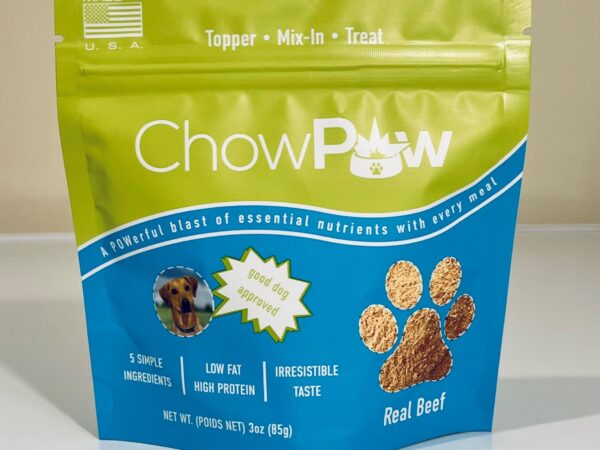
A topper can help with that, as long as it's used as a meal enhancement, not a replacement for the underlying complete and balanced diet. For dogs who turn away from plain weight-control kibble, ChowPow can be used in a small amount over the meal to improve aroma and palatability while keeping the main food in place.
That matters because compliance is a nutrition issue, not just a behavior issue. If your dog repeatedly refuses the food, the plan breaks.
A quick visual can help if you need ideas for making mealtime more engaging:
What owners often get wrong
Many people assume hunger means the food “isn't working.” Often it means the plan needs better satiety tactics.
Try this checklist:
- Look at meal speed: Fast eaters often act hungry sooner.
- Audit extras: Chews, lick mats, and table food may be stirring appetite patterns.
- Check palatability: Refusal can look like pickiness when the diet isn't appealing enough.
- Stay consistent for several weeks: Frequent food switching can make appetite behavior worse.
A successful weight plan should feel sustainable. Your dog doesn't need to love dieting, but they do need to feel comfortable enough to live with it.
Monitoring Progress and Planning for the Future
Good weight management is less like a sprint and more like steering a boat. Small course corrections matter.
Weigh your dog regularly, keep notes on energy, stool quality, appetite, and meal behavior, and look at body shape over time. If you want a simple way to stay organized, these printable food journal templates can make it easier to log meals, treats, and weigh-ins.
What progress should look like
You're looking for gradual improvement, not dramatic swings. If your dog isn't losing, your veterinarian may adjust calories, portions, treats, or the food itself. If your dog seems too hungry, weak, or is dropping faster than expected, that's also a reason to check in.
Body shape matters along with scale weight. ChowPow's guide to body condition score can help you learn what to look for at home when the number alone doesn't tell the whole story.
The goal isn't a lighter dog for a month. The goal is a healthier dog for years.
After the weight comes off
Many owners relax once the target is reached, then the weight slowly returns. Maintenance needs its own plan.
Keep the habits that worked:
- Continue measuring food
- Recheck treats and extras
- Watch activity changes
- Reassess portions as your dog ages
The best dog food for overweight dogs may not be the same food your dog eats forever, but the lessons stay the same. Feed deliberately, monitor carefully, and make changes early rather than late.
If your dog needs help staying interested in a calorie-controlled meal, ChowPow is a dog food topper that can be added to existing kibble as a meal boost, not a replacement. It's designed to enhance flavor and support meal acceptance, which can make a structured weight-management plan easier to maintain.
-
Product on sale
 Dog Food Topper - Beef HeartOriginal price was: $14.99.$10.95Current price is: $10.95. - or subscribe and save up to 20%