
Bladder Cancer in Dogs: A Complete Guide for 2026
A dog that suddenly needs to go outside all the time can throw your whole household off balance. Maybe your normally reliable senior dog has started having accidents. Maybe you noticed straining, or a small streak of pink in the urine, or that uneasy crouch that says something does not feel right.
Many families first hear “it may just be a urinary tract infection,” and sometimes that is true. But when symptoms keep coming back, fear creeps in fast. You start watching every bathroom trip, every bowl of water, every restless night.
If that is where you are, take a breath. Bladder cancer in dogs is a serious diagnosis, but it is not one you have to face blindly. Clear information helps. A calm plan helps. So does emotional support for the humans in the room. If you are feeling overwhelmed, a practical guide to coping with a cancer diagnosis can help you process the shock and make the next decisions from a steadier place.
A Worried Owner's Guide to Starting this Journey
When owners describe the first signs, they often sound small at first.
A dog asks to go out more often. Then she squats and only passes a little urine. Then there is blood. Then antibiotics seem to help, but only briefly. Soon the same pattern returns.
That is part of what makes bladder cancer in dogs so unsettling. It does not always announce itself loudly. It often looks like a common urinary problem until it refuses to behave like one.
Why this feels so confusing
Bladder problems all tend to overlap in the same few ways. Dogs may strain, dribble, pace, lick at the area, or need frequent trips outside. Owners naturally think infection first, because infection is common and familiar.
Cancer feels like a leap. It is not where most minds go on day one.
That gap between “probably a UTI” and “we need more testing” is emotionally hard. Owners often blame themselves for not noticing sooner, or for hoping the first round of medication would fix it.
Key takeaway: You did not cause this by missing one early clue. These signs can be subtle, and even experienced owners often learn the full picture step by step.
What you need most right now
You do not need to memorize every medical term at once. You need a practical way to think through the problem.
Start with these questions:
- What has changed: Is your dog urinating more often, straining, leaking, or showing blood in the urine?
- What happened after treatment: Did symptoms improve and then return?
- How is daily life affected: Is your dog sleeping poorly, pacing, refusing walks, or seeming uncomfortable?
- What support does your vet recommend next: Urine testing, imaging, or referral to an oncology team may all be part of the next step.
A good plan brings the fear down to a manageable size. It turns a frightening unknown into the next appointment, the next test, the next choice.
That is how most families get through this. Not by solving everything at once, but by moving one informed step at a time.
What Is Bladder Cancer in Dogs
When veterinarians talk about bladder cancer in dogs, they usually mean invasive urothelial carcinoma, also called transitional cell carcinoma or TCC. It is not the only bladder tumor a dog can get, but it is the one most owners will hear about.
Think of the inside of the bladder like a smooth waterproof lining. In this cancer, abnormal cells begin growing in that lining and push deeper into the bladder wall. Instead of staying on the surface, they often act more like roots growing into soil.
Why this cancer is difficult
This disease is usually aggressive in dogs. It also tends to grow in a difficult location.
According to a review in Frontiers in Oncology, bladder cancer, primarily invasive urothelial carcinoma or TCC, accounts for approximately 1.5–2% of all cancers in dogs, Scottish Terriers have a 20-fold increased incidence, and over 50% of tumors are located in the bladder trigone, the area where urine enters and exits the bladder (Frontiers in Oncology).
The trigone matters because it is busy real estate. It sits near the openings of the ureters and the urethra. A tumor there can interfere with normal urine flow, which helps explain why dogs may strain or pass only small amounts.
Which dogs are more likely to be affected
Some dogs carry higher risk than others.
Breeds commonly discussed in practice include:
- Scottish Terriers
- West Highland White Terriers
- Beagles
- Shetland Sheepdogs
- Wire Fox Terriers
- American Eskimo Dogs
Sex and life stage can matter too. Many affected dogs are middle-aged to senior, and females are commonly overrepresented.
That said, any dog can develop this disease. Breed risk should increase awareness, not create panic.
Why it gets mistaken for infection
A bladder tumor irritates the urinary tract. Irritation creates symptoms that look very similar to infection.
That means a dog with cancer may have:
- frequent urination
- straining
- blood in the urine
- accidents in the house
Those signs are real, but they do not tell you the cause by themselves. That is why testing matters.
Think of it this way: A weed in a garden and a patch of dry grass can both make the lawn look unhealthy. You have to look closer to know what you are treating.
One more point owners often miss
Human bladder cancer and canine bladder cancer are not identical. In people, many tumors are found while still more superficial. In dogs, the disease is more often invasive by the time it is discovered.
That does not mean there is no hope. It means early attention to urinary changes matters. The sooner a vet starts sorting out what is causing the symptoms, the more options you may have for managing the disease and protecting comfort.
Recognizing the Common Signs and Symptoms
The earliest signs of bladder cancer in dogs can look ordinary. That is why owners often spend weeks thinking they are dealing with a stubborn infection.
This video gives a helpful overview of what urinary problems can look like in real life:
What you may notice at home
Watch for patterns, not just isolated moments.
- More frequent bathroom trips: Your dog asks to go out more often or starts waking you at night.
- Straining to urinate: You may see repeated squatting with only a small amount passed.
- Blood in the urine: Sometimes it is obvious. Sometimes the urine just looks darker or pink-tinged.
- Urinary accidents indoors: A previously housetrained dog may start leaking or not make it outside in time.
- Urgency with very little output: Your dog appears desperate to urinate but produces only drops.
- Discomfort around bathroom time: Restlessness, licking at the urinary area, or a tense posture can all be clues.
Why owners confuse it with a UTI
That overlap is real. A urinary tract infection can also cause frequent urination, straining, and blood in the urine.
If you want a simple side-by-side refresher on typical infection signs, this guide on signs your dog has a urinary tract infection is useful for comparing what you are seeing at home.
The difference is often the pattern over time. With infection, symptoms often improve when the right treatment is given. With bladder cancer, symptoms may ease briefly, then return, or never fully resolve in the first place.
When to call your vet sooner
Do not wait for symptoms to become dramatic.
Contact your vet promptly if:
- Symptoms keep coming back: Recurrent urinary issues deserve a deeper workup.
- Your dog seems painful: If you are unsure, this checklist on https://chowpownow.com/how-to-tell-if-your-dog-is-in-pain-a-checklist-for-concerned-owners/ can help you spot changes in posture, behavior, and daily comfort.
- Urine flow is very limited: Trouble passing urine can become urgent quickly.
- Energy or appetite drops: Urinary disease can affect the whole dog, not just the bladder.
A short symptom diary can help a lot. Write down when your dog urinates, how often, whether there is blood, and how they behave before and after. That gives your veterinarian clearer information than memory alone.
How Vets Diagnose Bladder Cancer in Dogs
Diagnosis usually unfolds in layers. Your veterinarian first checks for common causes of urinary symptoms, then moves toward tests that can identify a mass or cancer-related cells.
That process can feel slow when you are scared, but each step answers a different question.
The first round of testing
Most workups begin with basic evaluation.
Your vet may recommend:
- Physical exam: This gives context. It helps your vet assess hydration, pain, body condition, and any obvious abdominal discomfort.
- Urinalysis: This looks for blood, inflammation, crystals, and other clues in the urine.
- Urine culture: Infection and cancer can mimic each other, so checking for bacteria matters.
- Imaging: Ultrasound is often used to look for thickening, masses, or urinary tract changes.
These tests help rule out simpler explanations and show whether something structural may be happening in the bladder.
The role of imaging
Ultrasound is useful because it lets the vet see the bladder wall and surrounding area. A normal infection may irritate the bladder, but a tumor can create a more defined thickening or mass.
Imaging also helps with staging, which means looking beyond the bladder itself. If cancer is suspected, your team may want to assess nearby structures and possible spread.
The CADET BRAF urine test
One of the most important advances in this area is a urine-based genetic test.
A veterinary oncology review notes that the BRAF V595E mutation is detected in 85% of canine TCC cases, and that the non-invasive CADET® BRAF urine test offers high specificity for early detection from a simple urine sample, helping vets confirm the diagnosis and move to staging without an an immediate surgical biopsy (PetCure Oncology).
That matters for a simple reason. The bladder is not always a safe or easy place to biopsy right away, especially if the tumor sits near critical structures. A urine test can provide a strong clue without putting your dog through a more invasive procedure first.
Practical tip: Ask your vet what question each test is trying to answer. Owners feel less overwhelmed when they know whether a test is checking for infection, looking for a mass, or helping stage confirmed disease.
Questions to ask at the appointment
Bring a notebook. It helps more than many expect.
You might ask:
| Question | Why it matters |
|---|---|
| What findings make you suspicious for bladder cancer? | Helps you understand the current level of concern |
| Do we need a urine culture even if cancer is suspected? | Infection can still be present |
| Would ultrasound help us now? | Clarifies next diagnostic steps |
| Is the CADET BRAF test appropriate for my dog? | Identifies whether a non-invasive confirmation may help |
| If cancer is confirmed, how do we stage it? | Prepares you for treatment planning |
A clear diagnosis often takes more than one visit. That is normal. What matters most is moving from guesswork to evidence so decisions are based on what your dog needs.
Exploring Your Dog's Treatment Options
Treatment decisions often come down to one core question. Are you trying to remove disease, slow it down, relieve symptoms, or do some combination of all three?
The answer depends on tumor location, spread, your dog’s overall health, and what daily life looks like at home.
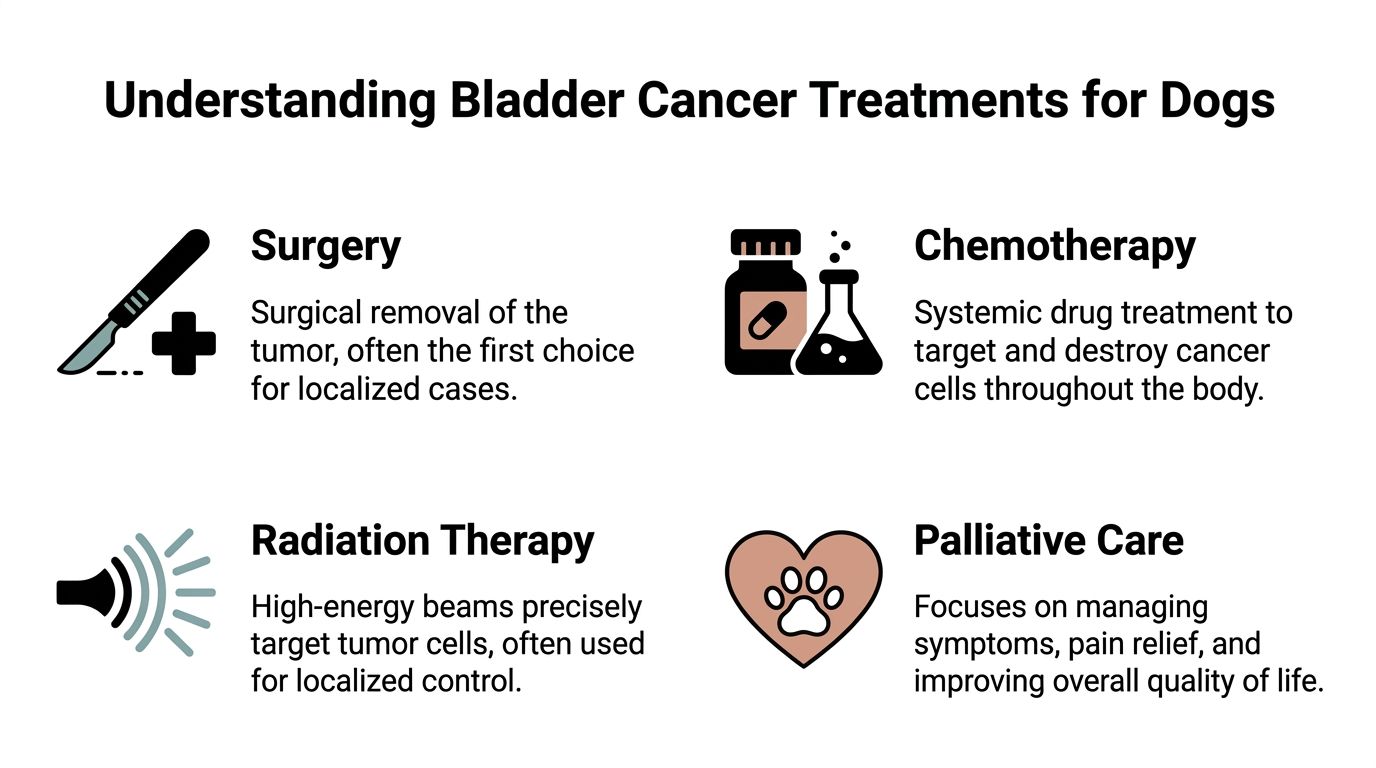
The main paths vets discuss
Some treatments aim to control the cancer. Others focus more on preserving comfort. In real life, many dogs receive a blended plan.
Surgery
Surgery sounds straightforward, but bladder cancer in dogs often grows in a location that makes complete removal difficult. If the tumor involves the trigone or nearby urinary structures, surgery may not be the best first option.
When surgery is possible, it is usually considered for select cases where location and extent make removal more realistic.
Medication and chemotherapy
Many dogs are treated medically rather than surgically. Anti-inflammatory drugs such as piroxicam are commonly discussed in veterinary oncology, sometimes alongside chemotherapy.
The goal is usually control, not cure. That means reducing inflammation, slowing growth, shrinking the tumor when possible, and helping the dog urinate more comfortably.
If your dog resists pills, practical dosing matters just as much as the drug choice. This guide on the https://chowpownow.com/best-way-to-give-dogs-medication/ covers stress-reducing ways to give medication more successfully at home.
Radiation therapy
Radiation may be considered when a team wants more targeted local control. It can be useful in some dogs, especially when the goal is to improve comfort or reduce the impact of a tumor in one specific area.
Not every dog is a candidate. Availability and treatment logistics also vary by region.
Palliative care
Palliative care is often misunderstood. It does not mean no care. It means your team is focused on comfort, function, and quality of life.
That may include pain relief, anti-inflammatory medication, management of urinary discomfort, help with appetite, and household adjustments that reduce stress for both dog and owner.
Comparing Treatment Options for Canine Bladder Cancer
| Treatment Option | Primary Goal | What It Involves | Key Considerations |
|---|---|---|---|
| Surgery | Remove localized disease when possible | Surgical evaluation and removal of accessible tumor tissue | Often limited by tumor location in the bladder |
| Chemotherapy | Slow progression and improve control | Drug protocols guided by a veterinarian or oncologist | Requires monitoring and follow-up visits |
| Radiation Therapy | Improve local control | Targeted treatment delivered in planned sessions | Access depends on specialty centers |
| Palliative Care | Maximize comfort and daily function | Symptom relief, pain management, appetite support, home adjustments | Can be used alone or alongside active treatment |
How families choose
There is no single “right” plan for every dog.
Some owners choose the most aggressive treatment available. Others prioritize fewer hospital visits and more comfort-focused time at home. Many move from one approach to another as the disease changes.
These questions often help:
- How much discomfort is the tumor causing right now?
- What is the goal of this treatment?
- What side effects should I watch for at home?
- How often will my dog need rechecks?
- Will this plan help my dog feel better, not just live longer?
A useful rule: Choose the plan that matches both your dog’s medical needs and your family’s realistic ability to deliver care well.
Good oncology care is not only about fighting cancer. It is also about protecting bathroom comfort, sleep, appetite, mobility, and calm routines. Those things count. They count a lot.
Prognosis and Managing Your Dog's Quality of Life
The hardest question is often the most direct one. “How long does my dog have?”
The honest answer is that no veterinarian can promise an exact timeline for an individual dog. What they can give you is a medical range, plus guidance on how to protect comfort through each stage.
What prognosis means in real life
A review in Veterinary Medicine and Science reports that the prognosis is guarded, with median survival times for treated dogs generally ranging from 1 to 2 years. The same review notes that metastasis is present in up to 20% of dogs at diagnosis and rises to 50–60% by the end of life, with more extensive tumor burden linked to worse outlook (PMC).
Those numbers are useful, but they are still averages. Your dog is not an average.
What matters day to day is how your dog feels, functions, and enjoys life.
Signs quality of life needs closer attention
Many families benefit from watching a few daily markers.
- Bathroom comfort: Is your dog able to urinate without prolonged straining?
- Rest: Can your dog settle and sleep, or do they seem restless and uncomfortable?
- Interest in food and people: A dog who still wants meals, gentle affection, and familiar routines is telling you something important.
- Mobility and energy: Short walks, changing positions easily, and moving without obvious distress all matter.
- Recovery after hard days: A bad day is not always a crisis. Several bad days in a row deserve a call to the vet.
Home care that makes a real difference
Small changes often ease a lot of stress.
Make the bathroom routine easier
Take your dog out more often. Keep trips calm and unhurried. If accidents are happening, place washable pads where your dog already tends to go rather than scolding.
Reduce physical strain
Set up soft bedding near the family so your dog does not need to keep moving from room to room. Use rugs or non-slip runners if floors are slick.
Stay ahead of pain and distress
Give prescribed medication on schedule. Do not wait until your dog looks miserable to catch up. If pain control seems weaker than before, ask for a reassessment.
Keep a simple comfort journal
Write down appetite, urination, sleep, mood, and activity. Trends show up faster on paper than in memory.
Quality of life is not one dramatic moment. It is the sum of ordinary things like peeing comfortably, sleeping soundly, eating willingly, and joining the family for another quiet evening.
Some owners fear that focusing on comfort means they are giving up. In practice, it means they are paying close attention to what the dog needs most right now. That is not less loving. It is often the most loving part of care.
Nutrition and Appetite Support During Treatment
A dog dealing with bladder cancer may still have a perfectly normal digestive tract, but treatment stress, pain, repeated vet visits, and medication can all change eating behavior. Dogs who once cleaned their bowl may suddenly sniff and walk away.
That puts owners in a bind. They know nutrition matters, but they do not want every meal to turn into a battle.
Why food support matters
Nutrition does not replace medical treatment. It supports the dog going through it.
An early detection and intervention review notes that the role of dietary factors in canine bladder cancer is underexplored, and that for dogs undergoing treatment, picky eating and weight loss are common, creating a need for nutrient-dense, palatable food toppers to stimulate appetite and support recovery (Animal Cancer Foundation).
That gap in care is very real in daily practice. Owners are often handed a treatment plan but very little guidance on what to do when the dog stops eating well.
Practical ways to support appetite at home
You do not always need a total diet overhaul. In many homes, the better move is to improve intake without making food feel unfamiliar.
Try these strategies:
- Keep the base diet stable: Sudden full diet changes can create more stress when your dog already feels unwell.
- Offer smaller meals: Some dogs handle several small meals better than one large bowl.
- Add moisture: Mixing food with warm water can soften texture and improve aroma.
- Use highly palatable meal enhancers: Toppers can help dogs re-engage with meals they have started refusing.
- Pair meals with medication timing thoughtfully: Ask your vet whether medicine should be given with food and whether nausea control is needed.
For more ideas on building a practical cancer-feeding routine, this guide on https://chowpownow.com/what-to-feed-a-dog-with-cancer/ is a helpful starting point.
What a good topper should do
A meal enhancer should support the food your dog already eats. It should not pretend to replace a complete diet unless your veterinarian specifically recommends a different feeding plan.
The best use cases are often very practical:
| Challenge at home | Helpful nutrition approach |
|---|---|
| Dog sniffs kibble and walks away | Add a strong-smelling topper to increase interest |
| Senior dog struggles with dry texture | Moisten meals to make them easier to chew |
| Medication causes mealtime resistance | Mix a palatable enhancer into a small serving first |
| Dog needs more encouragement to drink | Stir permitted toppers into water or wet food under vet guidance |
A gentle mindset around feeding
Owners often panic when a sick dog eats less for a day. That reaction is understandable.
Try to think in patterns, not single meals. Appetite support works best when you stay calm, keep notes, and adjust early. If your dog repeatedly refuses food, loses interest in favorite items, or seems nauseated, bring that to your veterinary team quickly.
Feeding support is part of treatment support. Appetite, hydration, and muscle maintenance all influence how well a dog handles the weeks ahead.
Frequently Asked Questions from Dog Owners
Is bladder cancer in dogs curable
Sometimes treatment can remove or control disease in select cases, but many dogs are managed rather than cured. The practical goal is often to slow progression and preserve comfort for as long as possible.
Can a dog still have a good life after diagnosis
Yes. Many dogs continue to enjoy meals, short walks, affection, and household routines after diagnosis. Quality of life depends on symptom control, bathroom comfort, appetite, and how well the treatment plan fits the dog.
Does blood in the urine always mean cancer
No. Blood in the urine can also happen with infection, stones, or inflammation. It always deserves veterinary attention, especially if it keeps returning.
Should I push for more testing if antibiotics did not solve the problem
Yes. If urinary signs persist or come back quickly, ask your vet what the next step should be. Imaging and urine-based cancer testing may be appropriate depending on the case.
How do I know if my dog is suffering
Look at patterns in rest, appetite, urination, movement, interest in family, and recovery from difficult days. If your dog seems uncomfortable more often than comfortable, or normal routines are becoming hard, call your vet.
What should I bring to the appointment
Bring a list of symptoms, dates, medications, appetite changes, and any photos or notes about urine color or bathroom behavior. A short journal can make the appointment far more productive.
If your dog is eating less, turning away from kibble, or needs extra support during treatment or recovery, ChowPow can help make regular meals more appealing without replacing your dog’s current food. It is a dehydrated beef heart meal enhancer designed to boost flavor and nutritional value, whether you sprinkle it on kibble, mix it with water for added interest, or use it to make medication time easier. For picky eaters, seniors, and dogs recovering from illness, that kind of simple mealtime support can make a meaningful difference.
-
Product on sale
 Dog Food Topper - Beef HeartOriginal price was: $14.99.$10.95Current price is: $10.95. - or subscribe and save up to 20%