
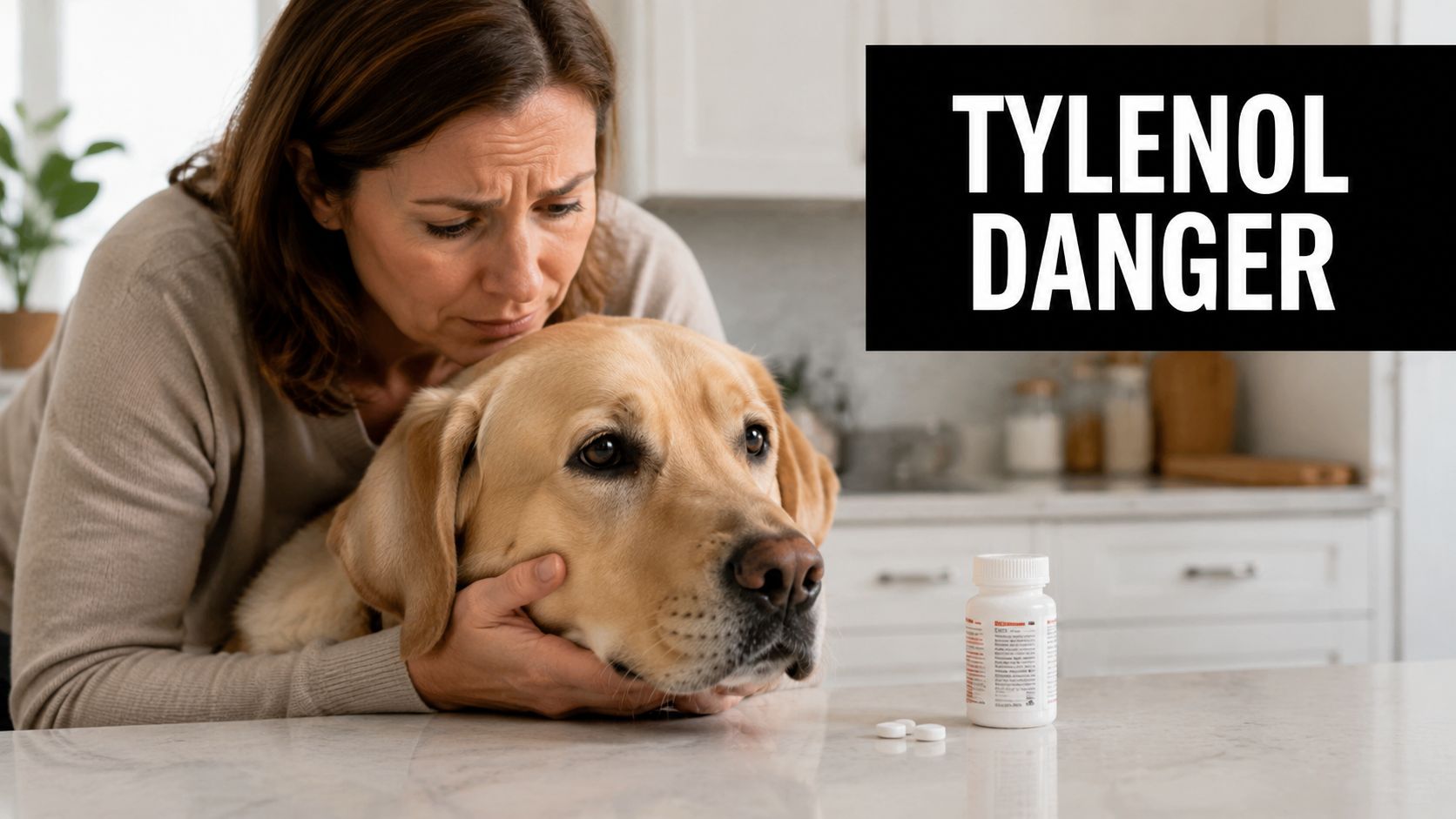
Can a Dog Have Tylenol? a Guide to Pet Safety
Tylenol is not safe for dogs and you should never give it without explicit veterinary instruction. A commonly cited toxicology threshold is 45 mg per pound of body weight, which means even one 325 mg tablet can reach a toxic range for a dog weighing about 7.2 pounds.
If you're here because your dog seems painful and you're staring at the medicine cabinet, stop there first. I understand the instinct. You want to help, and Tylenol feels familiar because people use it all the time. But with dogs, this is one of those situations where a common human medicine can turn into a poisoning emergency very quickly.
The good news is that you can take the right next step right now. If your dog may have gotten Tylenol, call your veterinarian or an emergency clinic immediately. If you're still wondering whether can a dog have Tylenol is ever a yes, the short answer is only when a veterinarian specifically directs it and supervises its use.
The Direct Answer to Tylenol for Dogs
If your dog is limping, crying, restless, or acting "not quite right," it's tempting to grab the same pain reliever you'd use for yourself. That's exactly where many accidental poisonings begin.
The direct answer to can a dog have Tylenol is no, not unless your veterinarian has told you to use it for your specific dog. This isn't a gray-area medication for home guessing. It's a drug that veterinarians treat carefully because the margin for error can be small, especially in little dogs.
Why pet owners get tripped up
Tylenol is so common in human homes that it doesn't feel dangerous. People often assume that if a medication is sold over the counter, a smaller amount must be okay for a pet.
That logic breaks down fast with dogs. The same tablet that seems harmless in a bathroom cabinet can be enough to create a serious problem in a small dog.
Practical rule: If a pain reliever was made for people, don't give it to your dog unless your veterinarian has told you exactly what product, what dose, and how often.
When the answer is ever yes
The FDA notes that veterinarians do sometimes use acetaminophen in dogs, but only under clinical supervision because unsupervised use can lead to liver failure or even death, as explained in the FDA's guidance on pain relievers for pets.
That distinction matters. "Sometimes used by vets" does not mean "safe to try at home."
Here are the safest ways to understand this:
- If your dog is in pain today: Call your vet and ask what they recommend.
- If your dog already swallowed Tylenol: Treat it as urgent, even if your dog looks normal right now.
- If a friend said they've used it before: Their dog, dose, medical history, and product may have been completely different.
A lot of pet safety comes down to one simple habit. Don't improvise with human medications.
Why Acetaminophen Is So Dangerous for Dogs
Tylenol contains acetaminophen, and in dogs the problem goes far beyond simple stomach irritation. This drug can injure the liver and damage red blood cells, which means it can affect both detoxification and oxygen delivery at the same time.
The liver works like the body's processing plant. It breaks down medications and clears waste. With acetaminophen, that system can get overloaded, and harmful byproducts can start damaging liver cells instead of being cleared safely. A published veterinary review on acetaminophen toxicity explains that the effects are dose-related in dogs, with liver injury and red blood cell changes both recognized consequences of toxic exposure.
Red blood cells act like oxygen delivery trucks, carrying oxygen from the lungs to the rest of the body. If acetaminophen alters those cells, they cannot carry oxygen the way they should. That is why a poisoned dog may look weak, breathe faster, or seem suddenly "off." The body is struggling to get oxygen where it needs to go.
Those signs can feel confusing if you were expecting a pain medicine to cause only vomiting or diarrhea. Acetaminophen poisoning is more serious than that. It can create a whole-body problem.
The real danger with Tylenol is the "why." Dogs can be harmed both by liver injury and by reduced oxygen transport.
Timing matters because these changes can begin early, sometimes before an owner realizes anything is wrong. A dog may still be walking around, but damage may already be starting. That is one reason veterinarians treat suspected Tylenol ingestion as urgent.
The practical takeaway is simple. Do not try to wait this out at home, and do not give another dose because your dog "seemed fine" the first time. Prevention is much safer than guessing. Store human pain relievers out of reach, ask your veterinarian before giving any medication, and if your dog needs a vet-approved medicine later, use a dog-safe food topper or pill aid to make dosing easier instead of reaching for something from your own medicine cabinet.
Understanding the Toxic Dose of Tylenol
The hardest part for many owners to grasp is this: the dangerous amount of Tylenol may be much smaller than you'd expect.
A commonly cited toxicology threshold for dogs is 45 mg per pound of body weight, according to the Towne Center Animal Hospital toxicology guide on acetaminophen toxicity. That number matters because it turns an everyday human medicine into a real poisoning risk for a small dog.
What that means in plain English
A standard 325 mg Tylenol tablet could reach a toxic range for a dog weighing about 7.2 pounds if the whole tablet is swallowed.
For a Chihuahua, Yorkie, or young small-breed dog, that is not a large exposure. It is one common pill from a purse, nightstand, or kitchen counter.

Why guessing is risky
Owners often ask whether a small piece is still a problem. It can be.
Dose calculations are not simple at home because several things change the risk:
- Your dog's body weight: Smaller dogs reach a dangerous dose faster.
- The tablet strength: Human acetaminophen products come in different strengths.
- How much got swallowed: Even part of a tablet can matter.
- How quickly treatment starts: Early care gives veterinarians a better chance to limit harm.
The bigger lesson is the "why." Tylenol is dangerous because the line between "maybe it was only a little" and "this could cause real injury" is thinner than many owners realize. That is why veterinarians do not recommend estimating a homemade dose from a human bottle.
A practical takeaway
There is no reliable household dose of Tylenol that you should calculate for your dog on your own.
If your dog seems sore or uncomfortable, call your veterinarian and ask for a dog-specific plan. And if your dog needs an approved medication later, make it easier to give the right medicine the right way by using a dog-safe food topper or pill aid instead of reaching for something from your own medicine cabinet.
Signs of Acetaminophen Poisoning to Watch For
Tylenol poisoning doesn't always announce itself right away. Some dogs look fairly normal at first, which can give owners false reassurance.
What matters is watching for a pattern of changes after possible exposure. If your dog got into Tylenol, even subtle symptoms deserve immediate veterinary attention.
Emergency checklist
Watch for these signs:
- Weakness or unusual tiredness: Your dog seems drained, wobbly, or less responsive than usual.
- Rapid or difficult breathing: Breathing may look faster, more effortful, or just abnormal for your dog.
- Vomiting or drooling: These are common early clues that something is wrong.
- Blue-tinged gums or tongue: This can reflect oxygen transport problems and needs urgent care.
- Facial swelling: Owners sometimes notice puffiness around the face.
- General "something is off" behavior: Hiding, refusing food, pacing, or appearing distressed can all matter.
Don't wait for every symptom
A common mistake is waiting for a full list of signs before calling. Poisoning doesn't follow a neat script in every dog.
One dog may vomit first. Another may just seem weak and breathe fast. Another may have gum color changes before anything else becomes obvious.
If you know your dog swallowed Tylenol, the emergency starts with the ingestion itself. Symptoms are important, but you don't need to wait for them.
When to treat it as urgent
Treat it as urgent if:
- You saw the ingestion happen
- You found a chewed bottle or missing pills
- Your dog had access to a purse, backpack, nightstand, or counter
- Your dog is showing any of the signs above after possible exposure
In the clinic, we care a lot about the timeline. The sooner your veterinary team knows what happened, the better they can decide what to do next.
Immediate Steps if Your Dog Ate Tylenol
You find a chewed Tylenol bottle on the floor, and your dog is licking nearby crumbs. That is enough to act.
Tylenol poisoning is a time-sensitive emergency because your dog's body starts absorbing the drug quickly. The earlier a veterinary team gets involved, the more options they may have to limit absorption and protect the liver and red blood cells. Treatment can include inducing vomiting in the right window, activated charcoal, and an antidote called N-acetylcysteine. Dogs with more serious poisoning may also need oxygen, IV fluids, hospitalization, or other supportive care, as described in VCA Hospitals' acetaminophen treatment guidance.
Start with this visual guide, then use the steps below.

What to do right now
- Call your veterinarian or the nearest emergency animal hospital right away. Call first, even if your dog looks normal.
- Collect the key details. Grab the bottle, box, or blister pack. Check the pill strength, how many tablets might be missing, the possible time of exposure, and your dog's weight.
- Do not try home remedies. Do not induce vomiting, give food to "soak it up," or offer another human medicine unless a veterinarian tells you to.
- Go in if the clinic tells you to come now. Bring the packaging and any remaining pills so the team can identify exactly what your dog got.
- Follow every instruction closely after the visit. Some effects can develop over time, so rechecks, lab work, and at-home medications matter.
A simple way to think about it is this: your job is information and speed. Your vet's job is treatment.
A short video can help you stay focused under stress.
Keep this number handy
You can also contact the ASPCA Animal Poison Control Center at (888) 426-4435.
Prevention matters just as much as emergency action. Human medicines for pain, stomach upset, and cold symptoms often look harmless on a counter, but dogs process them very differently. If you want to tighten up your medicine routine at home, this guide on whether dogs can have Pepto-Bismol safely covers another product owners commonly reach for without realizing the risks.
Bring the pill bottle, blister pack, or product label with you. That small step can save time and help your veterinary team choose the right treatment faster.
Vet-Approved Pain Relief Your Dog Can Take Safely
If your dog hurts, pain relief matters. The answer just isn't Tylenol from your medicine cabinet.
Veterinarians have better options because they can match the medication to the type of pain, your dog's age, existing health issues, and any other drugs your dog takes.
What vets may prescribe instead
Your veterinarian may use categories such as:
| Option | What it's used for | Key point |
|---|---|---|
| Canine NSAIDs | Inflammation, arthritis, orthopedic pain | These are made and dosed for dogs, not people |
| Gabapentin | Nerve-related pain, multimodal pain plans | Often used as part of a broader strategy |
| Other prescription pain support | Surgical recovery, chronic pain, hospice care | Choice depends on your dog's specific case |
The point isn't to memorize drug names. The point is to know that safe pain control usually comes from a dog-specific plan, not a human over-the-counter bottle.

Why prescription guidance matters
Two dogs with the same limp may need completely different care. One might need an anti-inflammatory. Another may need rest and diagnostics. A senior dog with liver concerns may need a different approach than a young healthy dog.
That's why "what can I give at home?" is often the wrong first question. A better one is, "What does my vet want me to use for this kind of pain?"
If you're comparing common human pain relievers, this article on whether you can give a dog aspirin is another helpful reminder that familiar human medications can create problems when pet owners self-dose.
Safe pain care usually includes more than one tool
A good plan may include:
- Rest and activity changes: Especially after injury.
- Weight support: Extra body weight can worsen joint strain.
- Prescription medication: Chosen specifically for your dog.
- Follow-up checks: To see whether the plan is working or needs to change.
You don't need to guess your way through pain management. Your vet can build a treatment plan that's both effective and safer.
Prevention and Making Medication Time Easier with ChowPow
Most Tylenol emergencies are preventable. The easiest win is to treat every human medication like a household toxin.
That means using closed cabinets, checking nightstands, keeping purses zipped and off the floor, and never leaving pill bottles on counters. If you're already improving your dog's home environment, it's also smart to review non-medication hazards like cleaners. Shiny Go Clean Madison's pet-safe cleaner list is a useful resource for reducing another common set of accidental exposures around the house.
Prevention habits that work
- Store medications high and closed: Don't rely on a "child-resistant" cap to stop a determined dog.
- Check dropped pills immediately: One tablet on the floor can be enough to matter.
- Warn visitors and family members: Grandparents, houseguests, and kids may leave medication in easy reach.
- Use one medication station: Keeping meds in one controlled spot reduces mistakes.
Making prescribed medication less stressful
The next challenge comes after your vet prescribes something safe. Many dogs hate pills, spit them out, or refuse food when they sense medicine is hidden inside.
That's where a food topper can help. ChowPow is not a replacement for your dog's regular kibble. It's a meal enhancer or supplement that can boost the appeal and nutritional value of the food you're already feeding. For some dogs, sprinkling a topper over kibble or using a small amount to disguise a prescribed pill can turn medication time from a fight into something much easier.

A practical way to think about it
When medication is vet-approved, the goal is getting the full dose into your dog safely and consistently. A topper can support that process by making the meal smell and taste more appealing, especially for picky eaters, seniors, or dogs recovering from illness.
If giving pills has become a daily wrestling match, this guide to giving a dog a pill with ease offers practical ways to make the process smoother.
Good prevention has two parts. Keep dangerous medications out of reach, and make approved medications easier to give correctly.
If you want an easier way to make prescribed medication and regular meals more appealing, take a look at ChowPow. It's a dehydrated beef heart meal topper designed to boost the nutritional value and taste of your dog's existing kibble, not replace it, which makes it a practical option for picky eaters, seniors, and dogs who need a little extra encouragement at mealtime.
-
Product on sale
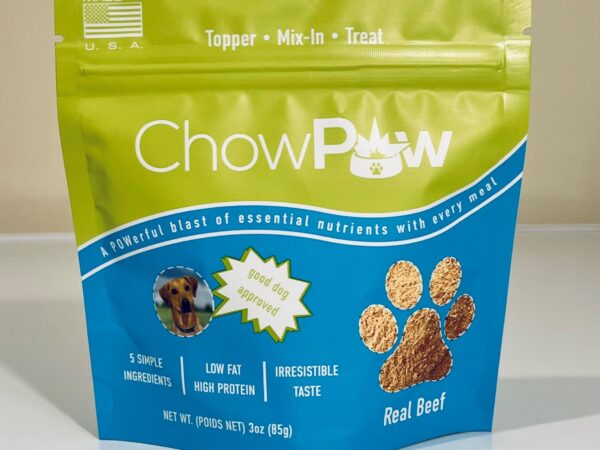 Dog Food Topper - Beef HeartOriginal price was: $14.99.$10.95Current price is: $10.95. - or subscribe and save up to 20%