
How to Read Dog Food Labels: An Easy Guide
Knowing how to read a dog food label is your superpower. It’s the one skill that lets you cut through all the flashy marketing claims and see what’s really going into your dog’s bowl every day.
When you can confidently scan the ingredient list, check the guaranteed analysis, and find the nutritional adequacy statement, you're no longer guessing. You're making an informed choice that will genuinely support your dog's health for years to come.
Why Your Dog's Food Label Matters More Than Ever
Let's be honest, standing in the pet food aisle can feel like a pop quiz you didn't study for. Every bag boasts the secret to a happy, healthy dog, but the real story is always printed in tiny font on the back.
Learning to decode that label is the single most important thing you can do as a pet parent. It’s how you move beyond pretty packaging and start choosing food based on actual nutritional quality, not just clever advertising. This guide is here to help you do just that.
A Growing Demand for Transparency
If you're feeling this way, you're not alone. The pet food industry is massive—global sales are expected to hit $151.8 billion in 2024—and owners like you are demanding to know more.
This push for clarity has led to real change. In 2023, the Association of American Feed Control Officials (AAFCO) approved the Pet Food Label Modernization (PFLM), the first major update to labeling rules in decades. You can dig into the details of these industry-wide changes over at Pet Food Processing.
To get started, here’s a look at a standard dog food label, with the key sections we’re about to break down.
This little block of text tells you everything from protein percentages to ingredient sources, which is exactly what you need to judge the food's quality. Of course, a great diet is just one piece of the puzzle. For some pups, a holistic approach includes finding specialized solutions for specific canine health issues like otitis externa that work alongside their nutrition plan.
Your dog's diet is the foundation of their health. What’s inside the bag directly fuels their energy, supports their immune system, and contributes to their overall vitality every single day.
Decoding the Ingredient List
Forget the fancy marketing on the front of the bag; the ingredient list is where a dog food's true colors are revealed. This is your single best tool for figuring out what you’re really feeding your dog. Learning how to read it is like getting a backstage pass to your pup's nutrition.
Ingredients are always listed by weight, starting with the heaviest. This means the first five to seven ingredients are the real stars of the show, making up the vast majority of the recipe. Your mission is to find high-quality, recognizable protein sources right at the top.
The Power of the First Five Ingredients
The moment you pick up a bag, flip it over and scan those first five ingredients. This is the foundation of the entire formula, and it tells you almost everything you need to know in seconds.
What you're looking for are specific, whole-food proteins. Things like:
- Deboned chicken or beef
- Lamb meal or salmon meal (Don't be scared by "meal"—it's a concentrated form of protein where the water has been removed, making it very nutrient-dense.)
- Chicken liver or beef heart (Organ meats are absolute nutrient powerhouses!)
These named sources tell you exactly what animal the protein came from. On the other hand, vague terms like “meat meal” or “animal digest” are big red flags. They don't specify the animal, which often means they're made from lower-quality, rendered scraps. If you want to dive deeper, we have a whole guide on what ingredients to avoid in dog food.
This infographic gives you a quick visual cheat sheet for sizing up a label, starting with that critical ingredient list.
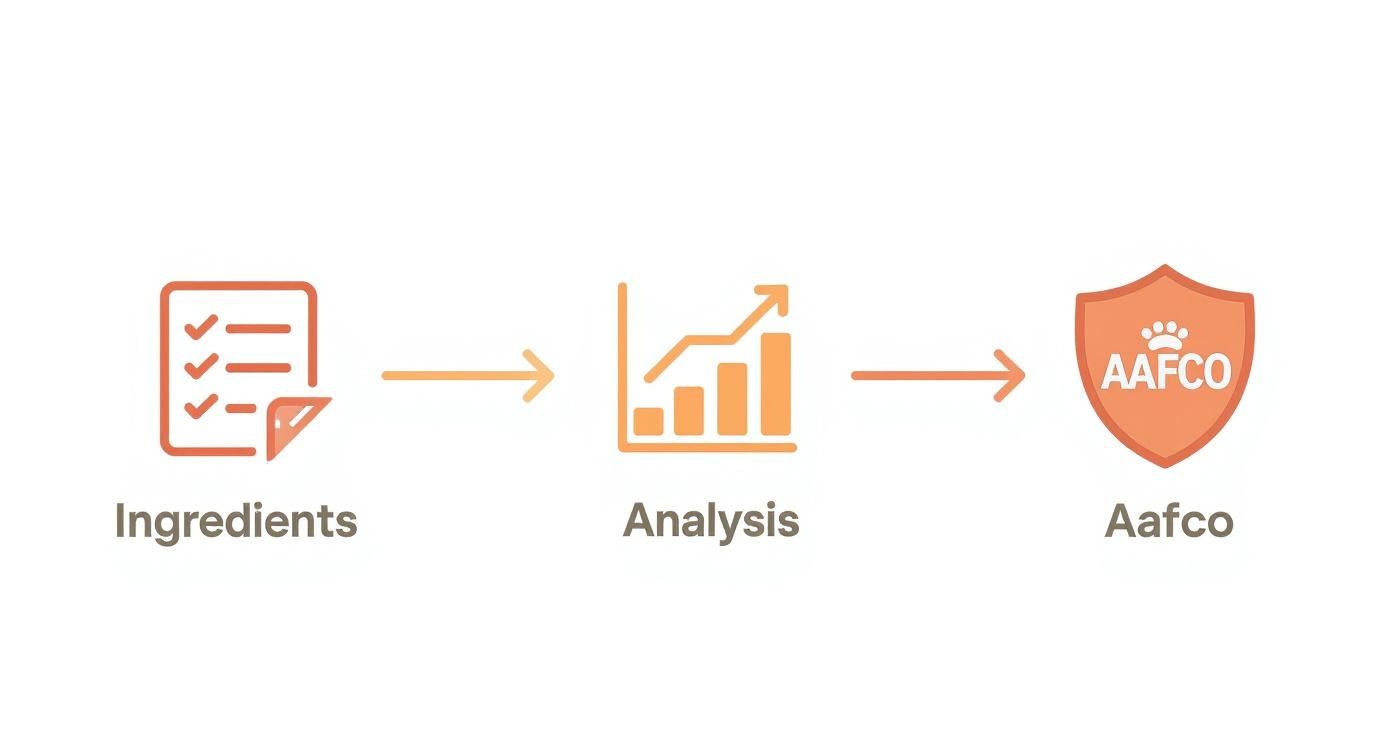
As you can see, once you've got a handle on the ingredients, you can move on to the guaranteed analysis and the AAFCO statement with confidence.
Good vs. Questionable Ingredients At a Glance
Feeling overwhelmed? It gets easier with practice. This little table breaks down some of the most common green flags and red flags you'll encounter on a label.
| What to Look For (Green Flags) | What to Be Cautious Of (Red Flags) |
|---|---|
| Named meats (Chicken, Beef, Salmon) | Vague terms ("Meat," "Animal," "Poultry") |
| Named meat meals (Chicken Meal, Lamb Meal) | Unnamed by-products (Meat and Bone Meal, Animal Digest) |
| Whole grains & veggies (Brown Rice, Sweet Potatoes, Peas) | Cheap fillers (Corn Gluten Meal, Wheat Gluten, Soy) |
| Whole organ meats (Beef Heart, Chicken Liver) | Artificial colors (Red 40, Yellow 5, Blue 2) |
| Natural preservatives (Mixed Tocopherols, Rosemary Extract) | Chemical preservatives (BHA, BHT, Ethoxyquin) |
| Chelated minerals (Zinc Proteinate, Iron Proteinate) | Generic, non-specific ingredients ("Animal Fat" vs. "Chicken Fat") |
Think of this as a quick reference guide. The more you see from the "Green Flags" column at the top of the list, the better.
Understanding Carbohydrates and Fillers
After you’ve sized up the protein, take a look at the carbohydrate sources. Carbs aren't the enemy! Wholesome ingredients like sweet potatoes, brown rice, or oatmeal provide essential energy and fiber.
The problem arises when cheap fillers like corn, wheat gluten, or soy crowd the top of the list. That's often a sign that the brand is skimping on quality animal protein to cut costs.
Keep an eye out for a clever trick called ingredient splitting. This is where a manufacturer lists a single, lower-quality ingredient in several different forms—like "pea protein," "pea fiber," and "yellow peas"—to make each one appear further down the list. If you see multiple variations of the same ingredient, mentally add them together. They probably make up a much bigger piece of the nutritional pie than it seems.
Key Takeaway: A high-quality dog food will have a named meat source as its first ingredient, followed by other whole foods. If the first ingredient is corn or a meat by-product, it's a sign to look for a better option.
Pet owners are getting savvier about this. In a 2023 survey, 88% of dog owners said transparent labeling was important, and 48% specifically wanted more detail about the ingredients. We're all demanding better, and brands are starting to listen.
Making Sense of the Guaranteed Analysis
Alright, once you've scanned the ingredients list, the next stop is the Guaranteed Analysis. This is the small box of percentages that gives you a peek into the food's nutritional nuts and bolts. But here's the thing: it’s not as straightforward as it looks.
This section shows the minimum or maximum levels of key nutrients, not the exact amounts. Think of it like a promise. If a label guarantees a minimum of 25% crude protein, it just means the food won't ever dip below that number. It could easily have 26%, 28%, or more. Understanding this little detail is a huge step in learning how to read a dog food label like a pro.
What Do These Terms Mean?
The word "crude" sounds a little weird, but it just refers to the scientific method used to estimate the nutrient content. It's a lab term, but for our purposes, here’s what each one really means for your dog:
- Crude Protein (Minimum %): This is the total protein in the food—essential for building muscle, repairing tissue, and keeping your dog healthy. Remember, quality and source matter just as much as the percentage.
- Crude Fat (Minimum %): Fat is pure energy. It's also vital for absorbing certain vitamins and is the secret to a healthy, shiny coat.
- Crude Fiber (Maximum %): This is the indigestible plant matter that keeps things moving. The right amount of fiber is non-negotiable for good digestion. We actually have a whole guide on the benefits of fiber for canine digestion if you want to get into the weeds.
- Moisture (Maximum %): Simply put, this is the water content. Dry kibble usually hovers around 10% moisture, but canned food can shoot up to 78% or even higher.
The Secret to Accurate Comparisons
Trying to compare the Guaranteed Analysis of a dry food to a wet food is like comparing apples and oranges—that massive difference in moisture content throws everything off. To get a true, apples-to-apples comparison, you have to calculate the nutrients on a dry matter basis (DMB).
It sounds complicated, but I promise it's easy. Here's my go-to two-step method:
- Find the Dry Matter: Subtract the moisture percentage from 100%. If a kibble has 10% moisture, its dry matter is 90%.
- Calculate the True Protein Level: Divide the crude protein percentage by the dry matter percentage, then multiply by 100.
Let’s use that kibble with 25% crude protein. The math looks like this: (25% Protein / 90% Dry Matter) x 100 = 27.8% protein on a DMB.
This little bit of math is your secret weapon. By stripping out the water, you see the real concentration of nutrients. It’s the only way to genuinely compare different kinds of dog food and make sure you’re picking the best option for your pup.
Once you know this trick, you can look past the surface-level numbers and see what you're really feeding your dog. While a high-quality kibble is a fantastic foundation, sprinkling on a supplement like ChowPow is a great way to boost that protein content even further and add back some of the key nutrients that high-heat processing can diminish.
What the AAFCO Statement Actually Means
When you spot the letters "AAFCO" on a dog food bag, it’s easy to feel a sense of relief. It looks like an official seal of approval, right? Well, it’s important to know what that statement is—and isn't—guaranteeing.
The Association of American Feed Control Officials (AAFCO) doesn't actually approve, certify, or endorse any specific dog food. Instead, it’s the organization that sets the nutritional standards that pet food companies are supposed to follow.
Think of AAFCO as the group that writes the rulebook for canine nutrition. They create the profiles that define a "complete and balanced" meal for dogs at different points in their lives. So, when a bag of kibble has an AAFCO statement, the manufacturer is simply stating that they followed those rules when making the food.
In the U.S., pet food labeling is a tricky web of regulations. The FDA handles federal laws, but most states have adopted AAFCO's model guidelines, which creates the industry framework we have today. This mix of federal and state oversight can sometimes lead to inconsistencies, which is why it helps to learn more about the specifics of pet food regulation and how it affects what you see on the shelf.
Formulated vs. Feeding Trials
Okay, this is where your label-reading skills really come into play. There are two very different AAFCO statements you might see, and one gives you a much higher level of confidence than the other.
-
"Formulated to meet the nutritional levels…": This statement means the dog food was made using a recipe that, on paper, should meet AAFCO's nutrient profiles. It's like building a car from a blueprint that looks great, but no one has actually taken it for a test drive.
-
"…animal feeding trials substantiate that [Product Name] provides complete and balanced nutrition…": This is the gold standard. It means the food was actually fed to real dogs under controlled conditions to prove it performs as expected. It confirms the nutrients are truly digestible and beneficial in the real world, not just in a spreadsheet.
Whenever possible, choosing a food that has gone through feeding trials gives you that extra peace of mind that the nutrition is proven, not just theoretical.
Matching Food to Your Dog's Life Stage
The AAFCO statement will also tell you which life stage the food is for. This is a big deal, because a puppy's nutritional demands are totally different from a senior dog's.
Keep an eye out for these terms:
- Growth/All Life Stages: This food is packed with the higher calories and nutrients needed for growing puppies. It can also be fed to adult dogs, but you'll likely need to adjust the portion size down to prevent weight gain.
- Adult Maintenance: This formula is specifically for adult dogs who have finished growing. It provides the right balance of nutrients to keep them healthy without the extra calories that could lead to packing on pounds.
By looking for an AAFCO statement that confirms "animal feeding trials" and matches your dog's life stage—either "Growth" or "Adult Maintenance"—you're making sure their kibble has a verified, age-appropriate nutritional foundation. From there, a supplement like ChowPow can be added to boost that solid base with extra high-quality protein and key nutrients.
Calories and Feeding Guidelines: More Art Than Science
Once you’ve deciphered the ingredients list and guaranteed analysis, it’s time to get practical. The calorie count and feeding guidelines are where the rubber meets the road, translating all that nutritional data into the right portion size for your dog. Getting this right is crucial for keeping them at a healthy weight.
Most labels list calories in two ways: "kilocalories per kilogram" (kcal/kg) and "kilocalories per cup" (kcal/cup). The kcal/cup figure is your go-to number for daily feeding since it tells you exactly how much energy is in the scoop you're using. Don't skip this step! A calorie-dense food might look like you're feeding less, but it packs a bigger punch, making it easy to overfeed by accident.
Why the Feeding Chart Is Just a Starting Point
Every bag of dog food has a feeding chart that gives you a daily portion suggestion based on weight. Think of this as a ballpark estimate, not a hard-and-fast rule.
The guidelines on the bag are designed for a hypothetical "average" dog. But let's be honest—your dog is anything but average.
Your dog's real-world needs are shaped by a ton of unique factors, including:
- Activity Level: A tireless Border Collie on a farm needs way more fuel than a senior Pug who has perfected the art of the nap.
- Age: Growing puppies and nursing moms have massive energy requirements compared to adult or senior dogs.
- Metabolism: Just like us, some dogs are born with a faster metabolic engine than others.
- Breed: Some breeds are just more prone to packing on the pounds and might need a lighter hand with the scoop than the chart suggests.
My advice? Start with the recommended amount on the bag, but then watch your dog, not the chart. You can easily check their body condition at home. If they're starting to look a little "fluffy," dial back the portion a bit. If you can see too much of their ribs, you can add a little more. This hands-on, observant approach is truly the best way to land on the perfect portion for your pup.
The Finishing Touches: Freshness and Supplements
Before you walk away from the label, find the "Best By" or "Use By" date. This isn't just a suggestion; it’s a guarantee of freshness and nutritional potency. Over time, fats can go rancid and important vitamins can degrade, leaving the food less nutritious and potentially full of mold or bacteria.
Once you’ve picked a high-quality kibble with the right calorie count, why not make it even better? A meal enhancement like ChowPow is a fantastic way to boost the nutritional value of their meal without piling on a bunch of extra calories. It's not a replacement for their main meal, but a supplement that adds a concentrated punch of top-notch protein and nutrients. For picky eaters or dogs needing extra support, it can make their meal both healthier and a whole lot more exciting.
Boosting Your Dog's Bowl with ChowPow
So, you've done your homework. You've become a pro at decoding dog food labels and have finally landed on a fantastic kibble for your pup. You might be wondering, "What's next?" This is where you can take a good meal and make it truly great. A meal enhancement like ChowPow is the perfect finishing touch, elevating your dog’s nutrition far beyond what's in the bag.
It's really important to know that ChowPow is not a replacement for your dog's regular food. Think of it as a powerful nutritional supplement designed to work with their kibble, boosting the nutritional value of it by adding a concentrated shot of high-quality protein and other vital nutrients to their daily diet.
Why Even Good Kibble Needs a Boost
Here's something many pet owners don't realize: even the highest-quality kibble goes through intense, high-heat processing. While this makes the food shelf-stable, it can unfortunately degrade some of the more delicate vitamins and nutrients. ChowPow was created specifically to add back what that processing takes out, making sure every single bowl is as nutritionally complete as possible.
This makes it an incredibly useful supplement for almost any dog owner. It’s a perfect solution for a whole range of common situations:
- Tempting the Pickiest Eaters: A simple sprinkle of ChowPow adds an aroma and flavor that’s hard for any dog to resist. It’s often the secret weapon to get a fussy dog to finally clean their bowl.
- Supporting Active Pups: For dogs who love to run, hike, and play, that extra protein is gold. It helps them repair muscle tissue and recover faster after a big day of adventure.
- Nourishing Senior Dogs: It gives older companions an easy-to-digest source of nutrition while providing much-needed support for their joints and immune system.
Think of a high-quality kibble as the solid foundation of your dog’s diet. Adding a meal enhancer like ChowPow is the final, perfecting touch that completes the structure, ensuring it's as strong and supportive as possible.
ChowPow really just bridges the gap between good nutrition and optimal nutrition, making every meal work harder for your dog's health. Once you learn how to pair a solid kibble with the right enhancements, you can truly customize their diet for their specific needs. To see just how easy it is to work into your routine, you can check out our full line of dehydrated dog food toppers. It's the simplest way to give your dog that extra edge.
Still Puzzling Over the Pet Food Aisle?
Even after you've got the basics down, a couple of tricky questions always seem to pop up right when you’re trying to make a decision. Let's clear those up so you can feel 100% confident in what you’re putting in that shopping cart.
What's the Real Difference Between 'Chicken' and 'Chicken Meal'?
This one trips up a lot of people. When you see 'chicken' on an ingredient list, you're looking at fresh chicken. The catch? Fresh chicken is mostly water, and a lot of that water weight is lost during the cooking process.
On the other hand, 'chicken meal' is chicken that has already been cooked down (a process called rendering) to remove the water. This leaves behind a super-concentrated protein powder. So, a food that lists chicken meal near the top often packs a more powerful protein punch than one that just lists fresh chicken.
Is Grain-Free Always the Best Choice for My Dog?
Not really. This became a huge marketing trend, but the truth is, most dogs do just fine with grains. Unless your vet has specifically diagnosed your dog with a grain allergy or sensitivity, healthy whole grains like brown rice, oats, or barley can be a fantastic source of nutrients.
What really matters is the overall quality of the recipe, not just whether it contains grains or not.
Finding that perfect kibble is a great first step in building your dog’s health. But even the best kibbles lose some nutritional value during the high-heat cooking process.
To add some of that goodness back and make mealtime exciting, try a scoop of ChowPow. It’s the easiest way to boost their bowl with high-quality protein and a flavor they’ll go nuts for. You can learn more over at https://chowpownow.com.
-
Product on sale
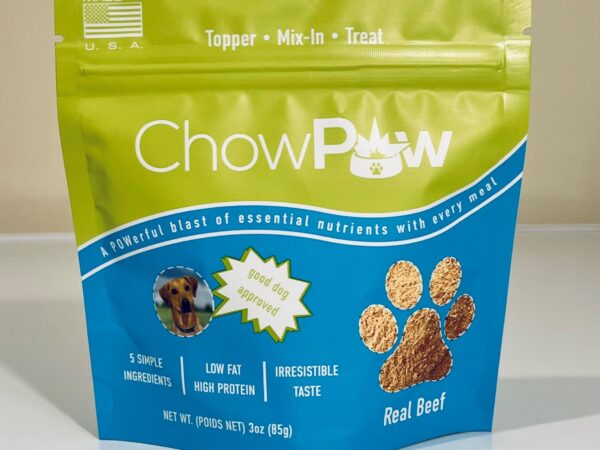 Dog Food Topper - Beef HeartOriginal price was: $14.99.$10.95Current price is: $10.95. - or subscribe and save up to 20%