
Bowel Obstruction Dog: A Complete Owner’s Guide
If you're reading this because your dog vomited after dinner, won't settle down, or just looked at food and walked away, I want you to know two things right away. First, you're not overreacting by being concerned. Second, a bowel obstruction dog situation can turn serious fast, so clear action matters more than guessing.
I talk to worried owners about this all the time. Many expect a blockage to look dramatic from the start. Sometimes it does. Sometimes it begins with vague signs like skipping a meal, acting tired, or vomiting once and then seeming a little better. That uncertainty is what makes intestinal obstruction so stressful.
The good news is that prompt veterinary care gives many dogs an excellent chance. The harder part comes after the emergency, when your dog is home, sore, tired, and not very interested in eating. That recovery phase deserves much more attention than it usually gets.
What Is a Canine Bowel Obstruction
Think of your dog's intestines like a long, flexible tube that moves food, water, and digestive contents forward. When something blocks that tube, the system can't do its job. Material backs up behind the blockage, fluid builds, pressure rises, and the bowel wall starts to suffer.
A partial obstruction means some material can still squeeze past. A complete obstruction means nothing meaningful is moving through. Both are dangerous, but a complete blockage is a true emergency because the intestine can lose blood supply and begin to die.
What happens inside the body
Once the bowel is obstructed, the problem isn't just "something is stuck." The whole surrounding tissue reacts. The bowel stretches, pressure inside the intestine increases, and bacteria multiply in ways they shouldn't.
According to Southwest Florida Veterinary Specialists, bowel obstructions can trigger bowel distension, increased pressure, and bacterial overgrowth that may lead to endotoxin translocation and systemic inflammatory response syndrome. The same source notes that necrosis can develop within 12 to 24 hours of complete occlusion, and mortality approaches 100% in 3 to 7 days without intervention.
That timeline is why veterinarians don't treat this like an upset stomach.
Practical rule: If your dog might have swallowed something and is vomiting, painful, or refusing food, assume the clock is already running.
Partial blockage versus complete blockage
Owners often ask whether a dog can still poop with a blockage. Sometimes, yes. A dog with a partial obstruction may still pass small amounts of stool or diarrhea. That doesn't rule out a serious problem.
A complete obstruction usually causes more obvious decline, but even then, the signs can vary depending on where the blockage sits and how long it's been there.
A simple way to understand this is:
| Type | What it means | What you may notice |
|---|---|---|
| Partial obstruction | Some fluid or material still passes | Intermittent vomiting, reduced appetite, discomfort, abnormal stool |
| Complete obstruction | The intestinal passage is effectively closed | Repeated vomiting, worsening pain, collapse, fast decline |
Why this becomes life threatening
The intestine isn't just a pipe. It's living tissue with a blood supply. If pressure cuts off circulation, the bowel wall weakens. Once that wall dies or tears, intestinal contents leak into the abdomen, and infection can spread rapidly.
That is why obstruction is one of those conditions where "let's see how tomorrow goes" can be a dangerous plan. If your dog has one, what you do in the first stretch of time can change the outcome.
Common Causes of Intestinal Blockages in Dogs
A common association is a dog swallowing a random object, and that's often correct. Dogs are curious, fast, and not always selective. I've seen blockages caused by items owners never imagined their dog would eat.
Foreign objects are the most common culprit
The classic causes are things that don't digest well and don't move easily through the intestines. Examples include socks, toys, rawhides, bones, rocks, and other household items. Some get stuck in the stomach first. Others pass into the intestines and lodge there.
Linear objects deserve special attention. String, rope, yarn, and similar materials don't just block the bowel like a cork. They can anchor and pull in a way that makes the intestines bunch or pleat, which is much more damaging than many owners realize.
If your dog is a chewer, choose treats and toys carefully. Bones are a common concern for owners trying to offer long-lasting chews, and it's worth reviewing whether bones are bad for dogs before making them part of your routine.
Some dogs are more likely to get into trouble
Young dogs are at high risk because they explore with their mouths. They don't stop to consider whether an object is edible. Puppies and adolescent dogs are especially famous for swallowing things whole.
Behavior matters too. Dogs with pica, scavenging habits, or intense food drive may be more likely to ingest non-food items. In a busy home, that risk rises when laundry, kids' toys, trash, or craft supplies are easy to reach.
A blockage doesn't require a "bad" owner or a reckless dog. It often happens in ordinary homes during ordinary moments.
Older dogs can have very different causes
In senior dogs, not every obstruction comes from something swallowed. PetMD's overview of intestinal blockage in dogs notes that bowel obstructions in older dogs are often linked to intestinal strictures, adhesions from prior surgery, intussusception, hernias, or tumors, and that tumors account for 15 to 20% of geriatric GI malignancies.
That matters because owners of older dogs sometimes dismiss signs of obstruction if they know their dog didn't eat a sock or toy. But a bowel can narrow or fold in on itself for reasons that have nothing to do with household objects.
A quick comparison of common causes
| Cause | More common in | Why it's dangerous |
|---|---|---|
| Swallowed foreign body | Puppies and younger dogs | Gets lodged and blocks normal flow |
| Linear object like string or rope | Curious chewers | Can bunch the intestines and cause more damage |
| Stricture or scar tissue | Dogs with prior inflammation or surgery | Narrows the intestinal passage |
| Intussusception | Can occur in different ages | One section of bowel telescopes into another |
| Tumor or mass | Senior dogs | Physically narrows or blocks the bowel |
Recognizing the Warning Signs of an Obstruction
A blockage rarely announces itself in one perfect, obvious way. Most owners notice a cluster of changes. The key is to watch the pattern, not just one symptom in isolation.

The signs owners notice first
The most common early change is vomiting, especially after eating or drinking. Some dogs vomit repeatedly. Others retch, bring up foam, or seem nauseated without producing much.
The next major clue is loss of appetite. A dog who normally runs to the bowl and suddenly turns away is telling you something important. Obstruction isn't the only cause of poor appetite, but it belongs on the list of serious possibilities.
Symptoms worth taking seriously
Look for these signs together rather than one by one:
- Repeated vomiting. Not just one isolated episode, but vomiting that keeps happening or returns after food or water.
- Refusing meals or treats. Dogs with abdominal pain often stop acting interested in food.
- Low energy. Your dog may seem withdrawn, weak, or much less interactive than usual.
- Abdominal pain. Some dogs tense up when touched, cry out when picked up, or assume a stretched "prayer" posture with front legs down and rear end up.
- Changes in stool. Some dogs strain, pass very little, or stop having normal bowel movements. Others may have diarrhea and still have an obstruction.
- Signs of dehydration. Dry gums, sunken eyes, or unusual weakness can appear as vomiting continues. If you're unsure what that looks like, this guide to signs of dehydration in dogs can help you recognize the basics.
The less obvious behavior changes
Some dogs don't cry or collapse. They pace, hide, pant, or can't get comfortable. Owners often describe this as "he just isn't acting like himself." Trust that observation.
A dog in GI pain may also become clingy or, just as often, want to be left alone. Neither response is reassuring.
This short video gives a useful visual overview of what obstruction can look like in real life.
If your dog may have swallowed something and now has vomiting plus appetite loss, that's enough reason to call a veterinarian. You do not need to wait for every symptom on the list.
What to Do if You Suspect an Obstruction
If you think your dog may have a blockage, act like it's urgent, because it is. Fast, calm decisions help more than home remedies.

What you should do right away
Start with the phone. Call your regular veterinarian or the nearest emergency clinic and tell them what happened, what your dog may have swallowed, and what symptoms you're seeing.
Pacific Santa Cruz Veterinary Hospital notes that dogs with complete blockages will typically die within 3 to 4 days without treatment, because the intestine can rupture and lead to fatal septic peritonitis. That same source emphasizes that immediate intervention is essential for a high survival rate.
Here is the approach I want owners to follow:
- Call immediately. Don't wait for the next vomiting episode.
- Remove access to possible problem items. If there are missing socks, toys, bones, or string, gather that information.
- Monitor but don't delay. Keep note of vomiting, stool, appetite, and energy while preparing to leave.
- Get transportation ready. Bring another person if possible, especially if your dog is painful or weak.
What not to do at home
This part matters just as much.
- Don't induce vomiting unless a veterinarian specifically tells you to. Sharp objects, strings, or caustic materials can cause more harm on the way back up.
- Don't give human medications. Pain relievers, laxatives, or anti-nausea products can complicate the case and may be toxic.
- Don't offer a "test meal." Owners sometimes try chicken, rice, treats, or canned food to see whether the dog will keep it down. That's not a safe diagnostic method.
- Don't pull visible string from the mouth or rear end. Linear foreign bodies can be anchored internally, and pulling may tear tissue.
Information to bring to the vet
The more specific you are, the more useful your history becomes. Tell the clinic:
| Helpful detail | Why it matters |
|---|---|
| What your dog may have swallowed | Material type affects risk and treatment choices |
| When symptoms started | Duration helps assess urgency and severity |
| Whether your dog has vomited, eaten, or passed stool | Shows how the gut is functioning |
| Any prior abdominal surgery | Scar tissue and adhesions can matter |
Call first, drive second: A quick phone call lets the clinic prepare for imaging, fluids, and surgery if needed.
How Vets Diagnose and Treat Blockages
When you arrive at the hospital, things can move quickly. That speed can feel overwhelming, but there is a clear logic behind it.

The first few steps at the clinic
A veterinarian usually starts with a physical exam. They're checking hydration, gum color, heart rate, abdominal pain, bloating, and overall stability. Some dogs arrive relatively bright. Others are already dehydrated, weak, or in shock.
Blood work often comes next. While it doesn't "prove" a blockage by itself, it helps your team assess dehydration, electrolyte changes, and whether the body is already under significant stress.
Imaging is often what confirms the suspicion. X-rays may show gas patterns, distended bowel loops, or obvious foreign material. Ultrasound can help identify fluid-filled intestines, abnormal movement, thickened bowel, or an object that doesn't show well on radiographs.
Treatment depends on what the vet finds
Not every blockage is treated exactly the same way. A dog with a possible partial obstruction, stable condition, and no sign of tissue damage may start with hospitalization, intravenous fluids, symptom control, and close monitoring.
Other dogs need a procedure quickly. If the object is in the stomach or upper GI tract, endoscopic retrieval may be possible in some cases. If the object is farther along, or if there is concern about compromised bowel, surgery is often the safest route.
Here is a simple comparison:
| Approach | When it may be used | What it involves |
|---|---|---|
| Medical management | Selected partial obstructions or uncertain cases under close supervision | Fluids, anti-nausea care, monitoring, repeat imaging |
| Endoscopy | Some objects in the stomach or upper GI tract | Scope-based retrieval without opening the abdomen |
| Surgery | Complete obstruction, worsening condition, or bowel damage concern | Removal of the object, and sometimes bowel repair |
What surgery may involve
The procedure depends on what the surgeon finds. Sometimes the surgeon can remove the object through a small incision into the intestine. In more severe cases, damaged intestine must be removed and the healthy ends reconnected.
The amount of bowel injury matters. So does the type of object.
A retrospective study of 208 consecutive cases over 48 months reported in PubMed found 94% survival for dogs with discrete foreign bodies and 80% survival for dogs with linear foreign bodies like string. The study also found that prompt presentation, diagnosis, and surgical intervention improved outcomes.
That doesn't mean surgery is hopeless if your dog swallowed string. It means string is more dangerous, and delay makes the situation harder.
Questions to ask your veterinary team
When owners are anxious, they often forget what to ask. Focus on these:
- Is this likely partial or complete?
- Is the object in the stomach or intestines?
- Do you see signs the bowel wall may be compromised?
- Does my dog need surgery now, or are you monitoring first?
- What should I expect in the first few days after treatment?
The goal isn't to become your dog's surgeon overnight. It's to understand the decision in front of you and why your veterinarian is making it.
The Road to Recovery After a Bowel Obstruction
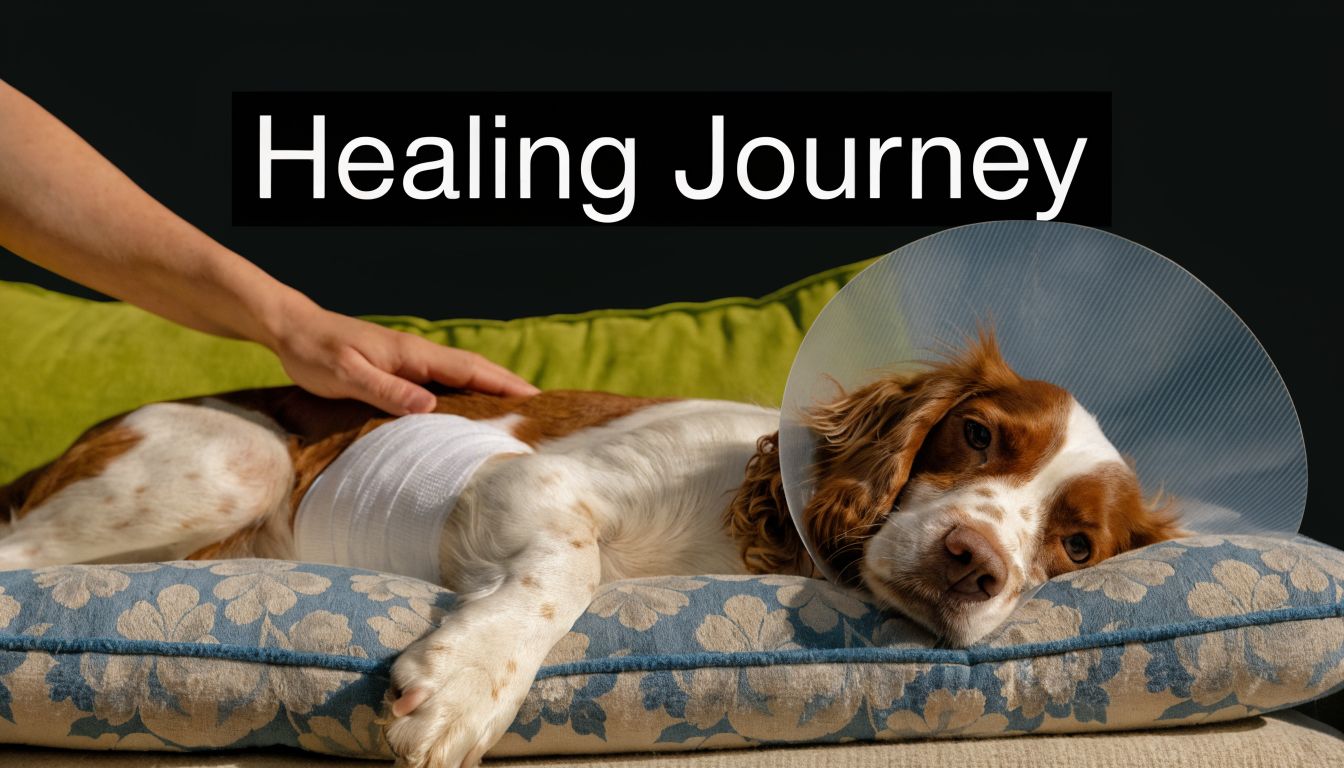
The emergency may be over when your dog comes home, but recovery is still active medical care. This is the stage where many owners feel relieved and then suddenly unsure. Their dog is quieter than usual, sleeping more, wearing a cone, and not eating with much enthusiasm.
What normal early recovery can look like
Most dogs need rest, pain control, and restricted activity. They may be groggy the first day home. Their abdomen can be tender, and their interest in food may be inconsistent for a short time.
If your dog had abdominal surgery, your veterinarian will usually want:
- Strict activity restriction so the incision and internal tissues can heal
- An e-collar or cone to prevent licking
- Medication given exactly as directed
- Close monitoring of the incision for swelling, discharge, redness, or opening
- A feeding plan with small, controlled meals rather than a sudden return to normal portions
For a fuller home-care checklist, this guide to post-surgery care for dogs is a helpful companion.
Appetite loss is common, and very frustrating
Many families struggle. They expect their dog to feel better immediately once the object is gone. Sometimes that happens. Often it doesn't.
The stomach and intestines may still be inflamed. Nausea can linger. Pain medication, stress, hospitalization, and the surgery itself can all suppress appetite. A dog may sniff food, lick once, and walk away. That behavior is upsetting, but it isn't unusual.
According to Cornell's canine health resource on gastrointestinal foreign body obstruction in dogs, 10 to 20% of dogs experience anorexia after GI surgery, and nutrient-dense, palatable toppers can boost intake by 30 to 50%, helping with weight regain and reducing the need for additional nutritional support.
What to feed during recovery
Your own veterinarian's discharge instructions come first. In general, post-obstruction diets are chosen for two reasons. They need to be gentle on the healing gut, and they need to be appealing enough that the dog will eat them.
That usually means:
| Feeding goal | What it looks like at home |
|---|---|
| Easy digestion | Small meals, bland or prescribed recovery food |
| Appetite stimulation | Warmed food, stronger aroma, hand feeding if advised |
| Adequate hydration | Water available at all times, or added moisture if your vet approves |
| Nutrient density | Enough protein and calories in a manageable volume |
A dog recovering from intestinal surgery often does better with food that smells inviting and doesn't require a large portion to deliver meaningful nutrition. That's especially true for picky eaters, seniors, and dogs who already had marginal appetite before the blockage happened.
Practical ways to help a reluctant eater
When owners hear "just get him to eat," they often feel stuck. Here are safer, more realistic approaches to discuss with your veterinarian:
- Serve small amounts more often. A full bowl can feel overwhelming to a nauseated dog.
- Warm food slightly. Aroma matters. Mild warming can make food more enticing.
- Keep meals calm and brief. Recovery dogs tire easily and may stop eating if the environment is noisy.
- Use approved meal enhancers. A topper can improve smell, flavor, and interest without replacing the dog's main diet.
- Add moisture if your veterinarian agrees. Some dogs will lick a softened meal more readily than they will chew dry food.
Recovery nutrition isn't about spoiling your dog. It's about reducing the gap between what the body needs and what the dog is willing to eat.
When poor appetite becomes a reason to call back
A dog who eats less than usual for a short period may still be recovering normally. A dog who won't eat at all, vomits after meals, seems increasingly painful, or becomes weak needs reassessment.
Call your veterinarian sooner rather than later if you see:
- Repeated vomiting after coming home
- A swollen, red, or leaking incision
- Marked lethargy or collapse
- Persistent refusal of food or water
- Straining, crying, or obvious abdominal pain
- Any sudden setback after initial improvement
The emotional side of recovery
Owners often blame themselves during this stage. They think, "If I had caught it sooner," or "I shouldn't have left that item out." That guilt is common, but it doesn't help your dog heal.
What helps is routine. Give medications on schedule, feed as instructed, watch the incision, and keep activity low even if your dog starts acting more normal. Internal healing takes longer than outward behavior suggests.
The dogs who do best after an obstruction usually have owners who stay observant, patient, and willing to call with questions.
Preventing Future Blockages and Supporting Digestion
Once you've been through one obstruction scare, your home starts to look different. Laundry piles, chew toys, trash cans, bath mats, rope toys, and leftovers all become potential hazards. That's not paranoia. That's awareness.
Dog-proof the environment your dog actually lives in
Prevention works best when it's practical. Don't just think about what your dog "shouldn't" eat. Think about what your dog can reach during a bored, unsupervised, or chaotic moment.
Focus on these areas:
- Floor-level risks. Socks, underwear, kids' toys, hair ties, and craft supplies should never stay in reach.
- Kitchen and trash access. Use secure bins and don't leave food waste where a determined dog can investigate.
- Chew selection. Skip items that splinter, shred easily, or break into large swallowable pieces.
- Yard checks. Sticks, stones, corn cobs, and discarded debris can all become problems outdoors.
If your dog spends time outside without direct supervision, a secure setup reduces access to random debris and unsafe items. Owners comparing containment options may find this guide to best outdoor dog kennels useful when planning a safer outdoor space.
Train for interruption, not perfection
Training helps, but management matters more. A strong "leave it" cue is valuable. So is teaching your dog to trade objects willingly instead of running off to gulp them down.
Some dogs are repeat swallowers. Those dogs need tighter environmental control, not just better intentions. If your dog has already had one foreign body episode, assume the habit could happen again.
Support digestion every day
Good digestive support won't prevent a dog from swallowing a sock. It can, however, help maintain steadier appetite, consistent eating habits, and better overall resilience.
A few habits make a difference:
| Habit | Why it helps |
|---|---|
| Consistent feeding routine | Makes appetite changes easier to notice quickly |
| Appropriate toy size and texture | Lowers the chance of pieces being swallowed |
| Supervised chewing | Lets you stop a problem before it becomes an emergency |
| Nutritious meal support | Helps picky dogs stay engaged with their regular food |
For many dogs, especially seniors, picky eaters, and dogs recovering from illness, the goal isn't replacing the base diet. It's making that existing meal more appealing and more supportive. A well-chosen topper can help owners improve palatability and encourage better intake while keeping kibble or the prescribed main food in place.
The best prevention plan is simple. Keep dangerous items out of reach, supervise what your dog chews, act quickly when something seems wrong, and make daily nutrition easy enough to maintain consistently.
If your dog is a picky eater, a senior with a sensitive appetite, or recovering from a health setback, ChowPow can help make regular meals more enticing without replacing your dog's current kibble. It's a dehydrated beef heart meal enhancer designed to boost flavor and nutritional value, so your dog gets more from the food already in the bowl.
-
Product on sale
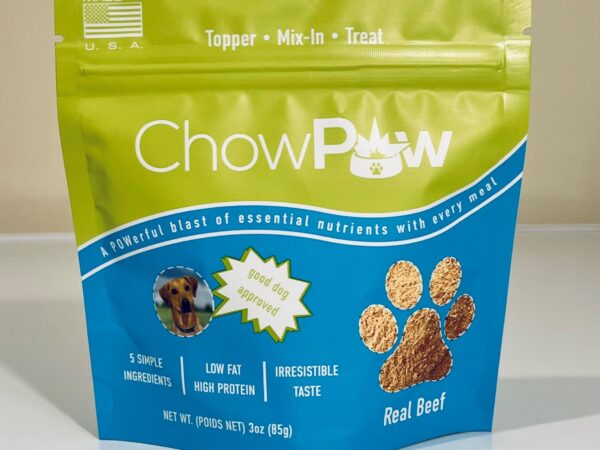 Dog Food Topper - Beef HeartOriginal price was: $14.99.$10.95Current price is: $10.95. - or subscribe and save up to 20%