
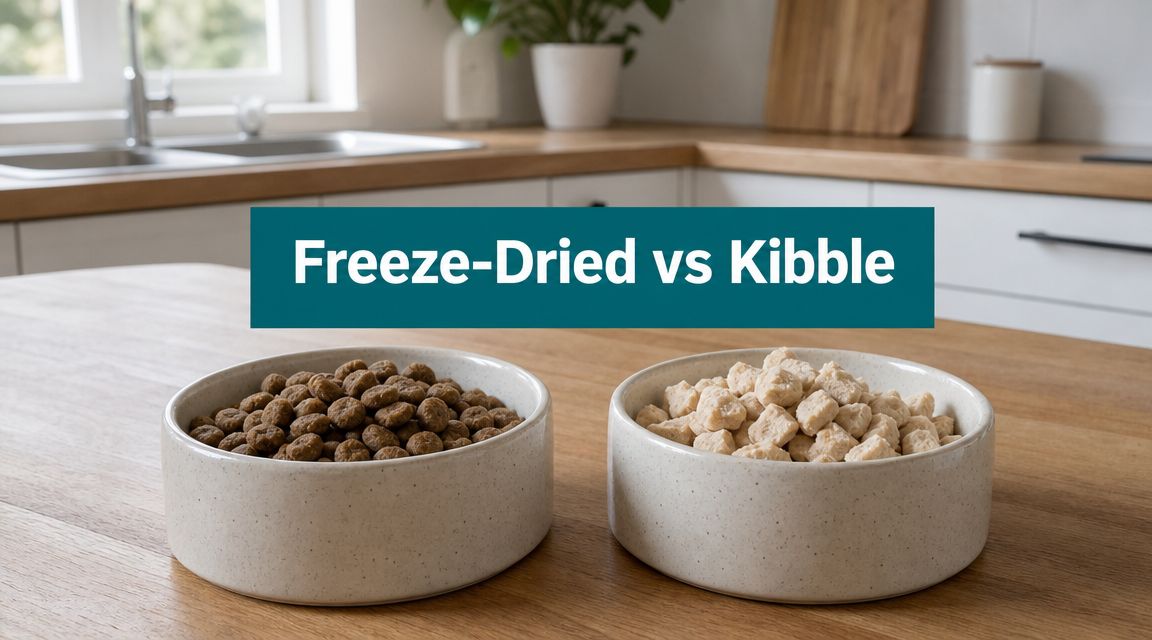
Freeze Dried Dog Food vs Kibble: An Honest Guide (2026)
You're standing in the pet food aisle, reading bag after bag, and every option seems to promise something different. One says “complete and balanced.” Another says “raw.” Another says “freeze-dried.” If your dog already eats kibble, it's easy to wonder whether you're missing something better.
That confusion makes sense. Kibble has been the standard for a long time because it's easy to store, simple to portion, and usually easier on the budget. Freeze-dried dog food has become a more visible premium option because it offers a raw-style format with less processing than kibble. Both have real advantages. Both have trade-offs.
Most dog owners don't need a dramatic food makeover. They need a clear way to think about freeze dried dog food vs kibble, and a practical way to improve what's already working.
Choosing Your Dog's Food in a Crowded Aisle
The first thing to know is that this isn't a battle with one obvious winner. It's a choice between two food formats built for different priorities.
Kibble is the familiar one. It's the everyday default in many homes because it's convenient, shelf-stable, and easy to serve. Freeze-dried food is different. It starts with raw ingredients, then has the water removed in a way that keeps the food shelf-stable while staying closer to its original state.
That difference matters because many owners aren't really asking, “Which food is best in theory?” They're asking a more honest question. What fits my dog, my budget, my routine, and my comfort level?
If you're sorting through labels and ingredient lists, it helps to zoom out first:
- If convenience matters most, kibble usually makes daily feeding easier.
- If ingredient integrity and aroma matter most, freeze-dried options often stand out.
- If your dog is picky, the decision may come down to what gets eaten without stress.
- If you want a balanced overview of broader feeding basics, this UK dog diet guide gives a useful plain-English refresher.
The best food is the one your dog does well on and you can use consistently.
A lot of the confusion comes from marketing language. “Raw,” “natural,” “premium,” and “whole food” can sound impressive, but they don't tell you the most important thing. The difference starts with how the food is made, because that affects nutrients, taste, cost, and handling.
How Kibble and Freeze-Dried Foods Are Made
The cleanest way to compare these two foods is to start at the factory, not the feeding bowl.
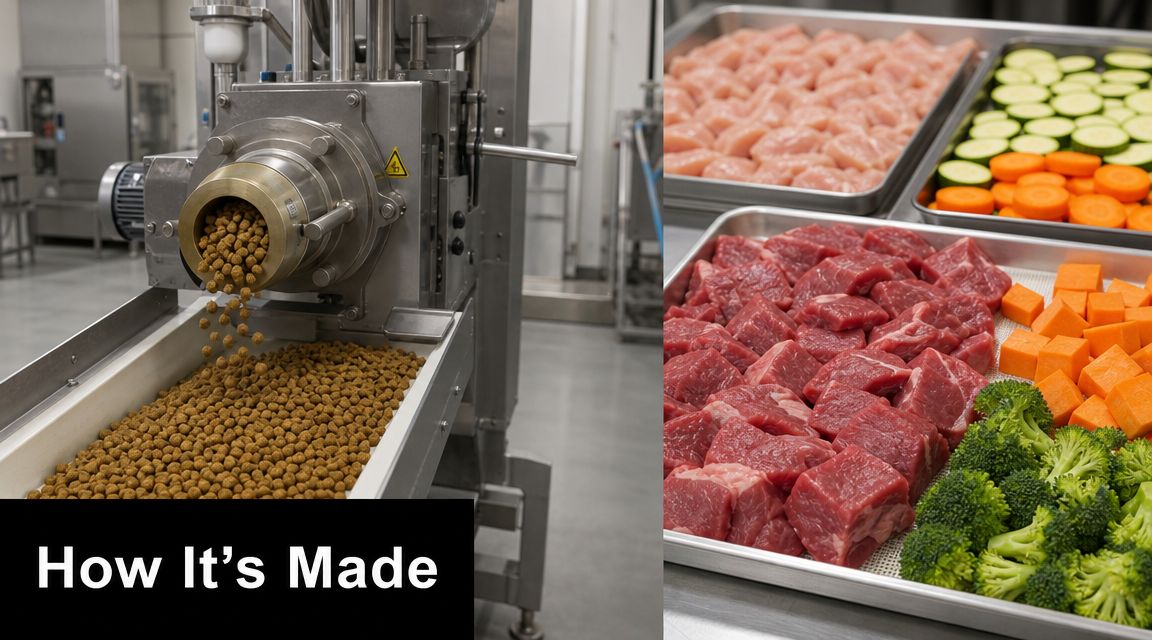
How kibble is produced
Kibble is usually made through high-heat cooking and extrusion. Ingredients are mixed, cooked, and pushed through machinery that forms the familiar dry pieces. That process is efficient and helps create a food that stores well and pours easily into a bowl.
The trade-off is heat. A major historical divide between freeze-dried dog food and kibble is processing intensity. Kibble's heat-heavy production can reduce nutrient quality, while freeze-dried foods are often described as retaining more vitamins, minerals, and proteins because they avoid that same level of heat exposure, according to this explanation of freeze-dried dog food vs kibble processing.
That doesn't make kibble “bad.” It means kibble is a more processed format, and that's part of why many formulas rely on supplementation to round out the finished nutrient profile.
How freeze-dried food is produced
Freeze-dried dog food starts with raw ingredients. Those ingredients are frozen, then the water is removed through sublimation in a vacuum chamber. In simple terms, the moisture is taken out without fully cooking the food.
That low-temperature approach is designed to preserve the food's original flavor, texture, and nutrient profile more effectively than high-heat methods. It also helps explain why freeze-dried foods often smell stronger and seem more exciting to dogs.
If you're trying to understand the category better, this guide to best freeze-dried dog food options is a helpful companion resource.
Why processing changes the final product
Most owners notice the difference first with their eyes and nose. Kibble looks dry, uniform, and engineered for easy serving. Freeze-dried food looks and smells closer to the original ingredients.
That one manufacturing difference shapes almost everything else:
- Taste and aroma often lean in freeze-dried food's favor.
- Storage and ease usually lean in kibble's favor.
- Price tends to rise with freeze-dried products because the process is more resource-intensive.
- Feeding style changes too, since freeze-dried food may be served dry or rehydrated.
Practical rule: If you want to understand any dog food format, ask how much heat and processing it went through before it reached the bag.
A Head-to-Head Comparison by Key Factors
Here's the quick version first.
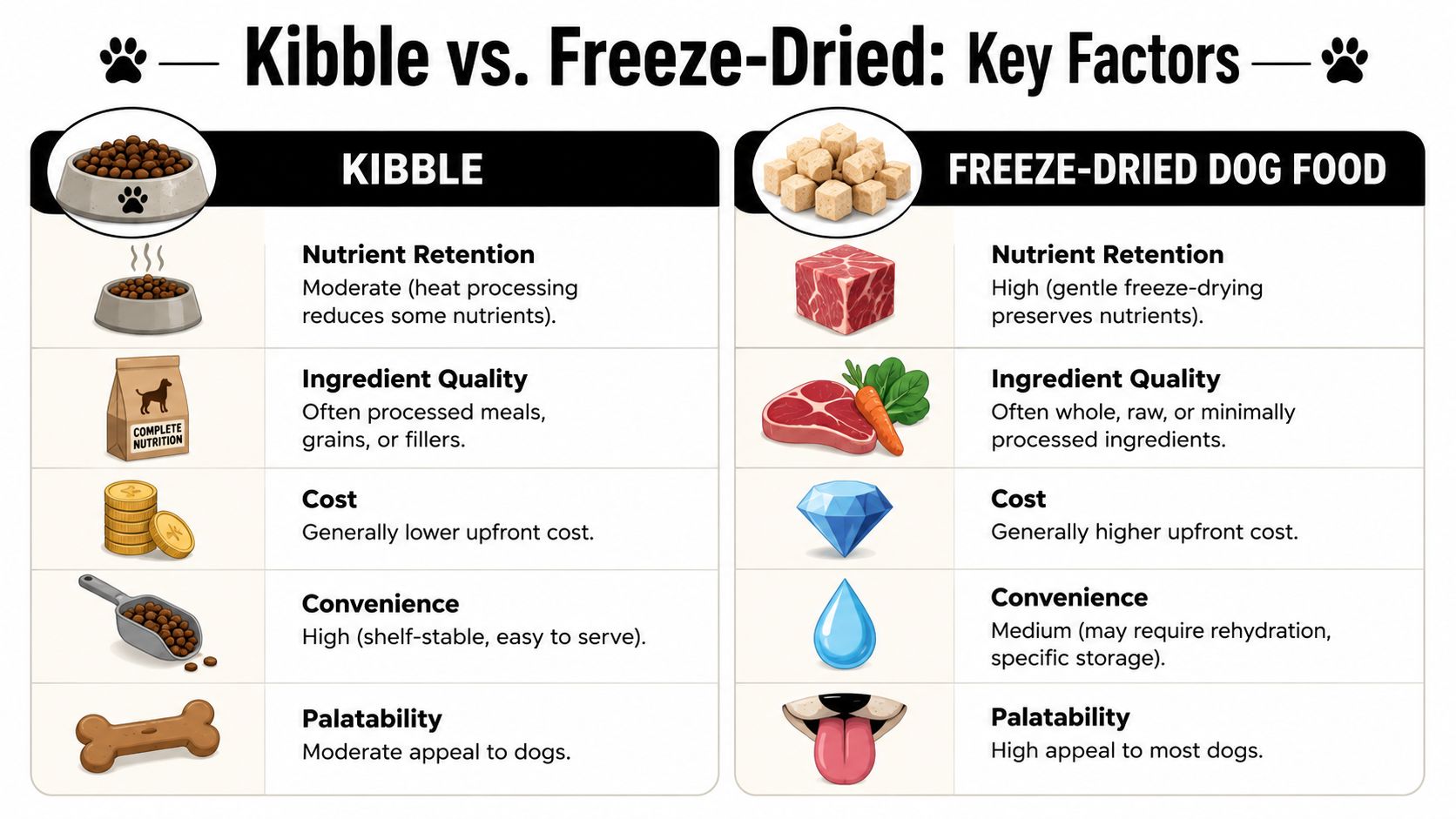
| Factor | Freeze-Dried Food | Kibble |
|---|---|---|
| Nutrient Retention | Generally better preserved because of low-temperature processing | Moderate, with some nutrients affected by high-heat processing |
| Digestibility | Reported among the highest in a recent academic trial | Lower overall in that same comparison of diet formats |
| Palatability | Often highly appealing because of aroma and raw-style texture | Moderate for many dogs |
| Cost | Usually more expensive per serving | Usually more budget-friendly |
| Safety and Use | Shelf-stable but still carries raw-style food safety considerations | Everyday convenience with lower handling concern for many households |
Nutrient retention and ingredient feel
Freeze-dried food usually wins this category in spirit and in design. Because it isn't fully cooked, it stays closer to the original raw ingredient. That's why owners often describe it as looking more “real.”
Kibble is built differently. Its strength is consistency and practicality, not minimal processing. For some owners, that's a perfectly reasonable trade.
Digestibility and stool quality
This is one area where the distinction gets more interesting. A recent academic trial found that dogs fed freeze-dried diets had among the highest apparent total tract nutrient digestibility values, while an extruded diet had the lowest digestibility values overall. The same source also notes that raw-style diets like freeze-dried food can still carry foodborne risks even after processing, as summarized in this freeze-dried vs kibble digestibility discussion.
A related point from the same source set is that research on raw meat-based diets versus kibble found firmer fecal consistency in the raw-fed group, with slightly better chronic enteropathy scoring as well. For owners, the practical takeaway is simple. Some dogs appear to digest less-processed diets very well, but that doesn't erase the handling and safety side of the equation.
For a related comparison of preserved food formats, this article on freeze-dried vs dehydrated dog food helps separate terms that often get mixed together.
A short video can also help make the differences more concrete.
Cost, convenience, and safety
Kibble usually holds its ground, being easier to buy, easier to store, and easier to feed as a complete daily staple. Freeze-dried food typically costs more per serving because freeze-drying is resource-intensive.
Safety is where readers often get tripped up. Freeze-dried is shelf-stable, but it is not the same thing as fully cooked. That matters more if you have a puppy, a senior dog, an immunocompromised dog, or a household where strict food handling matters.
- Choose kibble when your priority is dependable daily feeding with less fuss.
- Choose freeze-dried when your priority is palatability, ingredient integrity, or a raw-style approach.
- Pause and ask your vet when your dog falls into a higher-risk group or has a complex medical history.
Matching the Food to Your Dog's Needs
No chart can fully answer the question on its own because dogs don't live on charts. They live in real homes, with real habits, quirks, and limitations.

The easy eater in a busy household
Think of the dog who eats anything, finishes meals quickly, and does well on a routine. In that home, kibble often makes the most sense as the main diet. It's practical, easy to portion, and simple for everyone in the family to use correctly.
This is especially true when feeding needs to stay predictable. If three people in the household might handle meals, a straightforward food format reduces mistakes.
The picky senior or soft-appetite dog
Now picture the older dog who strolls to the bowl, sniffs, and walks away unless something smells especially appealing. In these situations, freeze-dried foods often get attention. They can be served dry or rehydrated, and the stronger aroma may help spark interest.
For dogs with reduced appetite, texture can matter almost as much as nutrition. Rehydrated freeze-dried food can feel gentler and more inviting than a bowl of plain dry kibble.
Some dogs don't need a new diet category. They need a meal that smells worth eating.
The owner drawn to raw-style feeding
Some owners prioritize keeping food closer to whole ingredients and avoiding heavier processing where possible. Freeze-dried food lines up well with that preference because it's a minimally processed raw-format diet.
That said, this group still has to think about practical details. Storage may be easy, but handling and household hygiene still matter. Convenience doesn't disappear, it just shifts.
The budget-conscious dog parent who still wants better meals
This is probably the most common situation. The dog does fine on kibble, but the owner wants more excitement, better ingredient variety, or a nutritional lift without a complete switch.
That person usually isn't looking for a food identity. They're looking for a workable routine.
- If your dog eats well and thrives on kibble, there may be no reason to abandon it.
- If your dog needs extra encouragement at mealtime, a raw-style option can be useful.
- If cost limits your choices, improving your current base diet may be smarter than replacing it.
The Best of Both Worlds A Hybrid Feeding Strategy
The biggest mistake in the freeze dried dog food vs kibble conversation is assuming you have to pick one side and stay there.
Many owners don't need a full freeze-dried diet. They need some of the benefits that freeze-dried foods are known for, especially aroma and excitement, without giving up the ease of kibble. That middle ground is more practical than it sounds.
Why a mixed approach works
Comparative consumer guidance often positions freeze-dried food as a topper, treat, or supplemental feeding format because its nutrient density and aroma make it highly palatable, while kibble remains the complete-meal benchmark for convenience and cost-effectiveness. The same guidance notes that for picky eaters or dogs with reduced appetite, a small amount can increase acceptance without requiring a full diet switch, as explained in this raw vs kibble feeding guide.
That idea relieves a lot of pressure. You don't have to throw out the bag of kibble in your pantry. You can keep the structure that works and improve the part that doesn't.
When the hybrid route makes the most sense
A hybrid plan is especially useful when one of these sounds familiar:
- Your dog eats kibble but seems bored by it
- You want stronger aroma without changing the whole feeding routine
- You're curious about less-processed ingredients but not ready for a full switch
- You need a realistic budget-friendly compromise
This approach also makes transitions easier. A dog who's hesitant about change may accept a familiar bowl with a small upgrade more readily than an entirely new meal.
Start with the food your dog already tolerates well, then improve the experience around it.
The hidden advantage here is consistency. Dogs often do best when owners can maintain a routine over time. A feeding plan doesn't help much if it feels too expensive, too complicated, or too hard to stick with every day.
How to Upgrade Kibble with a Nutrient-Dense Topper
If you like the logic of a hybrid strategy, the next question is practical. What kind of add-on improves a kibble meal without turning dinner into a project?
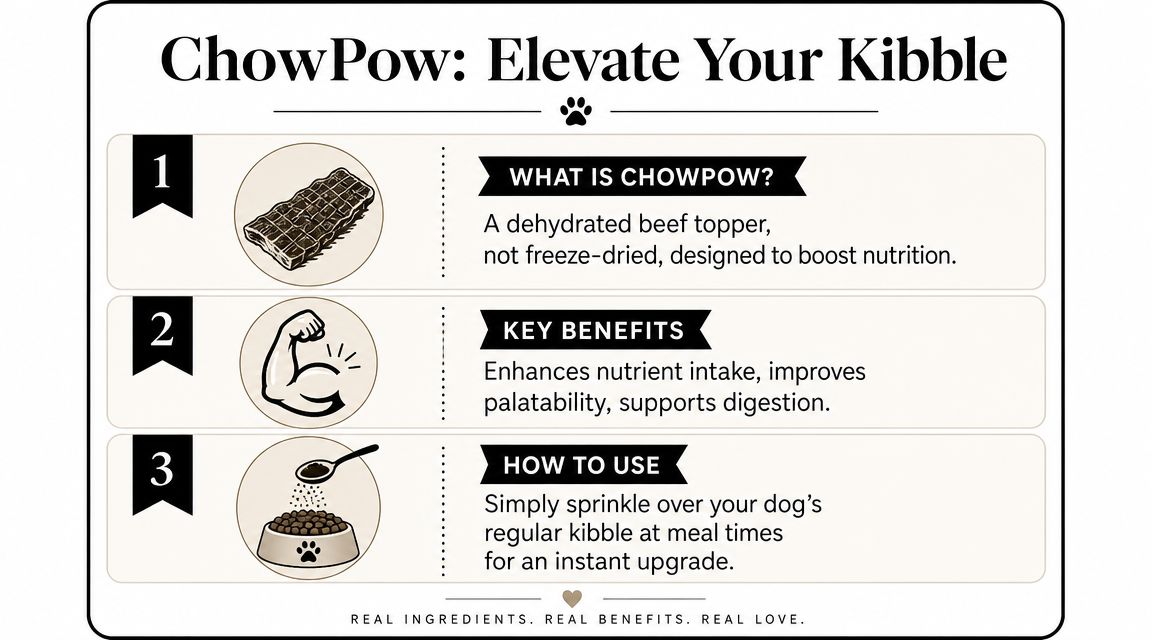
One useful option is a whole-food topper that adds flavor and nutrient density in a simple form. That's different from replacing the base food. It's more like upgrading it.
What a topper can do well
A topper is most helpful when kibble is already doing the heavy lifting but needs support in one of three areas:
- Better meal appeal for dogs that hesitate at the bowl
- Extra whole-food variety for owners who dislike a plain processed-only meal
- Gentler flexibility for seniors, recovering dogs, or fussy eaters
A dehydrated topper can be especially convenient because it stores easily and sprinkles right onto a normal meal. Some can also be mixed with water, which helps create a softer texture and a more aromatic bowl.
Why the format matters
Not every add-on serves the same role. Treats can distract from mealtime. Rich mixers can overwhelm sensitive stomachs. A simple topper works best when it's easy to portion and easy to use consistently.
For owners comparing products, this guide to best kibble toppers for dogs is a useful place to narrow the options.
The smartest use case is often modest, not dramatic. You're not trying to hide the kibble or build a gourmet meal. You're trying to make an already acceptable meal more nourishing and more appealing.
A simple way to think about it
Use a topper when your dog needs a boost, not a complete replacement.
That matters for expectation-setting. If your current kibble works well as the base, the goal is to strengthen the bowl, not reinvent it. For many households, that's the most sustainable path to better feeding habits because it respects budget, routine, and the dog's existing tolerance.
Making the Final Choice for Your Dog
The final decision usually becomes easier when you stop asking which food sounds most impressive and start asking which feeding routine you can realistically maintain.
If your dog is thriving on kibble, there's no prize for changing everything at once. If your dog is hard to motivate at mealtime, freeze-dried foods or a nutrient-dense topper may help bring the bowl back to life. If safety and simplicity matter most in your home, kibble may stay the clear base choice.
How to make any change gently
Dogs do better with gradual change. Whether you're trying a new full food or just adding a topper, go slowly enough that your dog's digestion can adjust.
A calm approach usually looks like this:
- Begin small. Add only a little of the new item to familiar food.
- Watch the dog, not the label. Appetite, stool quality, and enthusiasm tell you more than marketing copy.
- Give it time. Some dogs need a few meals before a new smell or texture feels normal.
- Keep one constant. If kibble is already tolerated well, changing only one variable at a time makes it easier to spot what helps.
A quick decision checklist
Use these questions to simplify the freeze dried dog food vs kibble choice:
- What can I afford consistently? A workable daily plan beats an idealized one you can't maintain.
- Does my dog eat eagerly or reluctantly? Appetite often changes the answer.
- How important is convenience in my routine? The right food has to fit weekday life.
- Do I want a complete switch or a smarter upgrade? Those are different goals.
- Does my dog fall into a higher-risk category? If so, handling and food safety deserve extra attention.
Feed the dog in front of you, not the trend in front of you.
For most households, the most balanced answer isn't a dramatic move from kibble to an all-new category. It's a steady plan built around a reliable base food, improved with a high-quality topper when your dog needs more flavor, more enthusiasm, or more whole-food support. That approach is easier to afford, easier to maintain, and often easier on the dog too.
If your dog eats kibble but needs more excitement, better flavor, or added whole-food support, ChowPow is a simple way to upgrade the bowl without replacing your current food. It's a dehydrated beef heart topper, not a full meal substitute, so you can keep the convenience of kibble and add a nutrient-dense boost where it counts.
-
Product on sale
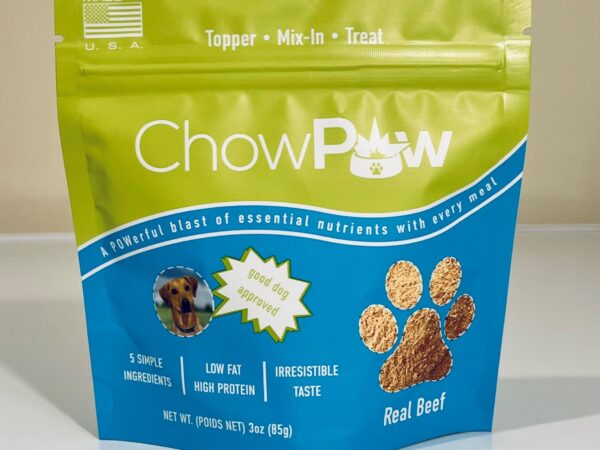 Dog Food Topper - Beef HeartOriginal price was: $14.99.$10.95Current price is: $10.95. - or subscribe and save up to 20%