

Grain Free Dry Dog Food: A Clear Guide to the Hype & Risks
You're standing in the pet food aisle, reading one bag that says “grain free,” another that says “whole grains,” and a third that promises “ancestral nutrition.” Your dog is at home, maybe a picky eater, maybe getting older, maybe doing fine but you still want to make the smartest choice. The problem is that the packaging talks like the answer is simple, and it isn't.
For many dog owners, grain free dry dog food feels like it should be the cleaner, healthier option. That idea didn't come from nowhere. But once you look past the front of the bag, the primary question changes. It's less about whether grains are present and more about whether the food is built to nourish your dog well, day after day.
The Grain-Free Aisle A Modern Pet Parent's Dilemma
A lot of caring owners got pulled into the grain-free conversation for understandable reasons. If you've ever read ingredient lists and thought, “Should my dog even be eating corn or rice?” you're not being gullible. You're trying to connect food with health, which is exactly what a thoughtful owner should do.
The confusion grew fast because grain-free exploded as a category. U.S. pet store sales of grain-free dry dog food increased by 28% from September 2012 to September 2013, according to this nutrition commentary on grain-free dog food trends and allergy claims. That same source notes there is no credible evidence that grain-free diets provide general health benefits over grain-inclusive diets, and true grain allergies are rare, accounting for less than 10% of all dog allergies.
That mismatch is where many owners get stuck. The label sounds meaningful. The science is more cautious.
Why the label feels persuasive
“Grain free” sounds like “free from something harmful.” That's the same kind of shortcut people use in their own grocery shopping. If a food is free of something, we tend to assume it must be cleaner or safer.
But a dog food label works a bit like a movie trailer. It shows you the part marketers want you to focus on. It doesn't automatically tell you whether the whole recipe is smart, balanced, or well formulated.
Healthy feeding decisions usually start on the back of the bag, not the front.
That's one reason articles like Are grains good for dogs can be helpful. They move the conversation away from fear and toward the more useful question of what your individual dog needs.
Where owners often get tripped up
Many people assume one of these must be true:
- Grain free means fewer carbs
- Grain free means fewer allergens
- Grain free means more meat
- Grain free means more natural nutrition
Sometimes a specific formula may fit one of those ideas. But the label itself doesn't guarantee any of them.
If your dog has a diagnosed sensitivity, your vet may recommend a food with certain exclusions. For most healthy dogs, though, the label alone doesn't tell you enough. A better way to think about the issue is this: you're not choosing a slogan. You're choosing a recipe.
What Grain-Free Really Means for Your Dog's Bowl
Consider a piece of kibble a brick. To build that brick, manufacturers need structure. Dry food doesn't become dry, shelf-stable kibble by accident. It needs starch in the recipe so the food can hold together during manufacturing.
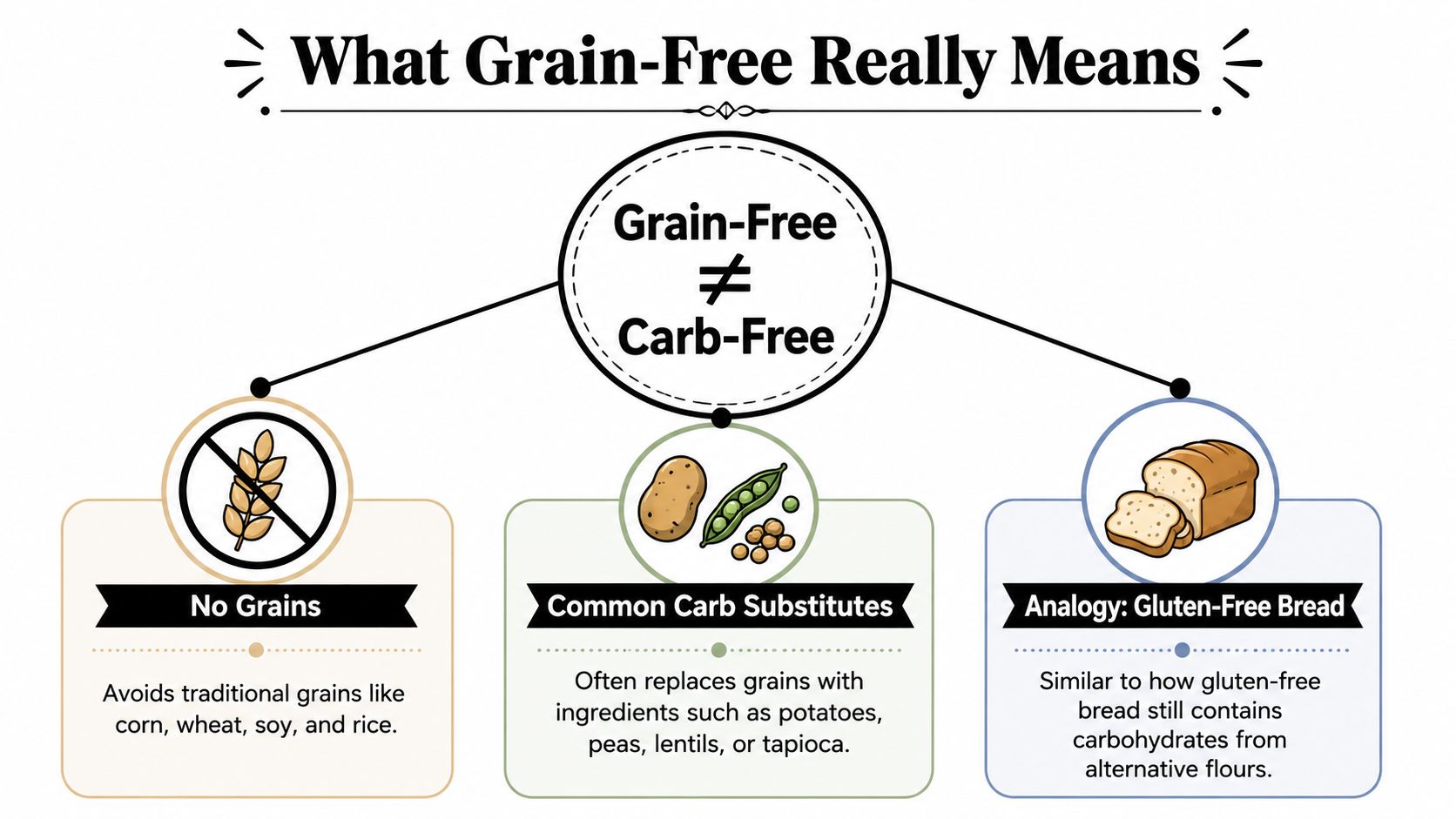
That's why grain free does not mean carb free.
What replaces the grains
A recent review explains that grain-free formulas commonly use alternative carbohydrate sources such as potatoes, peas, lentils, or chickpeas to replace grain-based starches, which are needed both for energy and for the kibble extrusion process during manufacturing, in this review of carbohydrate replacement in grain-free pet foods.
So if a bag removes rice, corn, wheat, or other grains, something usually steps in to do that job.
A simple way to picture it:
| Recipe style | Structural starch source | What that means |
|---|---|---|
| Grain-inclusive kibble | Grains like rice or corn | Uses traditional starch ingredients |
| Grain-free kibble | Potatoes, peas, lentils, chickpeas | Still uses starch, just from different sources |
That doesn't make grain-free automatically bad. It just means the formula needs to be judged by what's in it, not only by what's missing.
A helpful analogy
Think about gluten-free bread. It's still bread. It still needs ingredients that give it body and texture. The wheat gets replaced by something else.
Kibble works in a similar way. If grains come out, the recipe builder still has to solve the “how do we make this into kibble?” problem.
Here's where owners can make a smarter read of the ingredient panel:
- Look for replacement patterns. If peas, lentils, chickpeas, or potatoes show up repeatedly, those ingredients may be doing a lot of the structural work.
- Don't confuse grain-free with meat-only. A meat-forward bag can still lean heavily on non-grain starches.
- Watch the whole formula. Removing one ingredient family doesn't tell you whether the final bowl is stronger nutritionally.
For some pet parents, it also helps to separate ingredient sourcing questions from nutrition questions. If you're curious how feeding systems influence the food chain more broadly, these insights on sourcing grain-finished meat offer useful context. That's a different issue from whether your dog's kibble contains grains, but owners often blend those topics together.
Practical rule: When you see “grain free,” mentally replace it with “grain replaced.” Then ask, “Replaced with what?”
That one shift can make the label much easier to understand.
The Health Controversy Behind Grain-Free Diets
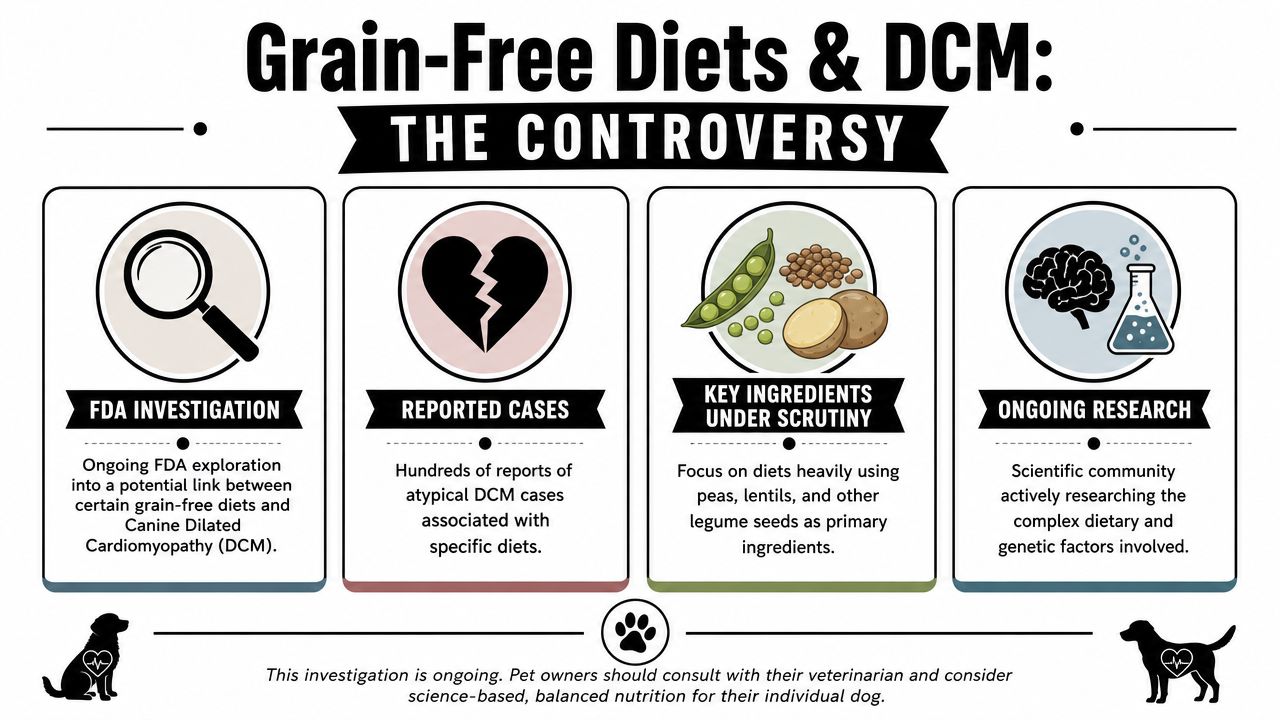
The grain-free debate became much more serious in July 2018, when the FDA announced an investigation into a possible link between certain diets and canine dilated cardiomyopathy, often shortened to DCM. DCM is a heart condition involving the heart muscle and its ability to pump effectively. For owners, the important point isn't to memorize the cardiology. It's to understand why grain-free went from trend to controversy.
Near the opening of that conversation, the FDA had reviewed 515 canine reports, and later summaries noted that more than 90% of foods in reported DCM cases were grain-free, 93% contained peas and/or lentils, and 42% contained potatoes or sweet potatoes, according to the FDA investigation into certain diets and canine dilated cardiomyopathy. The agency also said the pattern was seen mainly in dry dog food formulations.
What the FDA findings do and don't mean
At this point, many articles either panic or overcorrect. Neither helps.
The FDA findings raised a real concern worth paying attention to. But they do not mean every grain-free food is dangerous, and they do not prove that the absence of grains itself causes heart disease.
A more accurate takeaway is this: reported cases often involved grain-free dry foods that relied heavily on peas, lentils, and sometimes potatoes. That points attention toward formulation patterns, not just a front-label claim.
Why formulation matters more than buzzwords
If two kibbles sit side by side, one might contain grains and the other might not. That still doesn't tell you which one is more thoughtfully built.
The better question is whether the recipe leans too hard on a narrow set of substitute ingredients, and whether the company behind it shows real nutrition oversight.
A useful example is taurine. Many owners heard that word during the DCM discussions and came away thinking, “So should I just buy taurine?” It isn't that simple. Taurine is part of a bigger nutrition picture involving ingredients, formulation, absorption, and the dog in front of you. If you want that piece explained in plain language, what taurine does for dogs is worth reading.
Here's a quick way to frame the issue:
- Association is not proof. The FDA identified a pattern worth investigating.
- Ingredient concentration matters. Legumes and potatoes drew attention when they appeared as major recipe components.
- Dry food mattered in the reports. The pattern was seen mainly in dry formulations.
- One label can hide many different recipes. “Grain free” covers a wide range of products, not one nutritional profile.
A short visual summary can help if you want to hear the concern discussed in a more conversational format:
If your dog is doing well, this isn't a reason to panic. It is a reason to read the label more carefully and involve your veterinarian if you have concerns.
When owners should slow down and ask questions
Bring your vet into the decision if your dog has any of these:
- A history of heart issues
- Breed-related concerns
- A diet built heavily around legumes or potatoes
- A recent switch made only because grain-free sounded healthier
The most useful mindset is calm attention. Not fear. Not blind trust in a trend.
How to Read a Dog Food Label Like a Pro
If the front of the bag is advertising, the back of the bag is evidence. That's where you find the details that matter most.
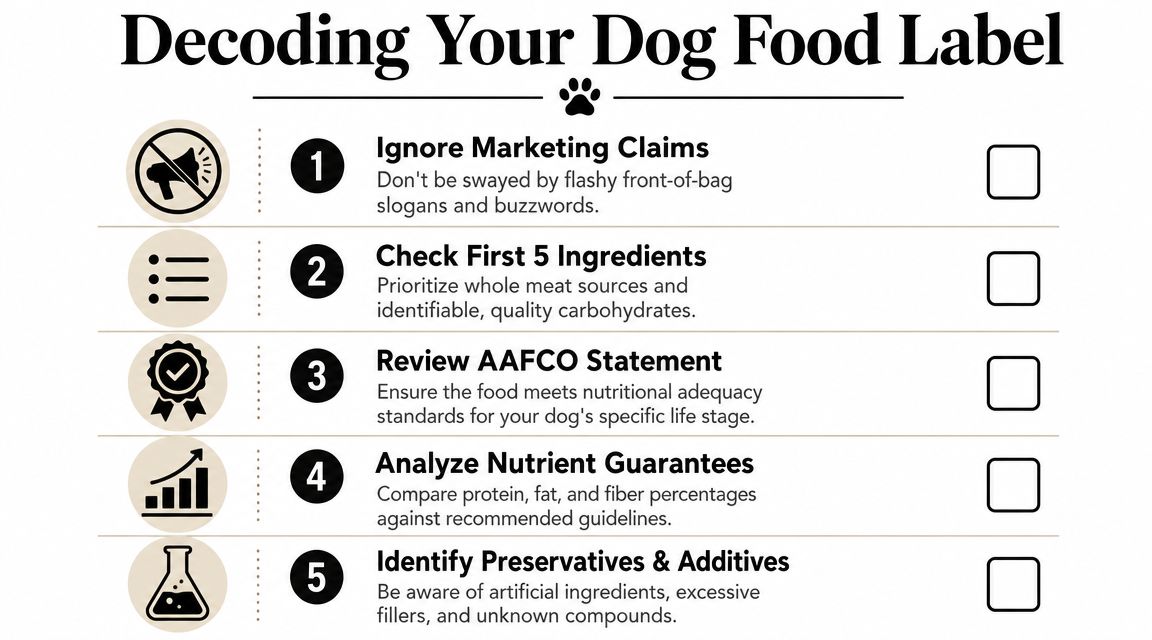
Veterinary guidance emphasizes that the safer selection criterion is not the grain-free label but a complete and balanced formula with an AAFCO adequacy statement and strong nutrition oversight, as explained in Chewy's veterinary-reviewed guide to grain-free dog food.
The two parts that matter most
Start with these before you care about any trendy phrase.
The AAFCO adequacy statement
This tells you whether the food is intended to be complete and balanced for a life stage such as growth, adult maintenance, or all life stages.The ingredient list
This helps you see the recipe pattern. Not just whether grains are absent, but what ingredients take their place.
If you want more practice with this, how to read dog food labels breaks the process down in a very owner-friendly way.
What to scan in the ingredient list
Don't read the list like a detective looking for one villain. Read it like someone trying to understand the whole meal.
A practical checklist:
- Top ingredients first. These give you your clearest snapshot of the formula's backbone.
- Repeated pulse ingredients. Peas, pea protein, pea flour, lentils, chickpeas. When several versions appear, the formula may rely heavily on them.
- Potato-heavy patterns. Potatoes and sweet potatoes can be useful ingredients, but they shouldn't escape scrutiny just because they sound wholesome.
- Named animal ingredients. Specific proteins are easier to interpret than vague catch-all terms.
A simple comparison table
| What you see | What to ask |
|---|---|
| “Grain free” on front | What replaced the grains? |
| “Premium” or “natural” | Does the back panel support that claim? |
| Long ingredient list | Which ingredients appear early and repeatedly? |
| Meat mentioned in big print | Is the full formula complete and balanced? |
One overlooked clue
Owners often focus on ingredients and forget to ask who formulated the food. That matters.
A bag can contain appealing ingredients and still be put together in a shaky way. Nutrition isn't only about nice-sounding components. It's also about balance, testing, and oversight.
That same mindset is useful in other parts of animal care too. If you want a broader look at how production decisions affect animals before food even reaches the bowl, Shopifarm's animal welfare insights add helpful background.
Don't shop for a single ingredient to love or fear. Shop for a complete recipe with a clear nutritional purpose.
Your fast label-reading routine
When you pick up a bag, ask these in order:
- Does it say complete and balanced?
- What life stage is it for?
- What are the first several ingredients?
- Is the recipe heavily built around pulses or potatoes?
- Does the company show evidence of nutrition oversight?
That process protects you far better than chasing the latest feeding fad.
Beyond the Kibble Boosting Your Dog's Nutrition
Even a carefully chosen kibble has limits. Dry food is convenient and can absolutely be part of a solid feeding routine, but many owners notice the same practical issues. Their dog gets bored. Appetite dips. A senior dog stops finishing meals. A recovering dog needs encouragement to eat. The bowl is technically complete, but it isn't always working well in real life.
That's where meal enhancement becomes useful.

What a topper can actually do
A good topper doesn't need to replace the kibble. In many cases, it shouldn't. Think of it more like upgrading a plain bowl into a more nutrient-dense and appealing meal.
That can help with:
- Picky eating when the base food is ignored unless something tastier is added
- Senior dogs who may prefer softer, more aromatic meals
- Recovery periods when appetite support matters
- Hydration support if the topper can be mixed with water or broth-like moisture
This is also where owners can stop bouncing from bag to bag in search of a perfect label. Sometimes the smarter move is keeping a sound base diet and improving the bowl around it.
How to use a topper wisely
The key is to treat toppers as support, not a free-for-all. If the kibble is your nutritional foundation, the topper should complement it.
A sensible approach looks like this:
| Goal | Kibble role | Topper role |
|---|---|---|
| Maintain daily nutrition | Provides the complete base | Adds interest and targeted support |
| Help a picky eater | Remains the main food | Improves aroma and palatability |
| Support an older dog | Offers routine and consistency | Makes meals easier to enjoy |
| Encourage intake during stress | Keeps diet stable | Helps the dog engage with the meal |
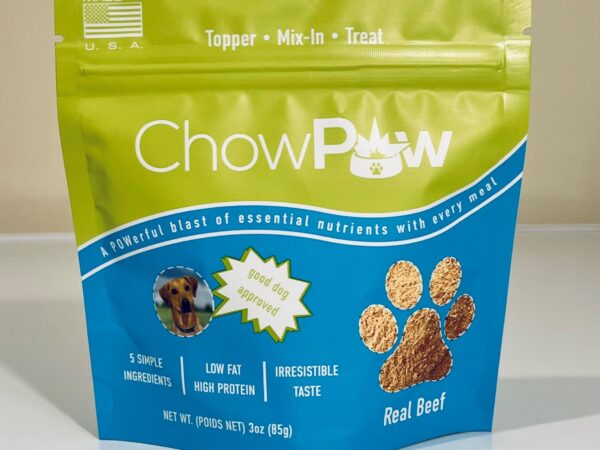
One option in this category is ChowPow, a dehydrated beef heart meal enhancer made to be sprinkled onto existing food or mixed with water. That's an important distinction. It's not a replacement for kibble. It's meant to boost the nutritional value and appeal of the food already in the bowl.
Some dogs don't need a whole new diet. They need a bowl that smells better, tastes better, and offers a little more nutritional depth.
Why this matters in the grain-free debate
If you've been obsessing over “grain free or not,” a topper-based mindset can be a relief. It shifts your focus from ideology to function.
Instead of asking, “Did I buy the perfect bag?” ask:
- Is the base food complete and balanced?
- Does my dog want to eat it?
- Could the bowl use better aroma, moisture, or nutrient support?
That's a much more practical way to feed a real dog in a real home.
Making a Safe Switch and Choosing Your Path
By this point, the grain question probably looks different. That's a good thing. The useful takeaway isn't “all grain-free foods are bad” or “grains are always necessary.” It's that the smarter decision comes from reading the full recipe and judging whether the food is complete, balanced, and not excessively dependent on pulses or potatoes, as emphasized in FEDIAF's fact sheet on grain-free pet food and formulation concerns.
How to switch foods without upsetting your dog's stomach
Dogs usually do better with gradual change than sudden replacement.
A simple transition plan:
Start small
Mix a little of the new food into the old food.Watch the dog, not just the bowl
Stool quality, appetite, energy, and comfort tell you more than marketing ever will.Increase slowly
Shift the balance bit by bit if your dog is tolerating the new food well.Pause if needed
If digestion gets messy or your dog seems off, slow down and talk with your veterinarian.
What path makes sense for most owners
You don't need to join a nutrition camp. You need a workable routine.
For many dogs, that means:
- Choosing a complete and balanced kibble
- Reading ingredient patterns carefully
- Not assuming grain free means healthier
- Using meal enhancers thoughtfully when the bowl needs support
- Asking your vet for guidance when there's a medical concern
Some owners will feel more comfortable with a grain-inclusive formula that uses ingredients like oatmeal or brown rice. Others may stay with a grain-free product after checking the recipe more carefully. The right move depends on the whole formula and the dog eating it.
The best feeding choice is usually the least glamorous one. It's the one that holds up under a label check, fits your dog's needs, and supports steady health over time.
If you want to improve the bowl you already trust, ChowPow offers a simple way to add nutrient-dense flavor and support to your dog's regular kibble without replacing it. For picky eaters, seniors, and dogs that need a little encouragement at mealtime, a meal enhancer can be an easier next step than starting over with a new bag.
-
Product on sale
 Dog Food Topper - Beef HeartOriginal price was: $14.99.$10.95Current price is: $10.95. - or subscribe and save up to 20%