
What Causes Picky Eating in Dogs: Solutions for 2026
You scoop the food, set down the bowl, and wait for the happy tail wag you were expecting. Instead, your dog sniffs, looks at you, and walks away. A few minutes later you're second-guessing everything. Is the food the problem? Is your dog being stubborn? Is something wrong?
If you're dealing with that untouched bowl day after day, you're not alone. Picky eating can feel personal, especially when you're trying hard to do the right thing. But in most cases, food refusal is information, not defiance. Your dog is telling you something with that pause, that sniff, that retreat, or that half-hearted nibble.
The most useful way to think about what causes picky eating is this. Your dog isn't trying to win a battle. Your dog is giving clues. Some clues point to routine and learning. Some point to stress, discomfort, sensory sensitivity, or pain. Your job isn't to force the meal. It's to become a calm detective.
A good detective starts with safety. Then they watch patterns. Then they test likely causes one by one. That approach turns mealtime from a frustrating mystery into something you can solve.
The Untouched Food Bowl A Familiar Story
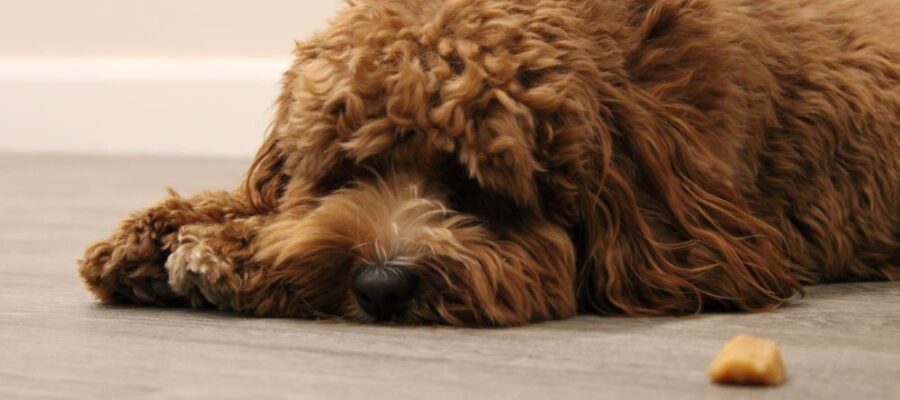
You put the bowl down. Your dog walks over, sniffs once, then looks back at you like you changed the rules without warning. By the third day, you are adding broth, crumbling treats, hand-feeding a few bites, and wondering how dinner turned into a negotiation.
This is a familiar pattern, and it usually builds in small steps.
A dog skips one meal. The family worries, so they sweeten the deal. The dog learns that waiting sometimes brings something tastier. Or the first skipped meal had nothing to do with preference at all. It may have started with nausea, mouth pain, stress, or a bad association with the feeding spot. The bowl stays the same, but the meaning of the bowl changes.
That is why picky eating can feel confusing. The same behavior, an untouched meal, can come from very different causes. One dog is holding out for extras. Another is avoiding discomfort. Another is too keyed up to settle and eat. From the outside, those dogs can look identical.
A detective solves that kind of mystery by looking for the backstory, not by judging the clue. Your dog's refusal to eat is a clue.
Practical rule: Treat picky eating like a symptom with a history.
What your dog may be communicating
A refused meal can point in several directions:
- "Eating feels uncomfortable." Dental pain, nausea, or body discomfort can lower appetite fast.
- "Something about this meal or this place bothers me." Smell, texture, noise, bowl position, or nearby activity can matter more than many owners realize.
- "I learned to wait." If refusing food reliably leads to toppers, treats, or hand-feeding, dogs often repeat that pattern.
- "I am too stressed to eat." A worried dog may pace, watch the room, or stay alert instead of settling into a meal.
- "Something changed." A new food, schedule shift, medication, houseguest, or recent illness can all leave fingerprints.
Picky eating works a lot like a check-engine light. The light does not tell you the exact problem by itself. It tells you to look closer and notice what else is happening.
The first shift that helps
Start with one simple question. What changed before the bowl started being ignored?
That question helps you move from frustration to observation. Was the change sudden or gradual? Did it start after a new bag of food, a stressful event, a bout of stomach upset, dental discomfort, or a period of heavy coaxing at meals? Those details matter because they separate ordinary fussiness from a pattern that needs medical or behavior support.
You do not need to solve the whole case at once. You only need to gather clues calmly and in order. That is how owners stop guessing and start finding the reason their dog is leaving dinner behind.
Red Flags When to Call the Vet Immediately
Before you change bowls, switch proteins, or try feeding tricks, check for signs that this may be a medical problem first. Picky eating can sometimes be an early signal of gastrointestinal pain, dental problems, allergies, or oral-motor challenges. A sudden change in appetite deserves attention because it can reflect an underlying health issue, not just fussiness (clinical overview of root causes and red flags).

Call your vet right away if you notice these signs
- Sudden refusal to eat for more than 24 hours. A dog who abruptly stops eating is different from a dog who's been mildly selective for a while.
- Severe vomiting or diarrhea, especially if it's bloody. Food refusal plus digestive upset should never be brushed off.
- Extreme lethargy or sudden weakness. If your dog seems drained, wobbly, or unusually still, appetite loss may be part of a bigger problem.
- Clear signs of pain. Whining, hiding, flinching, guarding the mouth, pacing, or refusing to be touched can all matter.
- A swollen or bloated abdomen. This needs urgent veterinary attention.
- Labored or rapid breathing. Breathing changes and appetite changes together are not a wait-and-see situation.
Signs that may be less dramatic but still matter
Not every medical issue looks like an emergency. Some appear as subtle feeding changes:
| Behavior | What it can suggest |
|---|---|
| Sniffs food, then backs away | Nausea, aversion, stress, or smell changes |
| Wants treats but not the meal | Learned preference, but sometimes mouth pain makes softer or smaller items easier |
| Starts eating, then stops | Nausea, discomfort, fatigue while chewing |
| Drops kibble from the mouth | Dental pain, oral discomfort, chewing difficulty |
If your dog's appetite changed suddenly and you can't explain it, assume health first and behavior second.
When not to experiment at home
Hold off on home troubleshooting if your dog seems sick, painful, or unlike themselves. This isn't the moment for "maybe they're just bored." It's the moment to get a professional opinion.
A lot of owners worry they'll overreact. In practice, the bigger mistake is often the opposite. They spend days trying toppers, hand-feeding, and meal games when the dog needed a medical exam.
Decoding Your Dog's Dinner Time Behavior
Two dogs can both "not eat" for completely different reasons. That's why the details matter. To figure out what causes picky eating, watch how your dog refuses food, not just whether they refuse it.
Your dog's behavior at the bowl is a little like body language in a conversation. The meal may be silent, but it still says a lot.
Common refusal patterns and what they may mean
Here's a quick decoding guide:
| Dinner-time behavior | Possible clue |
|---|---|
| Sniffs and walks away | Smell doesn't appeal, mild nausea, stress, or caution with something unfamiliar |
| Eats only after you add extras | Learned waiting behavior, sensory preference, or boredom with the base meal |
| Takes food out of the bowl to eat elsewhere | Bowl discomfort, environment stress, competition, or a desire for a safer spot |
| Eats a few bites, then quits | Nausea, mouth discomfort, early fullness, distraction, or fatigue |
| Eats treats but not kibble | Preference learning, but also possible chewing discomfort or stronger aroma needed |
| Licks gravy or moisture, leaves solids | Texture issue, dental discomfort, or low interest in dry food |
These aren't diagnoses. They're clues. You use them the same way a mechanic listens to the kind of noise a car makes before opening the hood.
The questions worth asking at the bowl
When you watch your dog at mealtime, note:
- Timing: Is the problem every meal, or only mornings?
- Setting: Does your dog eat better in a quieter room?
- Texture: Does your dog prefer wet, softened, or crumbled food?
- Sequence: Does refusal happen before the first bite or after a few bites?
- Expectations: Has your dog learned that waiting brings treats, scraps, or hand-feeding?
If you want a deeper breakdown of these patterns, this guide on why a dog becomes a picky eater is useful because it helps connect behavior at the bowl with likely causes.
Keep a short food behavior log
You don't need a spreadsheet. A simple note on your phone is enough.
Write down:
- What was offered
- How your dog responded
- Any extras added
- Anything unusual that day, such as visitors, medication, travel, storms, or another pet nearby
After a few days, patterns usually pop out. Maybe your dog avoids meals only when the room is busy. Maybe crunching dry food is the actual issue. Maybe the refusal started after you began offering more treats between meals.
That kind of pattern is gold. It tells you where to look next.
Uncovering Medical and Physical Causes
Sometimes what looks like pickiness is really self-protection. Dogs don't think, "I should explain that my molar hurts." They hesitate, chew less, or skip the bowl.
That distinction matters. A dog avoiding food may be avoiding discomfort, not food itself.

Mouth pain and chewing problems
Dental pain is one of the easiest causes to miss. Dogs often keep trying to act normal even when chewing hurts. Think about how you eat with a sore tooth. You might still be hungry, but crunchy food suddenly feels like work.
Watch for signs like these:
- Dropping kibble while trying to eat
- Turning the head to one side while chewing
- Licking lips or pawing at the mouth
- Choosing softer foods over hard pieces
A dog may still accept treats if they're small, soft, or smell stronger. That can fool owners into thinking, "He can't be sick. He ate a snack." But a snack isn't proof that the mouth feels fine.
Stomach discomfort and nausea
Nausea doesn't always look dramatic. Sometimes it looks like a dog who approaches the bowl, sniffs, and leaves. Or a dog who seems interested, takes two bites, then stops.
That pattern makes sense if you imagine the dog's internal experience. Hunger says "go eat." Nausea says "don't." The result is a lot of conflicted bowl behavior.
Common physical causes can include:
| Physical issue | What you might notice |
|---|---|
| GI discomfort or motility problems | Interest in food followed by retreat, inconsistent appetite, picky texture choices |
| Allergies or food sensitivities | Refusal tied to discomfort, digestive upset, or irritation |
| Oral-motor challenges | Trouble picking up, chewing, or managing certain textures |
| Broader pain or body discomfort | Hesitation to bend down, difficulty standing at the bowl, mealtime avoidance |
Sensory and developmental factors
Some dogs are more sensitive than others. Research summarized in an ALSPAC model of about 6,000 children found that feeding difficulties in the first year, plus introduction of lumpy foods after 9 months, increased the likelihood of picky eating later, supporting the idea that delayed texture exposure can narrow food acceptance during a key developmental window (research summary on sensory and feeding-development pathways).
The dog takeaway is not that your puppy followed that exact human timeline. It's that early texture experience matters. A dog raised on one texture, one format, or one narrow feeding routine may struggle later when food feels different in the mouth.
A sensitive eater may not be rejecting nutrition. They may be rejecting a sensory experience that feels wrong or overwhelming.
You can read more about related health drivers in this article on what causes loss of appetite in dogs.
The medical detective question
Ask yourself this: Would this behavior make sense if eating felt uncomfortable?
If the answer is yes, slow down before labeling your dog picky. Dogs with mouth pain, stomach discomfort, or sensory mismatch often need comfort, adaptation, and sometimes treatment. They don't need a mealtime standoff.
Behavioral and Environmental Root Causes
Your dog sniffs the bowl, looks at you, and walks away.
If a vet exam has already ruled out an obvious medical problem, that moment becomes a clue. This is the part where you shift from worried owner to detective. The question is no longer, "Why is my dog being difficult?" It becomes, "What has my dog learned about mealtime, and what in the environment might be getting in the way?"
Behavior shapes eating more than many owners realize. Dogs learn through patterns. If skipping kibble leads to treats, a tastier replacement, extra attention, or hand-feeding, the refusal starts to do a job. It gets results.
That does not mean your dog is stubborn or manipulative. It means your dog is observant.
Learned habits around the bowl
Some picky eating starts with a well-meaning human response. A dog hesitates once, the owner worries, and dinner turns into negotiation. A little cheese appears. Then some chicken. Then a different bowl. Then coaxing. Soon the dog has learned that waiting is part of the recipe.
Repeated exposure still matters here, as noted earlier in the article. A new food may need several calm, low-pressure offerings before a dog treats it as familiar instead of suspicious. One refusal does not always mean true dislike.
A few patterns commonly keep picky eating going:
- Treat overflow. Frequent snacks can make the regular meal less rewarding.
- Menu upgrading. If refusal reliably leads to something tastier, your dog may start holding out.
- Pressure at the bowl. Hovering, pleading, and hand-feeding can make eating feel tense instead of safe.
- Unpredictable meal timing. All-day grazing can blur hunger signals.
A simple way to picture this is a slot machine that sometimes pays out. If refusing dinner occasionally leads to roast chicken, the behavior can become surprisingly persistent.
The home environment is a critical, often overlooked factor
Some dogs are willing to eat the food, but not in that setting.
A bowl placed in a busy hallway, near a loud laundry room, beside another pet, or on a slippery floor can change the whole experience. Add visitors, travel, a recent move, construction noise, or a new baby, and a sensitive dog may stop eating well even though the food itself has not changed.
This is why the detective approach matters. Two dogs can leave food untouched for completely different reasons. One is waiting for upgrades. The other feels too unsettled to eat.
You can see this same stress spillover in other household behavior problems. A guide on preventing cat pee on carpets focuses on cats, but the lesson carries over. Changes in routine, territory, noise, and tension often show up through behavior long before owners connect the dots.
A quick behavior audit
Use these questions to narrow the cause:
| Question | If yes, consider |
|---|---|
| Do treats or chews show up between meals most days? | Your dog may not be arriving at the bowl hungry |
| Does food refusal lead to a tastier replacement? | Your dog may have learned to wait for an upgrade |
| Is the bowl near foot traffic, noise, or another pet? | The setup may feel stressful or distracting |
| Do meal times shift from day to day? | Hunger cues may be weak or inconsistent |
| Did this start after a move, travel, guests, or another routine change? | Stress or environmental disruption may be part of the pattern |
The goal is clarity, not blame. Dogs repeat what pays off and avoid situations that feel uncomfortable. Once you identify the pattern, the behavior starts to make sense, and that is usually the first real step toward fixing it.
Practical Strategies to Encourage Your Dog to Eat
Once you've narrowed down the likely cause, you can stop trying random fixes. That's when progress usually starts. The best strategies match the reason behind the refusal.
Routine fixes that rebuild hunger cues
Picky eating often emerges early and can persist if the pattern sticks. Research summarized by Harvard notes that a predictable meal and snack rhythm helps preserve hunger cues, and some eaters may need up to 15 offerings before accepting a new food (Harvard summary on persistence, routine, and repeated offerings).
That doesn't mean forcing food. It means making meals more predictable.
Try this:
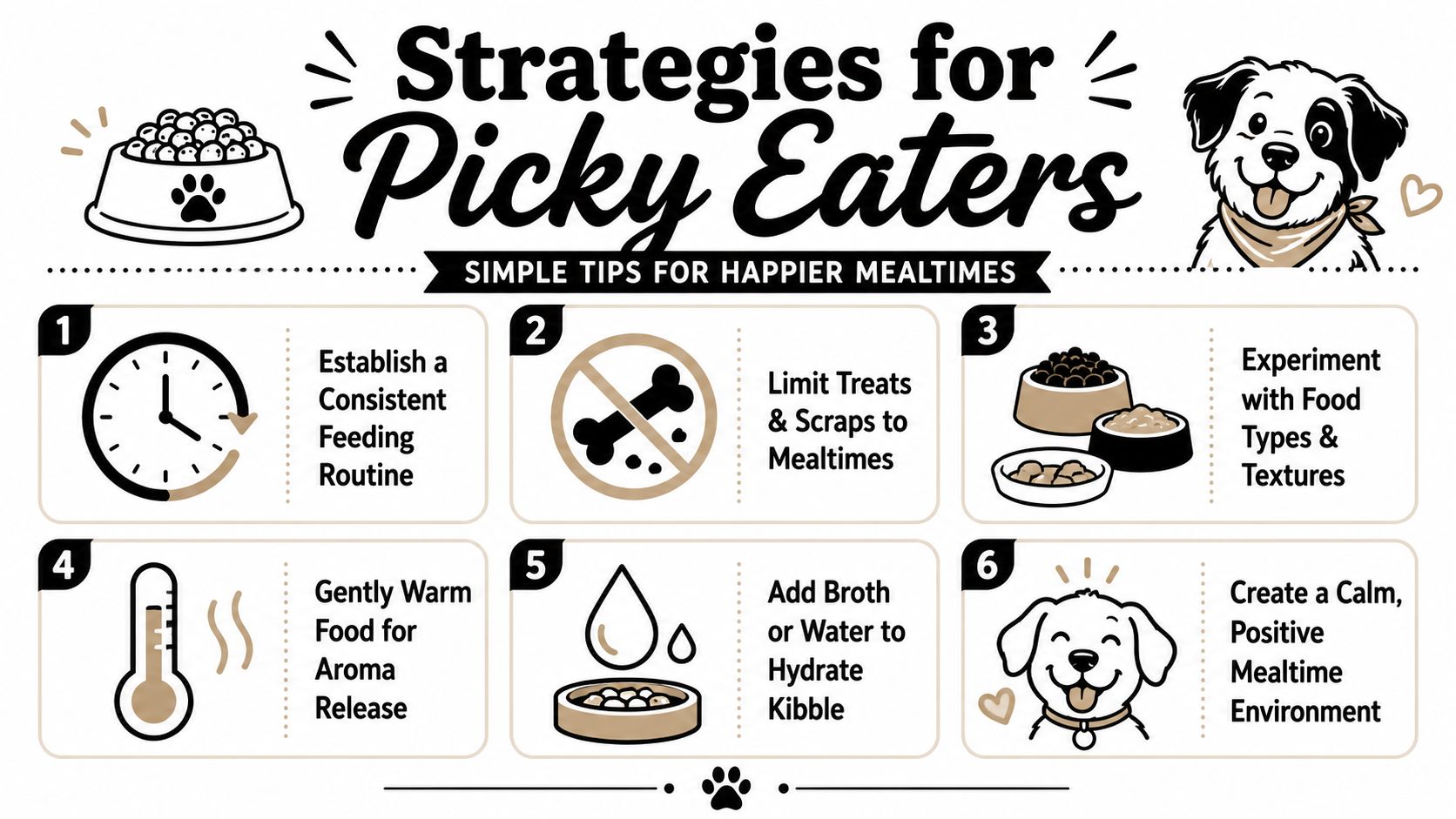
- Offer meals on a schedule. Put the bowl down at set times rather than leaving food out all day.
- Keep the window brief. If your dog doesn't eat, calmly pick it up and try again at the next meal.
- Trim random snacks. Save treats for training or mealtime support so the main meal matters again.
Environment fixes for stressed or sensitive eaters
Some dogs eat better when dinner feels safe and quiet.
You can improve that by changing the setup:
- Feed in a low-traffic room
- Separate pets during meals
- Use a stable bowl on a non-slip surface
- Reduce mealtime audience pressure
Bowl design can help some dogs too, especially those who dislike awkward neck angles or messy setups. A tilted dog drinking and eating bowl may be worth exploring if your dog seems fussy about posture, access, or bowl comfort.
Food presentation changes that often help
Small presentation changes can make a meal easier to accept:
- Warm the food gently. Aroma matters. Warming can release smell and make food more interesting.
- Add water or broth. This softens dry kibble and changes texture.
- Experiment with texture. Some dogs prefer softer, moister, or finer food.
- Rotate carefully, not constantly. Variety can help boredom, but too many sudden changes can create more selectivity.
A quick visual walkthrough can be helpful before you start experimenting:
Match the strategy to the clue
Use your observations from earlier:
| Clue you noticed | Strategy to try |
|---|---|
| Dog seems distracted or tense | Quieter location, solo feeding, calmer routine |
| Dog only eats with upgrades | Stop escalating the menu, tighten schedule |
| Dog prefers soft foods | Add moisture, soften kibble, check for mouth discomfort if this is new |
| Dog rejects new food fast | Repeat exposure calmly over multiple offerings |
Small wins count: A dog who sniffs, licks, or takes one bite is still moving forward. Acceptance often grows gradually, not all at once.
Consistency beats creativity here. Most dogs don't need a new trick every night. They need a clear pattern they can trust.
The Role of Meal Toppers for Appetite and Nutrition
Some dogs don't need a whole food overhaul. They need a better bridge between "I should eat" and "this meal feels worth eating." That's where a meal topper can make sense.
A topper works best when you treat it as a meal enhancement, not a replacement for your dog's regular food. If your dog already eats kibble or another balanced base diet, the topper's job is to improve aroma, taste, texture, and nutritional value enough to support better acceptance.

Why toppers can help some picky eaters
Picky eating can be influenced by innate biology, temperament, and early feeding history. For some sensitive eaters, offering the same food again isn't enough. A high-value, nutrient-dense topper can be a useful adaptation because it works with the dog's sensory preferences instead of fighting them (discussion of biology, temperament, and adaptation strategies).
In plain terms, some dogs need a stronger sensory invitation.
A good topper can help when:
- A dog is bored with plain kibble
- A senior dog needs softer, easier-to-enjoy meals
- A recovering dog needs extra encouragement to eat
- A sensitive dog responds better to smell and flavor than repetition alone
What to look for in a topper
Not all toppers solve the same problem. Some mainly add flavor. Others add meaningful nutrition too.
When evaluating options, look for:
| What matters | Why it matters |
|---|---|
| Strong natural aroma | Smell often drives interest before the first bite |
| Simple ingredient list | Easier to understand and easier for sensitive dogs |
| Easy mixing | Useful for dry food, softened meals, or hydration support |
| Nutrient density | Helpful for dogs who are eating less than usual |
If you're comparing options, this guide to the best dog food toppers for picky eaters can help you think through which kind of topper fits your dog's situation.
The important boundary
A topper shouldn't become another bargaining chip in a nightly negotiation. It works best when it's part of a calm plan. Same bowl. Same meal time. Better sensory appeal. Better support.
That's especially useful for dogs who need encouragement without a complete diet change. The goal isn't to replace the base meal. It's to make that existing meal more inviting and more useful.
Building a Happier Mealtime for You and Your Dog
By now, the mystery is usually less mysterious. The untouched bowl may point to discomfort, stress, learned habits, sensory sensitivity, or a combination of several. What causes picky eating isn't one universal thing. It's a pattern made up of clues.
The most helpful owners aren't the ones who panic fastest. They're the ones who observe well. They notice whether the appetite change was sudden or gradual. They pay attention to chewing, posture, timing, noise, routine, and expectations. Then they respond to the cause instead of wrestling with the symptom.
That approach is gentler on your dog and easier on you. Mealtime stops being a test of wills and starts becoming problem-solving.
Comfort matters outside the bowl too. Dogs who feel safe and settled often eat better, especially sensitive seniors and anxious rescues. Even simple environmental supports, like a cozy rest area or handmade faux fur for dogs, can be part of the bigger picture when you're helping a dog feel secure again.
Patience matters. Consistency matters. A calm routine matters. Most of all, remember this. Your dog isn't trying to make your life harder. They're telling you something. When you learn to read that message, better meals usually follow.
If your dog needs extra encouragement at mealtime, ChowPow can help make their current food more appealing and more nutritious. It's a meal enhancer, not a replacement for your dog's kibble. You can sprinkle it over food, mix it with water, or use it to add aroma, flavor, and nutrient-dense support for picky eaters, seniors, and dogs recovering from illness.
-
Product on sale
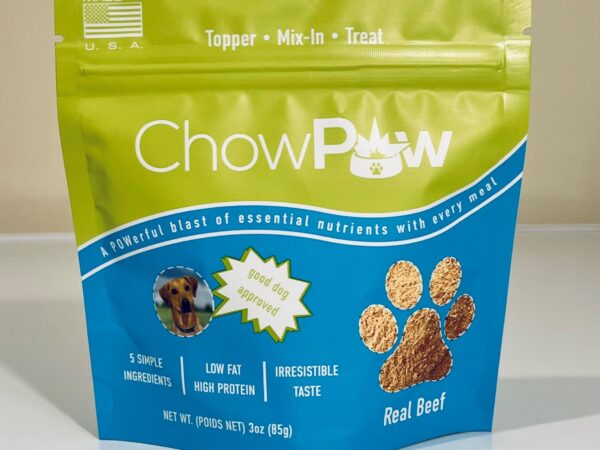 Dog Food Topper - Beef HeartOriginal price was: $14.99.$10.95Current price is: $10.95. - or subscribe and save up to 20%